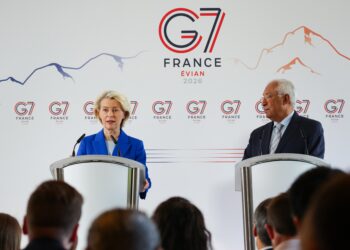
Brussels – “We, the Leaders of the G7, stand united in our unwavering support for Ukraine in
defending its freedom, sovereignty, and territorial integrity.” These are the opening words of the joint statement on the main geopolitical issues of the moment, signed by the G7 leaders meeting in Evian. It is traditionally the most important document at this type of summit, and, on the subject of Russia’s aggression against Ukraine, it is already an achievement that, at least on paper, a common position has been reached. Reports over recent months had painted a very different picture, in which the views on the conflict held by the major European countries and those of Donald Trump’s United States appeared to be fundamentally at odds.
New aid for Ukraine and sanctions against Moscow’s oil: is this a ‘pro-Kyiv’ Trump?
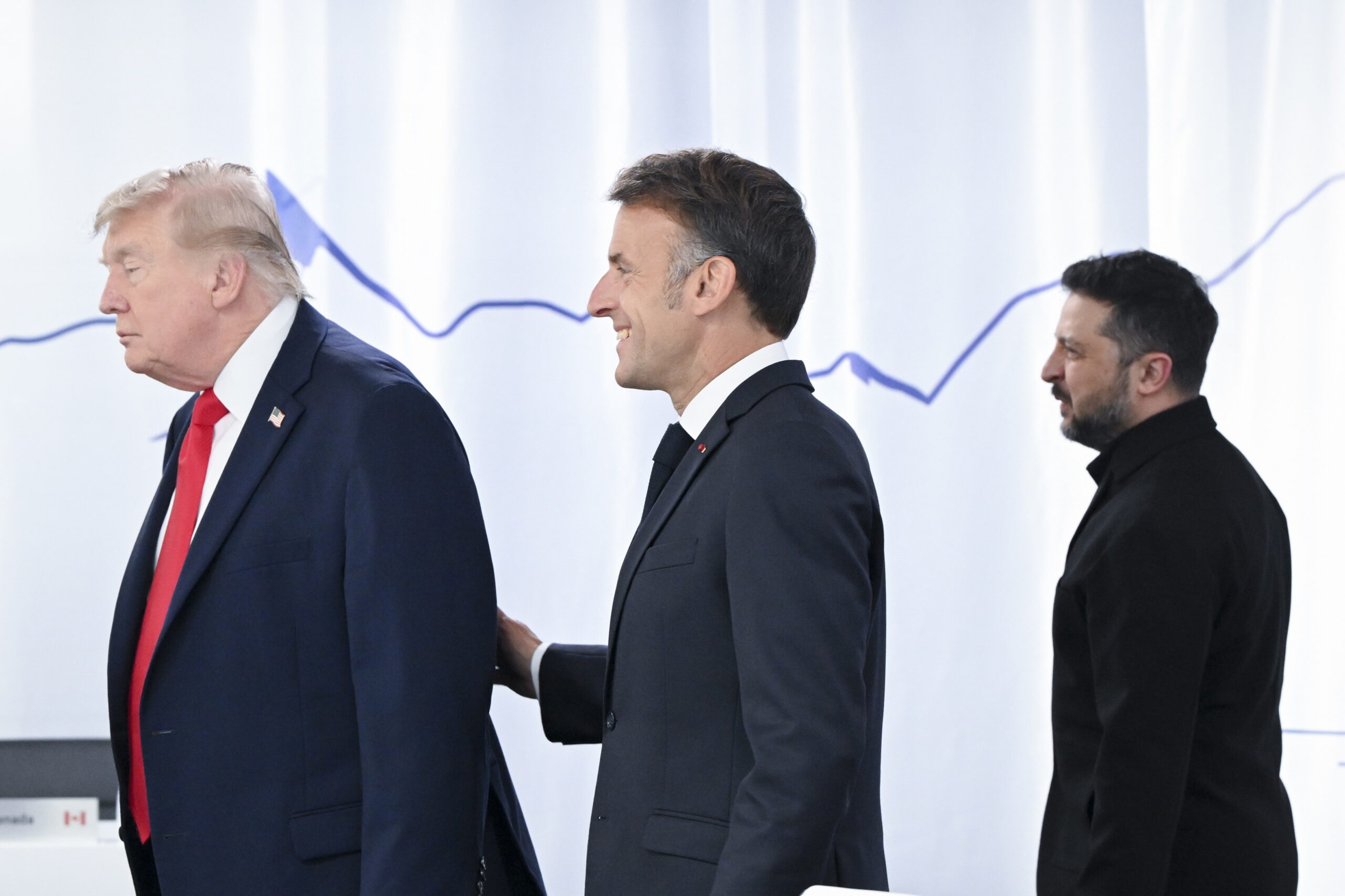
The impression that the leaders of the Old Continent had managed to bring the tycoon – at least on the surface – back to Kyiv’s side had already emerged yesterday (16 June). “Russia must reach an agreement, and I will do everything in my power to ensure this happens,” Trump had emphasised in a brief exchange with journalists, before announcing that, to this end, “sanctions on Russian oil could soon be reintroduced.” Words spoken to contradict the bleak forecasts of the French President, Emmanuel Macron, who shortly before, as he accompanied his Ukrainian counterpart Volodymyr Zelensky to a face-to-face meeting with Trump, had whispered that he had had a “difficult meeting” with the US President specifically on the subject of Ukraine.
Today’s statement reflects the sudden pro-Kyiv stance adopted by the erratic White House tenant. All the G7 leaders, including Trump, highlight the progress Ukraine has made on the battlefield in recent months, even speaking of a “new momentum” in military operations. And it is precisely to ensure that this momentum does not run out that the signatories have announced they have reached an agreement to “increase the delivery of
air defence capacities, additional systems and interceptors, and long-range capabilities.” Furthermore, the possibility of authorising Kyiv to produce more weapons directly on its own territory, using technology and licences from allied countries, is reportedly being considered.
Alongside support for the people under attack, the aim is also to step up action against the aggressor state. Following on from Trump’s announcement yesterday, the leaders have pledged to “increase pressure on Russia’s war economy” to persuade Moscow to come to the negotiating table. “We will strengthen our sanctions, including those on the oil and gas sectors,” is the commitment set out in the statement. Moreover, according to the leaders, this is the most opportune moment to proceed with further measures in the energy sector “as President Trump has secured an agreement, which we support, for the reopening of the Strait of Hormuz.”
The classic ego‑stroking of the tycoon, something all his interlocutors have by now understood, is the price to pay to get what they want.
Middle East: praise for the US-Iran deal, but uncertainty remains over the reopening of the Strait of Hormuz
The second part of the joint statement is precisely dedicated to the other major theatre of war of our time, the Middle East. Welcoming the agreement announced between the United States and Iran, which is due to be signed on Friday 19 June in Lucerne, the G7 countries emphasise that it represents a “historic opportunity to prevent Iran from acquiring any
nuclear weapon.” This provisional memorandum of understanding must be followed by a fully-fledged agreement that is “robust and comprehensive” and which ensures that Tehran “never obtains a nuclear weapon.”
There is, deliberately, no mention of the bargaining chip that Trump put on the table to secure this outcome: the lifting of all sanctions currently in force against the Islamic Republic, granting exemptions by the US Treasury Department for the export of Iranian crude oil and the gradual unfreezing of Tehran’s funds and assets subject to restrictions.
The other major issue at the heart of the agreement concerns the reopening of the Strait of Hormuz, on which it remains unclear whether Iran wishes to retain the right to impose a toll. The G7 communiqué reflects this concern, with leaders reaffirming “that the right of transit passage without restrictions or tolls is the bedrock of international trade.” The signatories also allude to the joint France-UK proposal to form a coalition to clear mines from the Strait and ensure a swift resumption of traffic. The idea has been well received, but there is still no mention of the role that other European Union countries might play.
In any case, the long-term objective, especially for Europe, remains to learn the lessons from this new crisis in order to strengthen its energy resilience. “We are committed to accelerating the diversification of supply routes”, reads the text, which contains a specific reference to Canada and its “potential to provide significant additional capacity to global markets in the coming years.” Just yesterday, Canadian Prime Minister Mark Carney announced that the country aims to produce 150 million tonnes of liquefied natural gas (LNG) by the end of the year to meet growing demand from European countries.
As for the other ongoing conflicts in the Middle East, the G7 leaders are once again calling for “an immediate and robust ceasefire” in Lebanon, the disarmament of Hezbollah and “ending the violence in the West Bank.” Once again, however, it is above all what is left unsaid that is causing a stir: on Lebanon, no mention is made of the destabilising role played by Israel, while on the West Bank, the call is for an end to the violence, not to Tel Aviv’s occupation.
Indo-Pacific: no to the use of force against Taiwan and an end to North Korea’s nuclear programmes
There are no wars underway (as yet), but the Indo-Pacific is a region rife with potential sources of instability. And today’s document seeks to address them.
The leaders first and foremost affirm their opposition to “any unilateral attempts to change the status quo, in
particular by force or coercion, in the East and South China Seas and across the Taiwan
Strait.” They then express “deep concern” regarding North Korea’s nuclear and ballistic missile programmes, reiterating the need for the country’s “complete denuclearisation.”
As for the “profound global imbalances” that exist between East and West from an economic perspective, the G7 emphasises that the only way to resolve them is through dialogue. In this regard, the leaders welcome the recent Global Convergence for Growth Summit. The summit, organised by France on 11 June and designed as a forum for easing trade and geopolitical tensions, was attended by representatives from the US, Brazil, China, Japan, India, South Korea and the European Union.
English version by the Translation Service of Withub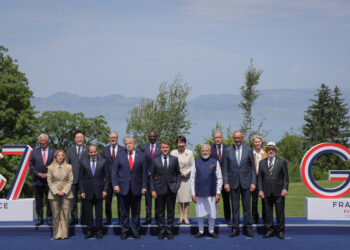
![[foto: European Council]](https://www.eunews.it/wp-content/uploads/2024/06/euco-strem-350x250.jpg)

![Da sinistra: il presidente del Consiglio europeo, Antonio Costa; il presidente dell'Ucraina, Volodymir Zelensky: la presidente della Commissione europea, Ursula von der Leyen [Bruxelles, 18 giugno 2024. Foto: European Council]](https://www.eunews.it/wp-content/uploads/2026/06/euco_ua260618-120x86.jpg)
![[foto: Saverio De Giglio/imagoeconomica]](https://www.eunews.it/wp-content/uploads/2026/10/cpt-120x86.png)