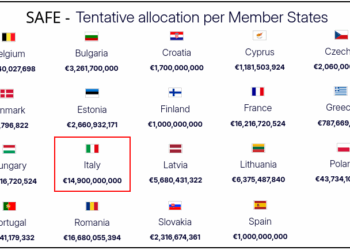
Brussels – Italy will use “a vast majority” of the 14.9 billion euros in loans allocated by the EU through SAFE. However, the final figure has not yet been communicated to Brussels, European Commission spokesperson Thomas Regnier confirmed, adding that discussions with Rome regarding the defence financing facility “are moving in the right direction.” “We have received strong assurances from Italy that it will, of course, use a large majority of the loans allocated to it. Italy remains fully committed to European defence and to this project,” Regnier said during the press briefing.
The key issue, however, remains how much of the 14.9 billion euros requested by Rome will actually be used. The European Commission does not intend to confirm a definitive figure at this stage, as the loan agreement has not yet been signed. Discussions with the Italian authorities centred precisely on “the final amount that Italy could draw on” and the timeframe within which Rome must communicate its decision. The reassurance provided today is that Italy will inform Brussels “in time”, enabling the European Commission to proceed swiftly with the signing of the agreement and, above all, to reallocate any unused resources to the other Member States.
The issue has become particularly sensitive following speculation in recent weeks that Rome might significantly reduce its request, ending up using only around 6 billion. Such a scenario would have entailed a significant revision of the defence spending programme initially announced by the government.
Italy lifted its reservations regarding SAFE on 28 July, when Foreign Minister Antonio Tajani had announced before the Foreign Affairs and Defence Committees of the Chamber of Deputies and the Senate the decision to request “funding of 14.9 billion by the end of the year.” Rome had thus chosen to utilise the allocation granted under the SAFE facility, the European programme providing 150 billion euros in loans to strengthen the industrial and military capabilities of Member States. The decision came at the end of a lengthy discussion with Brussels, which repeatedly urged the Meloni government to clarify how it would have used the resources. It was essential for the European Commission to know Italy’s intentions quickly, so that it could sign the agreements and allow European industry to plan tenders and contracts.
In July, Regnier had warned that “waiting until December to decide how and how much to use is not a good timetable.” Today, however, the tone is decidedly more relaxed. “Even if Italy does not take up all the loans, that money will not be wasted,” Regnier stressed. It will be possible to redistribute any unused funds to other member states. “Italy remains fully on board, and no resources will be wasted. That is what matters,” the spokesperson concluded.
At the national level, Defence Minister Guido Crosetto had described SAFE as “a purely technical decision” to fund already planned defence expenditure, distinguishing it from the budget amendment that the government intended to discuss in September to increase funding for defence and energy.
English version by the Translation Service of Withub


![Il ministro dei Trasporti, Matteo Salvini [Bruxelles, 5 dicembre 2024. Foto: Emanuele Bonini per Eunews]](https://www.eunews.it/wp-content/uploads/2024/12/salvini241205-120x86.jpeg)