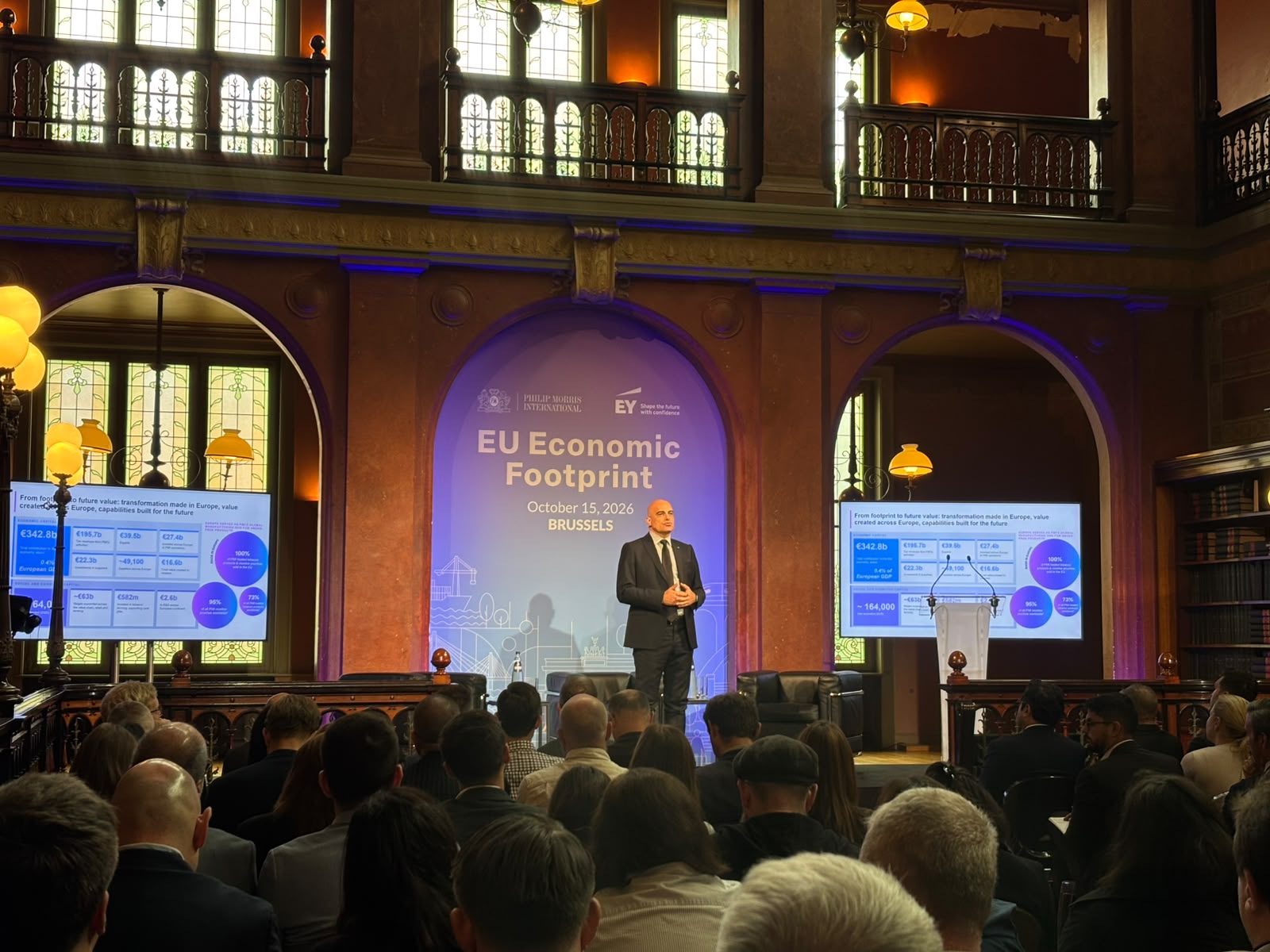
Brussels – Philip Morris International claims a contribution of around €343 billion to the European Union’s economy between 2021 and 2025, comprising €39.5 billion in exports, €27.4 billion in investment in its European operations and nearly 164,000 jobs supported in 2025. These are the key findings of the EU Economic Footprint Study, produced by EY-Parthenon and presented today (15 October) in Brussels.
“Behind the billions of euros in economic value are people,” said Marco Hannappel, president of PMI’s European Region, highlighting the role of farmers, manufacturers, researchers, retailers, and employees in the European supply chain. According to the group, this economic contribution goes hand in hand with an industrial transformation that is increasingly focused on non-combustion products, which include heated tobacco, e-cigarettes and nicotine pouches.
During the period under review, SMEs invested €422 million in research and development in the EU, in addition to approximately €2.2 billion in research activities in Switzerland. Hannappel also reported tax revenue of nearly €200 billion over five years and an impact on European GDP of 0.4 per cent. Within the EU, he explained, 17 of the group’s 19 factories have already been converted to the production of next-generation products. Today, according to the company, more than half of its European net revenue comes from combustion-free products, while 99 per cent of the investments outlined in the annual report are allocated to this category.
The industry is now looking to Brussels for regulatory decisions. The European Commission is expected to present proposals to revise the Tobacco Products Directive (TPD) and the excise duties (TED), two dossiers which Hannappel distinguishes in terms of their timelines and decision-making processes. On taxation, the president of PMI’s Europe Region expects “a more consensus-based discussion amongst Member States, grounded more firmly in data.” On product regulation, however, he fears that the process is proceeding “without sufficient analysis” of the measures’ effects.
“The impacts in terms of the product, its use and regulation require a timeframe that is logical and focuses not on the clock, but on the end result,” he said. The group is calling on the EU not to harmonise the rules on the basis of the most restrictive legislation, but also to take into account the national approaches it considers most effective.
Fingers are also being pointed at the eight governments that have asked the Commission for stricter restrictions on new nicotine-based products and their flavours. “I don’t think a letter from eight countries is enough to set a precedent,” said Hannappel, referring to the possibility of extending bans at the European level. The president was particularly critical of the call to halt the introduction of new products: “It’s like telling the electronics market never to innovate on mobile phones again.”
According to Hannappel, Italy should play a central role in the European debate, thanks to the greater experience it has gained in the market for next-generation products and to a regulatory framework which, according to the group, has helped to curb the illicit market and promote the uptake of alternatives to traditional cigarettes. “I believe Italy should be very proud of what it has achieved and of having been at the forefront of this sector,” he concluded.
English version by the Translation Service of Withub