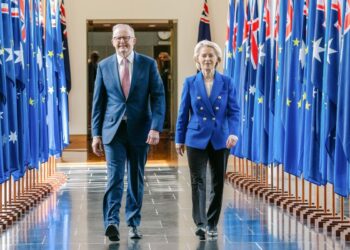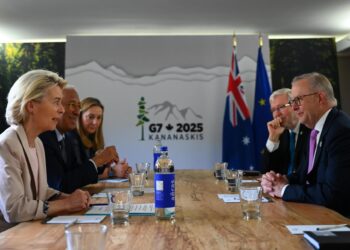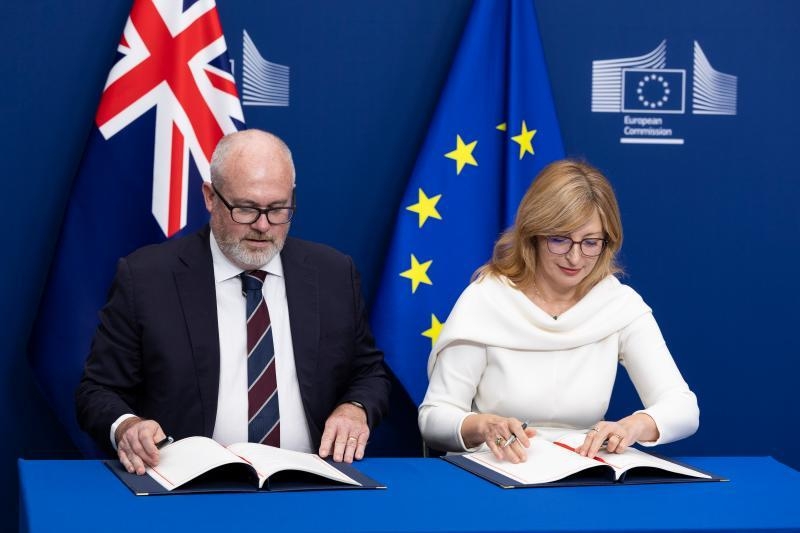
Brussels – The European Union and Australia are strengthening their ties in scientific research across health, climate, energy, and digital technologies. After reaching an agreement in March, Brussels and Canberra today (12 November) signed a deal enabling Australian researchers and organisations to join and lead projects under Horizon Europe – the EU’s flagship programme for research and innovation. The agreement was signed by Ekaterina Zaharieva, European Commissioner for Start-ups, Research and Innovation, and Tim Ayres, Australian Minister for Industry and Innovation and Minister for Science. “We may be half a world apart, but we share a belief in science and in what people can achieve when they work together,” said Zaharieva. “This agreement brings our researchers and innovators closer, giving them more opportunities to share knowledge and put ideas to work. It is also a clear commitment to keeping international scientific cooperation open and strong, for the benefit of both our societies,” she added.
Australia’s association relates to ‘Pillar II’ of Horizon Europe, which has a budget of 52.4 billion euros and funds collaborative research projects in sectors such as health, climate, energy and digital technologies. “Australia’s association with Horizon Europe is more than a scientific agreement. It is testament to the trust, ambition and shared values that underpin our EU-Australia partnership,” said the President of the European Commission, Ursula von der Leyen. “By deepening this partnership, we will turn outstanding research into real solutions for our citizens, strengthen our resilience, and help build a safer, more prosperous world,” she added.
The agreement will enable Australian researchers and organisations to join international consortia – also as lead partners – and to access funding on terms similar to those available to their EU counterparts. Australian participants will also retain access to those parts of Horizon Europe open to non-EU countries under the ‘Excellent Science’ pillar (which includes the ‘Marie Skłodowska-Curie’ actions) and the ‘Innovative Europe’ pillar, subject to the conditions set out in the individual calls for proposals. From January, transitional arrangements will allow Australian entities to apply for calls under Pillar II and to be assessed as potential beneficiaries. The association process is expected to be formally completed by mid-2027, following parliamentary scrutiny in Australia.
Horizon Europe is the EU’s research and innovation programme for the period 2021–2027, with a budget of 93.5 billion euros. The programme funds scientific excellence, tackles global challenges and helps strengthen Europe’s competitiveness. Negotiations on Australia’s association with Pillar II were concluded last June and, with this agreement, Australia officially becomes the 24th associated country. Other associated countries are Albania, Armenia, Bosnia and Herzegovina, Canada, Egypt, the Faroe Islands, Georgia, Iceland, Israel, Japan, Korea, Kosovo, Moldova, Montenegro, New Zealand, North Macedonia, Norway, Serbia, Switzerland, Turkey, Tunisia, Ukraine and the United Kingdom. On 6 November, the EU also successfully concluded negotiations with India on India’s participation in the Horizon Europe programme.
English version by the Translation Service of Withub