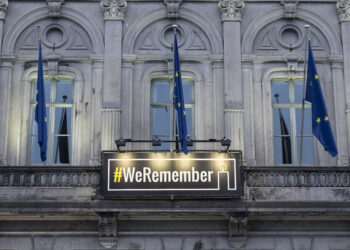
Brussels – Thirty-two sites where the Holocaust took place have officially become the first members of ESHEM, the European Sites of Holocaust Memory network, which connects these sites and the people who look after them – museum staff, educators, local Jewish communities, Roma organisations, and volunteers – so that they can continue to pass on this history to future generations. Among the members of the European Commission’s initiative, ESHEM, is Rome, with Largo 16 Ottobre 1943 – the date on which German soldiers rounded up the capital’s ghetto and deported 1,022 Jewish men, women, and children to Auschwitz, only sixteen of whom survived. However, the 32 member sites are located in Austria, Croatia, Denmark, France, Germany, Italy, Latvia, Lithuania, the Netherlands, Poland, the Czech Republic and Hungary, and outside the European Union in Moldova, Norway, Serbia, Switzerland, Ukraine and Mauritius. These include, for example, the former extermination camps at Treblinka (PL) and Sobibór (PL), the transit camps at Drancy (FR) and Westerbork (NL), the site of the mass shootings at Babyn Yar (UA), the escape route from Gilleleje (DK) to Sweden, and the Jewish cemetery at St Martin in Mauritius (MU).
The network was officially launched yesterday (17 November) at the Arsenal in Brussels during a ceremony opened by the Commissioner for Home Affairs, Magnus Brunner, and the director of ESHEM, Aleksandra Janus, with a message from Pina Picierno, Vice-President of the European Parliament. “The Holocaust did not take place only in the camps and ghettos. It swept across an entire continent and beyond: through woods, villages, and city streets, railway stations and escape routes,” said the director of ESHEM during the ceremony. “We have launched ESHEM, a network linking 32 memorial sites of the Holocaust in 18 countries. While the last witnesses of the Holocaust are leaving, their legacy now rests in our hands. With this network, we are ensuring that the past shapes our future,” Brunner commented.
Representatives of the member sites have received an ESHEM recognition statuette, and in the coming weeks an ESHEM plaque will be installed at each site so that visitors from across Europe can recognise these sites. Furthermore, the current 32 members could increase, as a second call for applications will be open from 1 December 2026 to 26 February 2027, aiming to bring the total number of member sites to at least 50 by the end of next year.
English version by the Translation Service of Withub