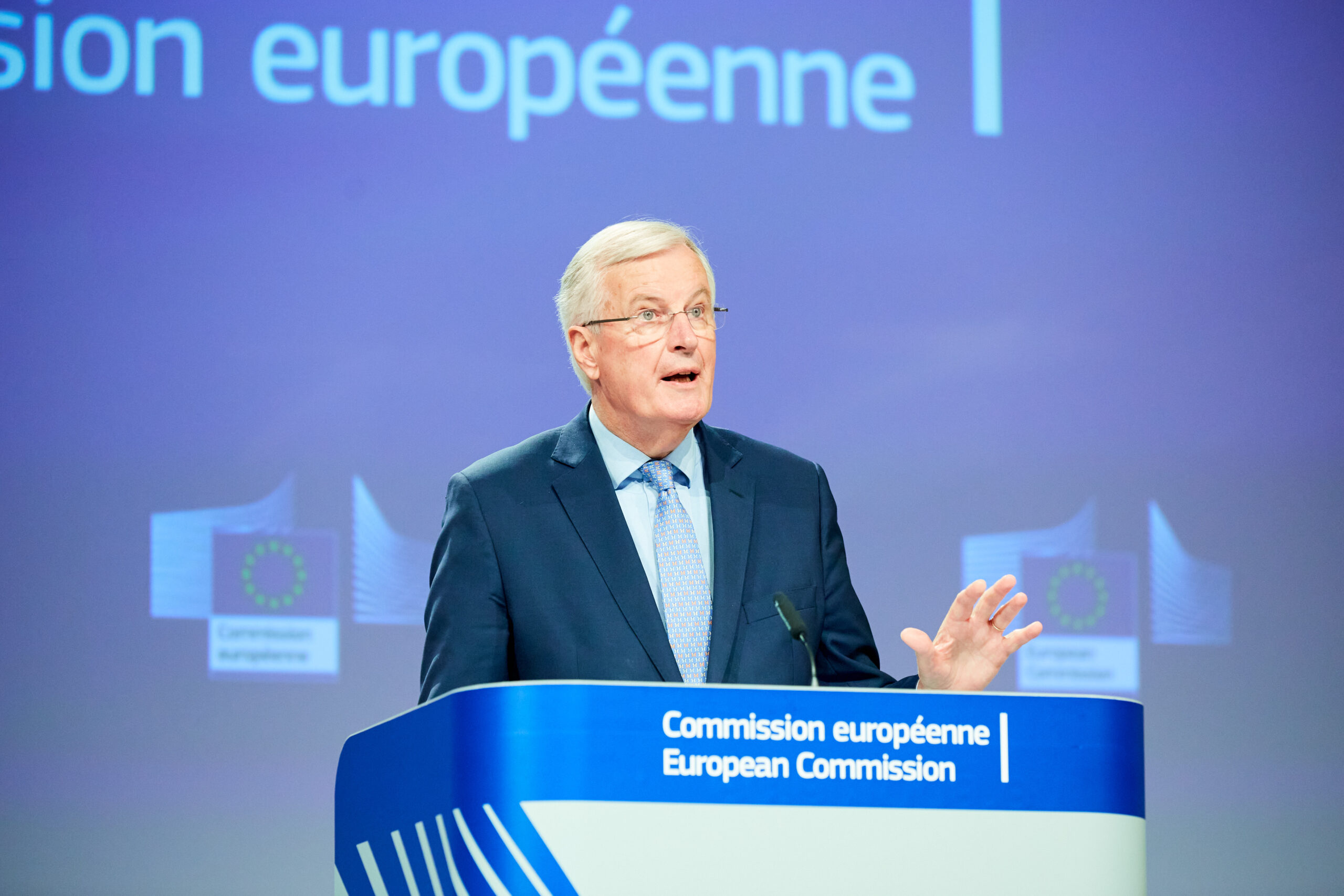
Brussels – It took Emmanuel Macron exactly 60 days to find the solution for a new government for France. After weeks of deep political crisis, which at times appeared to be on the verge of erupting into institutional paralysis, on Thursday (Sept. 5), the head of state finally nominated Michel Barnier for the role of prime minister, with the task of forming a new executive. A well-known face of transalpine neo-Gollism, the 73-year-old has a lifetime in national and European institutions. Now, he will have to try to restore stability to a deeply divided country, especially in view of the difficult budget law that will have to be drafted in the fall.
Ultimately, he played his game almost all by himself, monsieur le Président. A game that began with the calling of early elections last June 9 to catch off guard the far-right Rassemblement National (RN) of Marine Le Pen, which had just routed the liberal centre at the Europeans. Going by the “snatching” of the government from the progressive coalition, that Nouveau front populaire (NFP), which, having come first in the polls but without an absolute majority in the Assemblée Nationale, claimed the presidency of the executive for Parisian economist Lucie Castets. However, after lengthy consultations (a first for transalpine politics), Macron decided otherwise.
The NFP left, the head of state argued, would not be able to survive the House’s no-confidence vote that would come on the first useful vote. For the far right of the RN, it would be even harder. That left the centre, “his” liberal centre, which, after the defeat at the European elections, had risen as if by magic by getting an unexpected second place in the legislative vote and which, in a House balkanized as never before, will have to try to broaden its parliamentary base toward the other moderate and pro-European political forces, as underlined by former premier Élisabeth Borne (Macron’s party partner), for whom now “it will be necessary to find compromises between the progressive left and the republican right”. This is far from a foregone conclusion.
Barnier, who will be the longest-serving premier of the Cinquième République and will succeed the youngest premier ever, Gabriel Attal, has been elected to parliament seven times (five as an MP and two as a senator) and has held ministerial positions in Paris four times (in the Environment, European Affairs, Foreign Affairs, and Agriculture). His political trajectory is all in the neo-Gaullist centre-right: from the Rassemblement pour la République (RPR), the home of conservatives loyal to Jacques Chirac and critical of Valéry Giscard d’Estaing’s line, Barnier embarked in 2002 in Nicolas Sarkozy’s Union pour un mouvement populaire (UMP), to join in 2015 the new party born under the name of Les Républicains (LR), of which he was the presidential candidate in 2022.
Barnier also has a long experience in Europe: first appointed commissioner in 1999 in the Prodi College (with responsibility for Regional Policies), he was reappointed between 2010 and 2014 in the second Barroso College (at the Internal Market and then in charge ad interim of Industry) after a brief stint as an MEP (for a few months between 2009 and 2010), to conclude his parabola in Brussels as chief EU negotiator for the implementation of Brexit from 2016 to 2021.
As expected, Barnier’s appointment was greeted with relief by the president’s centrist allies and several European figures. MEP Sandro Gozi, an Italian elected in France and a member of the Renew Europe group, hailed the choice of a “person of absolute political and human value, a friend with whom I have always worked very well over the past two decades,” whom he described as “someone capable of building and broadening consensus around him to help French democracy emerge from the current difficulties.” The (re)elected chairwoman of the EU executive, Ursula von der Leyen, congratulated the former commissioner: “I know that Michel Barnier has the interests of Europe and France at heart, as his long experience shows,” she wrote on X.
But on the other side of the political spectrum, the appointment of the conservative premier was judged as a slap in the face of democracy, a theft from voters and their elected representatives. Jean-Luc Mélenchon, leader of the radical left-wing La France insoumise party (the largest among those that make up the NFP), lashed out at the president of the Republic: “Emmanuel Macron officially denies the results of the elections,” he said, pointing out that the Républicains were among the worst losers at the polls. The head of state thus allegedly “stole the elections from the French people”, according to the insoumis leader. At the same time, former Socialist President François Hollande pointed fingers at a desistance pact between Macron and the radical right-wing Lepenists. According to him, it is “almost certain” that Barnier’s nomination was able to come about “because the RN, precisely the extreme right, gave a kind of endorsement” in the form, likely, of a promise not to challenge him in the Assembly.
In short, the new head of the transalpine government now has the difficult task of recomposing the country’s deep—and still bleeding—political wounds. Getting parliament to work productively will be the first tricky test for Barnier, on whose agenda there is already a date circled in red, coming dangerously close. It is Oct. 1, the deadline by which the new executive is expected to present the draft for the 2025 budget law to the House. This appointment promises to be particularly delicate, with a deficit that could touch 5.6 per cent in 2024 and rise to 6.2 per cent next year. All this will be under the watchful eyes of Brussels, which opened an excessive deficit infringement procedure last July against Paris (and six other capitals, including Rome).
Technically, the premier does not need a vote of confidence from the deputies to assume his duties formally. However, it is likely that the new prime minister will still ask the Assembly to approve his programmatic lines in the coming days. At that point, with numbers in hand, it will be seen whether Macron’s political gamble has turned out to be a winner.
English version by the Translation Service of Withub

![Il ministro dell'Economia, Giancarlo Giorgetti, ai lavori dell'Ecofin [Bruxelles, 16 luglio 2024. Foto: European Council]](https://www.eunews.it/wp-content/uploads/2024/07/giorgetti-240716-350x250.jpg)