Brussels – “We are at the end, the next step is total destruction: the international community must take a strong position now because there is no more time.” Martina Marchiò, medical coordinator of Medici Senza Frontiere (Doctors Without Borders) is in Gaza City. Back in the Strip after last year’s experience in the central zone, Martina finds time to grant me an interview in which I would like her to ‘take’ me inside Gaza with her eyes and emotions, as the press cannot. I call her on a Saturday at the beginning of June, a few days before Israel shuts down the internet and starts the escalation against Iran, shifting the centre of gravity of the world’s media attention from Gaza to Tehran. It is afternoon. At my place in Brussels, the sun is shining, and outside my window, I can see people bustling around, bringing their shopping home, their children playing sports, and taking their bikes for a ride. A few children play football in the street, taking care only to let cars pass when there are any. “I am now in Gaza City and the neighbourhood we live in is not far from Shifa Hospital and the sea,” Martina tells me as soon as I ask her where exactly she is. “We live in one of those neighbourhoods that used to be among the most beautiful and wealthy in the city. Clearly, this is no longer the case: we only see great destruction and overcrowding.”
Eunews: What do you see around you?
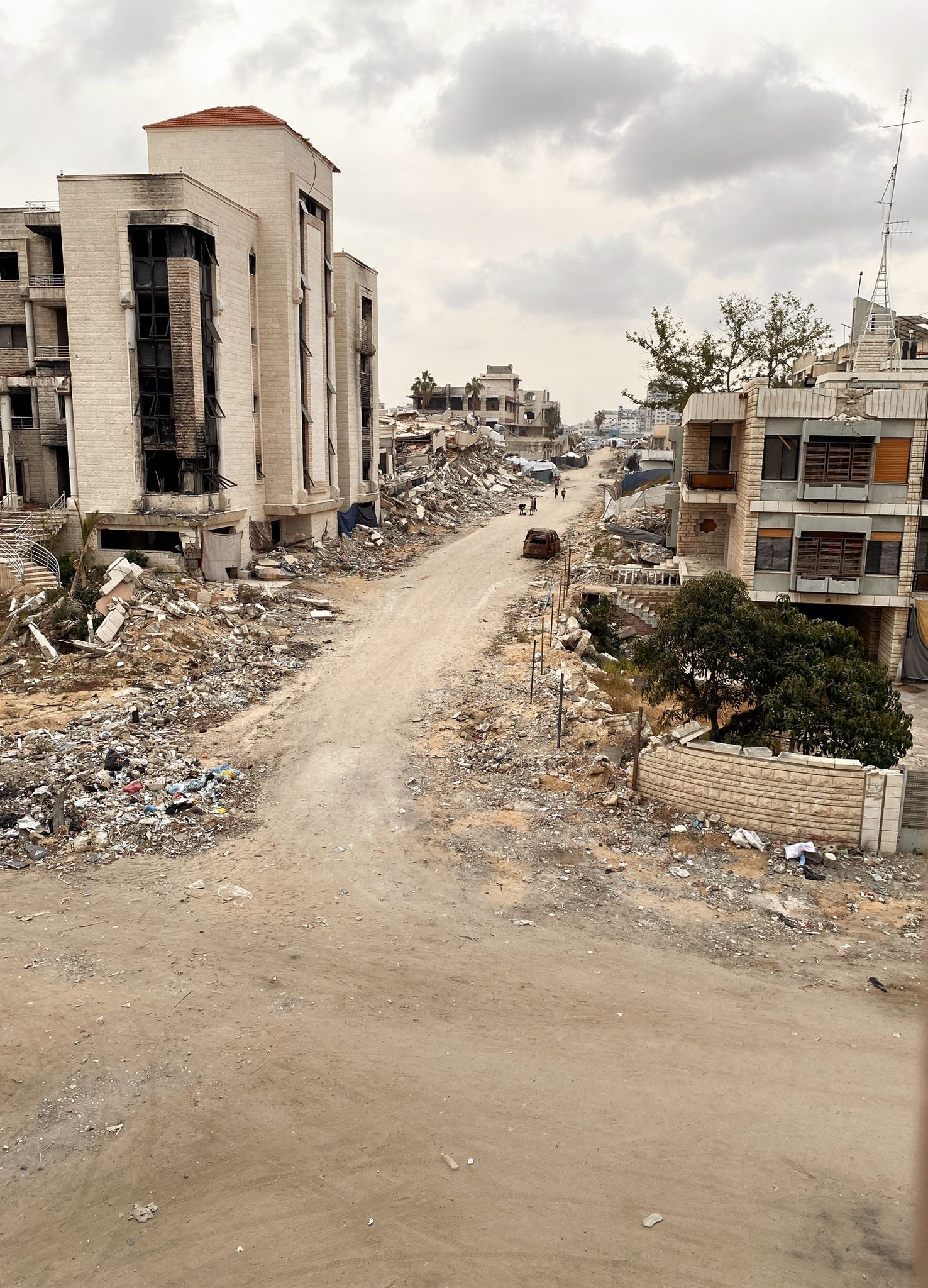
Marchiò: “It is a surreal, apocalyptic scenario. Most of the buildings are on the ground, destroyed. Others are still standing, but burnt or riddled with bullet holes. There are tents everywhere on the street now, whereas there were many fewer at the beginning. Unfortunately, the situation has worsened even further over the last three weeks. Since 81 per cent of the Strip is now occupied militarily or under evacuation, people are living in a tiny space. Services are scarce, in the few buildings standing, many families have arrived from the north, Jabalia, Beit Lahia, Beit Hanoun, and have moved to Gaza City because of the violence: a forced displacement.”
E.: What are the sounds and noises you hear?
M.: “I can hear the attacks, because they are always close, one, two kilometres or even less, because we are talking about tiny distances now. And there is always the noise of the drones… You feel like you have them even in your bedroom, and sometimes you really struggle to disconnect. Now we come from two very tense days. It sounds like a joke, but the attacks are always stronger on Fridays or holidays.. And then there are always the barges along the coast firing cannons or shots towards the beach. It always looks like there is a storm, but there is not.”

E.: What is it like where you live?
M.: “We are in a three-storey building, entirely for MSF. It’s nice, masonry. It’s a house that was partially damaged, but then rebuilt. We use the house and the office, which are in the same building, and the owner also lives here with her family, her children and her brother.”
E.: What do you eat?
M.: “For food, you need flexibility. There are unluckier days when you eat ready-made noodles, the ones you heat with boiling water, or canned things we have in stock from the cease-fire, beans, chickpeas, corn. For those who are not vegetarians, maybe you can find some cans of tuna. You can still find rice, if you’re lucky, you can find some flour for bread, although it costs $15 a kilo. You can still find pasta, albeit of poor quality, and some vegetables, especially tomatoes, cucumbers, aubergines and courgettes. Fish can be found along the beach, but at exorbitant prices. Meat, eggs, and fruit are not available anywhere. We buy some vegetables at the market, though rarely, so as not to fuel inflation. We are lucky, not everyone can afford these skyrocketing prices: a kilo of tomatoes costs 10 euros. There are a few lucky families where someone works and can guarantee at least one meal a day. Some families are also helped by external support, which is very helpful in securing a livelihood. Online payments still work, and those who receive digital donations can spend them at the market. When you enter Gaza from outside, you are allowed a limited amount—the maximum amount of food you can bring is three kilos per person, and you are only allowed to consume three kilos immediately. But between that, the stocks and what we can buy, you get by.
E.: Do you have access to clean water?
M.: “In general, there is seawater that is filtered and partially desalinated. Gaza City before the war was one of the most developed places in the Strip, unlike Rafah. So, for example, in this house, the water is quite clean and not salty. You can’t drink it, but you can wash yourself. Last year, on the other hand, the water in Rafah, like now in the central area, left salt on you. We drink water that is filtered. For hygiene, the products we use come from outside: I was told to bring bubble bath, and so I did. For cleaning clothes and hands, we use the soap we still have in stock.”
E.: You still have electricity and internet, so much so that we are making this call via WhatsApp. Are there any restrictions?
M.: “Electricity is provided by solar panels, for those who have them. Then, of course, there are the lucky ones who have generators for which fuel is needed. With the ceasefire, the UN brought in a lot of it, which is still being used today. However, unfortunately, a significant portion of that fuel is located in a red zone, which is completely inaccessible, making it non-trivial to retrieve and transport it to where it is needed. Last year, with the closure of the border, fuel was not getting in, and hospitals and clinics, as well as desalination and distribution of clean water, were also affected. The Al Aqsa hospital in the centre of Deir al-Balah was blacked out for five hours, with staff ventilating patients in intensive care by hand and surgeons operating with a torch on their heads. This is not normal. As for the internet, it depends on where you are. Usually, the line holds up; we also use it to talk among colleagues, but when there are attacks, it goes away“.

Photo by Martina Marchiò, MSF
E.: Is the area you live in safer than others? Is there any protection for aid workers?
M.: “The safe zone does not exist, there is no humanitarian zone. Last night they struck 70 metres from our clinic, last week 150 metres from us and 50 metres from another clinic. I would say that for us, the protection comes from the fact that we are expatriates—while we have seen enough of what happens to the Palestinians—because I think Israel prefers to avoid diplomatic incidents. But there have been casualties among international workers; we cannot hide it. Here, the rules of international humanitarian law are not respected: if there is a target, Israel goes to the target, no matter what is around. Sometimes it happened that the authorities told you beforehand, that is, the phone call came, not only to international organisations but also to the population. They phone and say they have to strike near where you are and tell you to stay at home. But this may or may not happen. Sometimes they strike and say nothing. Like last night, when they hit 70 metres from the clinic and the ward, and we had the night shift staff there. The explosion was very strong, 70 metres away, and it happened without any warning. Some members of our staff ended up with debris flying at them. At other times, evacuation messages were sent to people. So the inhabitants of a neighbourhood or an area know that they have to leave. Then, where to go is another matter: many don’t leave because they don’t know where to go. Obviously, when the attack happens not only by air but also by land, as happened in the Jabalia camp that was practically wiped out, people necessarily leave.”
E.: What did you do in the two explosions near the clinic and the house?
M.: “Yesterday’s attack happened at 4.40 a.m.; the staff took the patients and ran to the room that is considered to be the safest. It is not a real safe room, but it is the safest room in the building. Since bunkers do not exist, a room is usually chosen for safety: generally, a room that is on the ground floor and has load-bearing walls and is not right on the street. That way, if the upper floors collapse, there are load-bearing walls, and if fragments, stones or debris come in, you are protected. Then you leave the window open so that the glass doesn’t shatter. So when there was the attack, they moved in there, and my colleague in charge of security called the Israeli authorities to find out what was going on, because obviously Israel was informed that we had been operating 24 hours a day for a week. The week before, when they struck a hundred metres from where we live, I was on the terrace hanging out the laundry. I immediately went into the house, retrieved my backpack, and started running down the stairs. Even in the house, there is a room that is considered safer. By the time I got there, there was another explosion, louder. In those cases, you feel the building shake…the blast is very powerful, and it feels like a slap to the building. We stayed there 24 hours, spending the night. Again, we checked the security conditions with the Israeli authorities, and at one point, they told us we could leave and go back to business. But they did not inform us before the explosion, it was after our phone call that they told us what to do”.
E.: Let’s take a step back, how did you get into Gaza?
M.: “I entered with the 22 April rotation. From Amman, we took the bus to the border with Israel. We entered through Kissoufim, on Deir al Balah. We left at 6 a.m. and arrived at 5 p.m. There are stops and controls. In the passage from Jordan to Israel, they scan your luggage, they make you open it if they see strange things, they ask you detailed questions, even very pressing ones, to see if you are lying. It typically takes an hour to go through this type of check. In my case, it was four because I and three other colleagues had things we thought we couldn’t bring. One colleague had an extra mobile phone to give to his office: he had simply put it in his hold luggage, and this was seen as a suspicious gesture. I and two other colleagues, on the other hand, had taps for our guest houses, where we live. They questioned us about the purpose because, being made of metal, they suspected it was for military purposes. We were stuck for four hours, not knowing whether they would send us back to Jordan or admit us. Then, also thanks to the explanations provided by MSF, they let us continue, but they confiscated the taps.”
E.: So, who and what enters Gaza is always decided by Israel…
M.: “They know everything and decide whether the rotation can take place or not. The night before the rotation, they validate the list of those who must enter Gaza. On 22 April, for example, some people had not been validated and went back to their countries from Amman. The rotation is confirmed the night before, and the same morning, they give the so-called ‘green light’ to go. The rotation lasts one day: on that day, there are those who go in and those who go out. Everything is controlled and counted because there is a maximum number of expatriates who can stay inside the Strip. So, we went in, while others went out, and even the outward journey is long because they check in detail, especially what you want to get out of the Strip.”

Photo by Martina Marchiò, MSF
Martina explains to me that, in the Strip,
Medici Senza Frontiere
has a team coordinated by the centres in Amman and Jerusalem and divided into two zones: North Gaza, where she is now, and Central Gaza, which covers Deir al-Balah and Khan Younis, where she was last year. “In both projects, there are activities at the outpatient level that are overcrowded right now because in each outpatient clinic there are more than 450 visits a day, in some outpatient clinics it is even 600 or 700 a day. These are patients who come for primary health, for pregnancy health, for malnutrition. In the last two weeks here in Gaza City, there has been a 32% increase in malnutrition cases registered in our clinics. Then there are patients who come for wound care, physiotherapy, and mental health. We also give support in some Ministry of Health hospitals, both at the surgical level of trauma and at the maternal and child level, so we support maternity wards, neonatology wards, intensive neonatology and also paediatrics. And then we support some emergency rooms, also from the Ministry of Health. We also have two field hospitals in the central area, which act as an extension of the Ministry of Health’s hospitals, to increase operating theatres and beds.”
E.: What distances do you cover to go to work, and how do you travel?
M.: “We travel by car: it’s ten minutes to go to the ward and the clinic. The space in the north of Gaza is now tiny: we’re talking about five kilometres to go north, four kilometres to go east, to the west there’s the sea, and to the south we’re at the limit. The other clinic is three and a half kilometres away, unfortunately, on the edge of the red zone. In general, the travelling time increases a lot because of the tents, the donkey carts, the people on every corner…it becomes challenging.”
E.: Are your movements always communicated and known to the parties?
M.: “Everyone knows our coordinates. Every time you set up an office, move into a new place, or establish a hospital or clinic, you send the coordinates and wait for a response confirming receipt of the information. Sometimes they respond late, sometimes not even that. As MSF, we don’t do the recovery of the wounded; the Palestinian Red Cross does that. But our movements, if they are in red zones, are clearly coordinated. That means Israel has to know you are going somewhere, you have to tell them 48 hours in advance, and you have to give them the list of people who are in the cars. If, on the other hand, they are in a non-red zone, we go ‘normally’… Travelling by car is a risk; we always find ourselves hoping that there is no interesting target on the way.”

E.: What is the situation of the hospitals?
M.: “They work partially because destruction is significant. No hospital operates at the same capacity in terms of beds, human resources, medicines, and instrumentation as it used to. The problem is that they receive four times as many patients. Before 7 October 2023, there were hospitals in Gaza with excellent staff, with high-level specialities. One of these was Shifa, a university polyclinic, one of the most brilliant hospitals. The hospital in Shifa— with which we collaborate because we opened a small annexed department this week—was hit three times. When you arrive in Shifa, you see some of the main buildings completely collapsed, others partially collapsed, and then you see a new part that the Ministry of Health has started to rebuild, also thanks to the support of some UN agencies or humanitarian organisations. They have rebuilt a part with 120 beds and 45 places in emergency rooms. You can see this gap in the landscape, between the destroyed blocks and the rebuilt part, and then a few steps away is a mass grave containing over 300 bodies—they couldn’t even count them. The hospital now focuses on trauma. Then maybe there is another hospital that did something else before the war and now focuses on maternity. The hospitals have sort of divided up the services to try to organise the circuit of care.”
E.: How does MSF work?
M.: “MSF works both with a team of expatriates and with a team of Palestinian personnel, and we work both in structures that are 100 per cent MSF and in structures in collaboration with the Ministry of Health. We happened to work in real health facilities as well as setting up field hospitals that are mainly made of tents or semi-permanent constructions. We even happened to work in a former chicken farm that we transformed into a clinic. Or to repurpose structures that we used as offices or MSF housing before the war and turn them into health facilities. It takes a lot of creativity and inventiveness to give a quick response.”
E.: What material did you manage to bring in?
M.: “We were able to bring in a lot of medical material, not only medicines but also for operating theatres and surgery. Not all material is accepted because Israel decides what can go in and what cannot, and there are always materials that are considered to have dual use. For example, a wheelchair cannot enter, a crutch or a ventilator cannot enter because anything with metal parts is stopped. Of course, the Ministry of Health also has its own channels and stocks, and for both medicines and medical equipment, we can help.”
E.: What were the procedures with the Palestinian Ministry of Health?
M.: “Every time you choose to set up a service, the Palestinian Ministry of Health has to validate the activity, and there are procedures to follow. As in any other country, we always have an agreement signed with the Ministry of Health to agree on activities and modalities. If we need support from the Ministry of Health that we do not currently have, they can provide it to us, and vice versa. It happens that NGOs or UN agencies can support the Ministry. Now, in one hospital, beds were missing, and some UN agencies were able to provide them.”
E.: Do you health workers have any kind of routine?
M.: “No, it depends a lot on attacks, evacuation orders, and population movements. You always work with plans a-b-c and see what happens during the day. But in fact, you get used to not having plans: you go to sleep at night not knowing whether you will stay in your bed or have to run downstairs. You wake up in the morning not knowing how the day will go. Colleagues say goodbye to us in the evening and say: “See you tomorrow, maybe, God willing.” You don’t really know what will happen in the night.”
E.: Can you tell us something about your Palestinian colleagues?
M.: “So many of them really impress me with their strength and resilience, because they keep pushing despite being victims themselves. These 20 months are beginning to take their toll on everyone. One of my colleagues has been here in Gaza City since 7 October; she chose to stay even at a time when most people were leaving, and even when the north was later completely cut off from the south-central area where I was last year. She saw unimaginable things. She literally picked up the body parts of so many of her family members, and she did not eat for 15 days. She survived with her four children, her sister died, and she took care of the other four children. Now, when we are together, she often tells me that it feels like a nightmare, that she thinks she will wake up and go back to her former life, a life of beauty, of full days, of family. So she doesn’t give up, she shows me where her house was, in a completely collapsed building, in a neighbourhood that was very, very beautiful back then. Sometimes she shows me pictures of her past and tells me she finds it hard to recognise that life as her own. In spite of everything, in spite of the enormous losses she has had, the traumas that will never go away and that we can’t even imagine, she comes to work every morning, every morning she is on the front line and perseveres.
E.: How do you deal with sanitary material?
M.: “For three months, the border has been closed. There is a shortage of antibiotics and painkillers, even gauze. We have to make some difficult decisions. Although we would need to open ten outpatient clinics, with the stock we have, we could open five. It would take more than 600 trucks a day to meet the population’s needs, but only a handful have arrived. We are piecing out everything we can so that we don’t run out of stock and find ourselves paralysed. All the organisations are a bit in the same boat, sometimes we share stocks.”
E.: What kind of difficult choices are you talking about?
M.: ‘You have to choose who you are going to save when there is a massive influx of wounded people into the hospital, both at the level of stabilisation, but also at the level of who you take to the operating theatre. This also applies to malnutrition, at a time when everyone is hungry and asking you for food. The other day, a lady asked me for a bag of therapeutic food. She said, “Give it to me, please, just this once.” She is a pregnant woman, and I told her I could not give her anything. She was malnourished, and I had to keep those bags for the malnourished patients; I barely have any for them. She went away crying. It’s very hard. It’s a blow, it’s quite a blow to see old people, children, women, crying from hunger.”
E.: This winter, we have seen babies freeze to death. With warmer temperatures, what do you expect?
M.: “It is now hot and, although it cools down at night, during the day it is 28-30 degrees. We fear what we saw last year. There are, on average, 20 people in a tent, and the sanitary conditions are what they are. The heat is coming, along with heatstroke, dehydration, and less clean water. We fear infectious and gastrointestinal diseases. In addition, the last round of vaccinations for polio, a disease linked to the deteriorating hygienic conditions, is missing. And for the babies… it is clear that dying of cold or heat is still an atrocious death.”
E.: Are there any issues that are more urgent than others at this particular moment?
M.: “Most patients now come asking for food, and having a meal a day is the main problem. So many people can’t even get a meal a day anymore, and that is worrying. It struck me to see both the elderly and children and adults begging and crying because they are hungry. There, you realise that you have hit rock bottom.”
E.: Which numbers do you stick to and which do you consider reliable?
M.: ‘We always refer to the numbers given by the Ministry of Health, and then of course also the numbers given by the UN and WHO. They are the most reliable. If we talk about the dead, the numbers are partial because here in Gaza City, it is full of buildings that have completely collapsed, and people have written the names of those still trapped underneath on the broken pieces of wall. There are so many collapsed buildings from which no one has been able to get the bodies out. Then there are areas that are completely inaccessible, where not even rescuers can reach because they are hit. So people often remain under the rubble for months and the numbers can only be partial.”
E.: Can you flesh out any of these ‘numbers’?
M.: ‘I was struck by so many amputated children, I had never seen so many amputated children as in the Gaza Strip. According to UN figures, an average of 10 children a day lost limbs in Gaza in 2024. These are crazy and disturbing figures. I remember a little girl who came to our clinic to accompany her little sister who no longer had a leg. While her little sister was being medicated, she was with a psychotherapist playing with plasticine. At one point there was an explosion, a very loud one, and she froze, she was completely stuck. Later, the psychologist told me that the child had lost half her family a week earlier in an explosion. So she was the only one left with her little sister and mother, while her little brothers and father were gone. To see such a little girl, 8-9 years old, completely terrified—she was shaking, her eyes were blank—is something that hurts. So is seeing her little sister who no longer has a leg: she survived, but she is a child left disabled in a place where there are no roads, no services, and not even wheelchairs are let in.”
E.: Do you perceive any idea of a future, maybe even in the very short term?
M.: “Here, no one talks about the future, but about surviving until tomorrow. That is the idea of the future, an immediate future. By sea, it is not possible to go out, because even the small fishing boats that fish in the predetermined kilometre range have been sunk for no reason since last year. Israel controls the sea, sky and land; it is a completely occupied zone, as it was before 7 October: the situation has remained the same. There is no way out: it is an open-air prison.”
E.: How do you feel as a European health worker in Gaza?
M.: “I feel I am where I want to be, where I can do something in my own small way. Of course, it’s a drop in the ocean, but I believe in it like so many others. At a time when a people is being exterminated and completely annihilated, I think it is important to have the eyes of humanitarian organisations here. Not only for the medical support part, but also for the testimony part, and to show the world what is happening, as journalists are not allowed in. What comes to the world is due to the Palestinian people, the Palestinian journalists and press, and the humanitarian workers who are inside.”
E.: Are you afraid?
M.: “I feel fear, but I think it’s the one that saves you a bit because it keeps you clear-headed about where you are. Not to have it would mean being a bit clueless. It’s clear that I’m afraid, but one accepts the risk. I thought hard about whether to come back here a second time, then I decided: not an easy choice.”
E.: What changes have you seen since last year?
M.: “We are now at the very end of the road. This is what has changed: we are at the end, and the next step is total destruction. There is not much left. That is why we need the international community to take a stand now. There is no more time. The level of destruction and forced displacement of the population is unprecedented. This plan of total annihilation is reaching its final throes. It is late, and twenty months later, we say we are one step away from the end. There must be a ceasefire now and a reopening of the border now, so that aid can come in in a big way. And as the ceasefire negotiations continue to fail, the only possibility I see is to have a strong international position.”
Martina’s two-month stay in Gaza is coming to an end, and she will return in a few days. “Going away, leaving behind people who have become friends, as well as colleagues, is difficult, and like last time, I will continue to speak, tell stories, raise awareness, to try to stir consciences a little. I will also continue to take my book, which I wrote last year about Gaza, around with me, including to schools (Brucia anche l’umanità – Diario di un’infermiera a Gaza [Humanity is burning too – Diary of a nurse in Gaza]. Published by Infinito Edizioni, 104 pages). But it will be difficult to leave. Here I am also receiving some lessons. My colleague’s story is, for me, quite identifying with the fact that here the population, as well as colleagues, teach you to always go on, to rebuild, to find that strength even when you feel you can’t take it anymore. For me, this is an important lesson: in a place like this, where everyone has lost many family members, lost their homes, lost their businesses, moved more than 20 times, to still have that drive is something non-trivial.”
We end the call.
Outside my window, a young boy in the street doesn’t move out of the way and gets honked at by a driver who is in a hurry. He tells the driver to get lost, retrieves the ball with a smooth move and lets the Mercedes pass. Then he starts playing again.

![L'Alta rappresentante UE per gli Affari esteri, Kaja Kallas, al Consiglio Difesa, 1/12/25 [Credits: EU Council]](https://www.eunews.it/wp-content/uploads/2025/12/d0bea0c9-ca9c-4258-a056-2f571171c37d-350x250.jpg)