Brussels – The European Union’s march towards climate neutrality and decarbonisation by 2050 has one more milestone, the intermediate 2040 target of cutting net greenhouse gas (GHG) emissions by 90 per cent compared to 1990 levels. A goal that can be achieved with different flexibilities, the watchword at the start of the second Ursula von der Leyen Commission.
This is the content of the proposal that the European executive, in line with its policy orientations for the period 2024–2029, put forward today (2 July) and, specifically, it is an amendment to the Climate Act to be approved by the European Parliament and the EU Council. To achieve the goal, the Commission permits three flexibility measures for EU countries: a limited role for high-quality international credits from 2036 onwards, the use of national permanent removals in the EU Emissions Trading Scheme (EU ETS), and greater cross-sectoral flexibility.
With a more flexible attitude, Brussels aims to overcome the scepticism of member states and the European People’s Party, which in recent months have shown resistance to the intermediate target. Italy’s Minister for the Environment and Energy Security, Gilberto Pichetto Fratin is satisfied, and, interviewed by Skytg24 Economia, branded the choice as “something decidedly important” because “we are moving from the rigidity of the previous Commission’s programme to greater flexibility, which many countries, including Italy, have requested,” in order to “have measures and actions for the 2050 objective that are adaptable country by country and naturally modulable over time.”
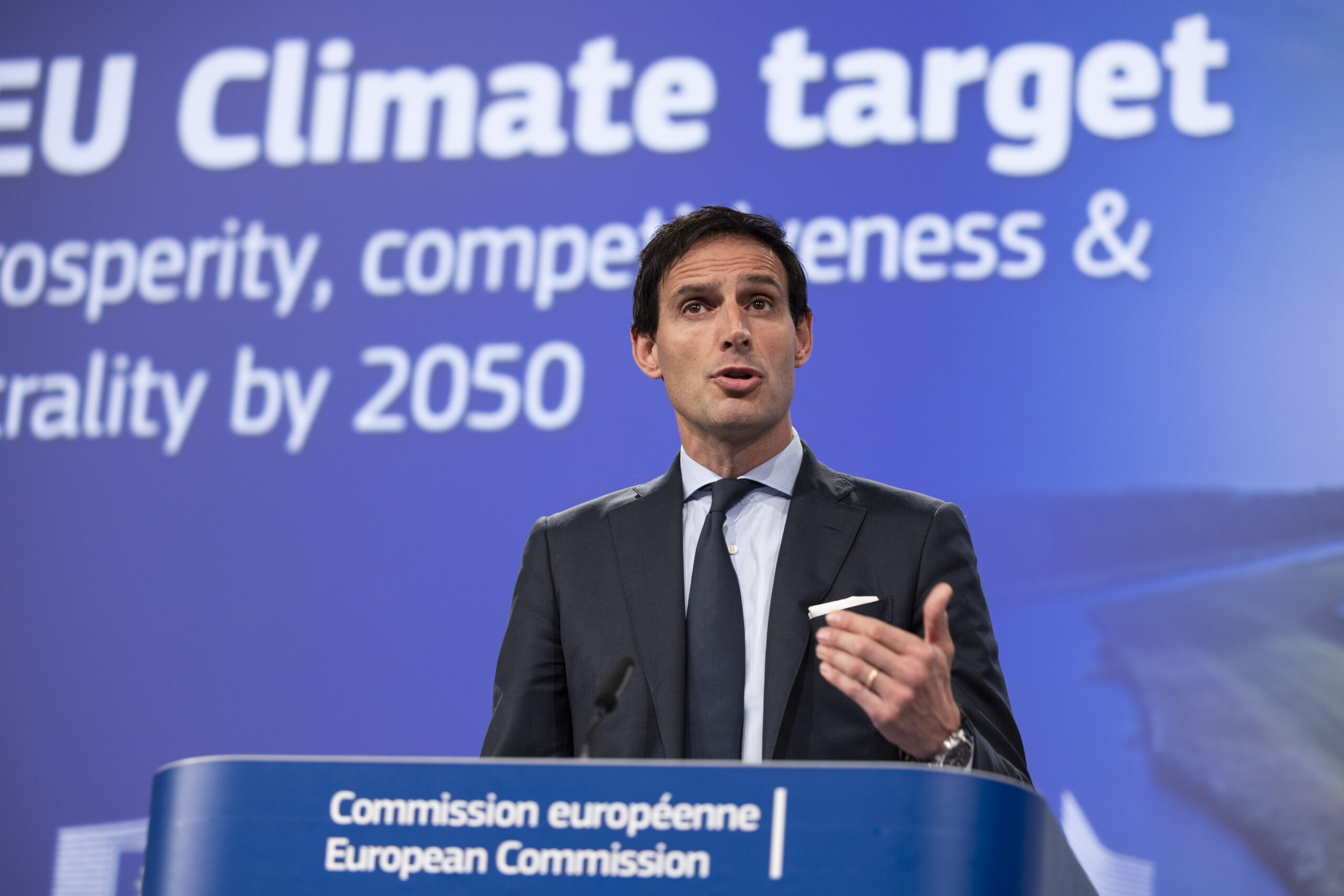
More specifically, the concepts behind the international credits are those of externalisation and offsetting: from 2036, states will be able to take into account, in the calculation to reach the 2040 target, environmental actions and projects that they have financed in non-EU countries equal to a maximum share of 3% of the EU’s net emissions in 1990. This percentage is equivalent to approximately 145 Mt of CO2 and is in line with the German coalition agreement between CDU/CSU and SPD, which allows Berlin to support the 2040 target. “These carbon credits will have to be verifiable, certifiable, and additional. Only then will they really help to build a bridge with our friends around the world. This will give breathing space to sectors that are difficult to decarbonise,” explained Climate Commissioner Wopke Hoekstra at a press conference. In particular, the Berlaymont made it clear that these international credits will have to come from “credible and transformative” activities, such as direct carbon capture and storage (DACCS) and bioenergy with carbon capture and storage (BioCCS) in partner countries.
Claiming a role in the formulation of the measure of credits was Minister Pichetto Fratin: “A specific request from Italy was, also with reference to the Mattei plan, to be able to count those actions that are done outside the European continent, outside the European Union,” he said. “Our Mattei plan intends to intervene in North Africa, in Africa, with actions that must be counted as decarbonisation actions and must be credited to the country that carried out the action,” he went on to say.
Doubts about international credits
However, the measure does not convince everyone. Starting with the European Scientific Advisory Committee on Climate Change itself, i.e. the experts advising the EU executive, which had sounded the alarm on the issue in its report dedicated to the topic a month ago. “The Advisory Committee advises against the use of international carbon credits to meet the 2040 target, as they risk diverting resources away from domestic investments and could undermine environmental integrity,” it reads. Hence, the political perplexity also among those who support the amendment of the Climate Act with the -90 per cent in 2040. Such as the PD MEP Antonio Decaro, chairman of the European Parliament’s Committee on the Environment, Climate and Food Safety (ENVI), according to whom “flexibility cannot become an escape route for deregulation” and “any change to the target set for 2040 must be subordinate to respect for scientific rigour and the guarantee of social equity.” Of the same opinion are the Greens, who, with co-chairman Bas Eickhout, stress that “the Commission is taking a dangerous gamble with international credits” because “not only is their effectiveness highly questionable, but their introduction is economic stupidity.”
The activist world is also opposed, with Transport & Environment judging it “a false step to open up to credits” because “there is no evidence that they actually work as intended,” while WWF and the European Environmental Bureau (EEB) speak of a “loophole”. Different shades for the M5s MEP, Dario Tamburrano, who believes that flexibilities “do not weaken European climate goals,” but “opening a new negotiation on the EU climate law risks weakening other essential aspects in the process of decarbonisation and adaptation” as “the right-wing majority and deniers in the European Parliament will certainly take advantage of this opportunity.” At the opposite pole is the Lega (Patriots for Europe), which through MEP Silvia Sardone defines the 2040 target—despite the flexibilities—as “ideological, unrealistic, and nonsensical” and a “confirmation” of “the totally disconnected approach from reality of this Commission.”
The other envisaged flexibilities
Concerning the other two flexibility measures, the Commission points out that carbon removals, both natural and industrial, “are essential to achieve climate neutrality by 2050 and will need to be significantly increased by 2040″ as they “will play an increasingly important role in achieving net greenhouse gas emission targets,” including permanent carbon removals at national level under the EU ETS to offset residual emissions from sectors that are difficult to decarbonise.
“Secondly, we will integrate permanent European carbon removals into the ETS,” Hoekstra clarified. “For example, a European factory that stores CO2 from bioenergy can generate and sell quotas, thus earning money from the ETS. Today, this is not possible. In our view, this will strengthen the business case for companies to capture and store CO2,’ he explained. Finally, flexibility between sectors will allow a state to compensate for the effort to reduce emissions experienced by one sector with the achievements of another, e.g. “the difficulties of land use with excess emission reductions from waste and transport”. He noted that Brussels will provide “more flexibility between legislative acts and sectors between 2030 and 2040” because “each Member State is different and faces different challenges in reducing emissions in different sectors”.

The proposal will now be submitted to the European Parliament and the Council for discussion and adoption, and the Commission aims to secure the OK of the two co-legislators before the UN Conference of the Parties on Climate Change (COP30) in November in Belém, Brazil, both to give a signal to international partners, and because the 2040 target will also be important for the Commission to finalise, in cooperation with the Danish EU Council Presidency, the communication of the EU’s Nationally Determined Contribution (NDC) on emission cuts to 2035.
The European Climate Act, which came into force in July 2021, enshrines the EU’s commitment to achieve climate neutrality by 2050 and sets the intermediate target of a net reduction in greenhouse gas emissions of at least 55% by 2030, compared to 1990 levels. In the previous legislative term, the EU adopted the 2030 ‘Fit for 55’ legislative package to achieve the agreed-upon decarbonization targets, the implementation of which is ongoing in the countries. According to the latest data, the EU is ‘on track’ towards the goal of a 55 per cent reduction in emissions by 2030: at the end of May, the Commission’s assessment of the 27 National Energy and Climate Plans (NECP) certified that “the EU is currently on track to reduce net greenhouse gas emissions by around 54 per cent by 2030, compared to 1990 levels,” just a whisker away from the target set.
And now, with the 2040 target, Brussels wants to provide “investor certainty and innovation,” strengthening the industrial leadership of companies and increasing Europe’s energy security. “European citizens, who are increasingly sensitive to the impact of climate change, expect Europe to act,” commented European Commission President Ursula von der Leyen. “Industry and investors expect us to set a predictable direction of travel: today, we show that we are firmly committed to decarbonising the European economy by 2050. The goal is clear, the path is pragmatic and realistic,” she added.
English version by the Translation Service of Withub