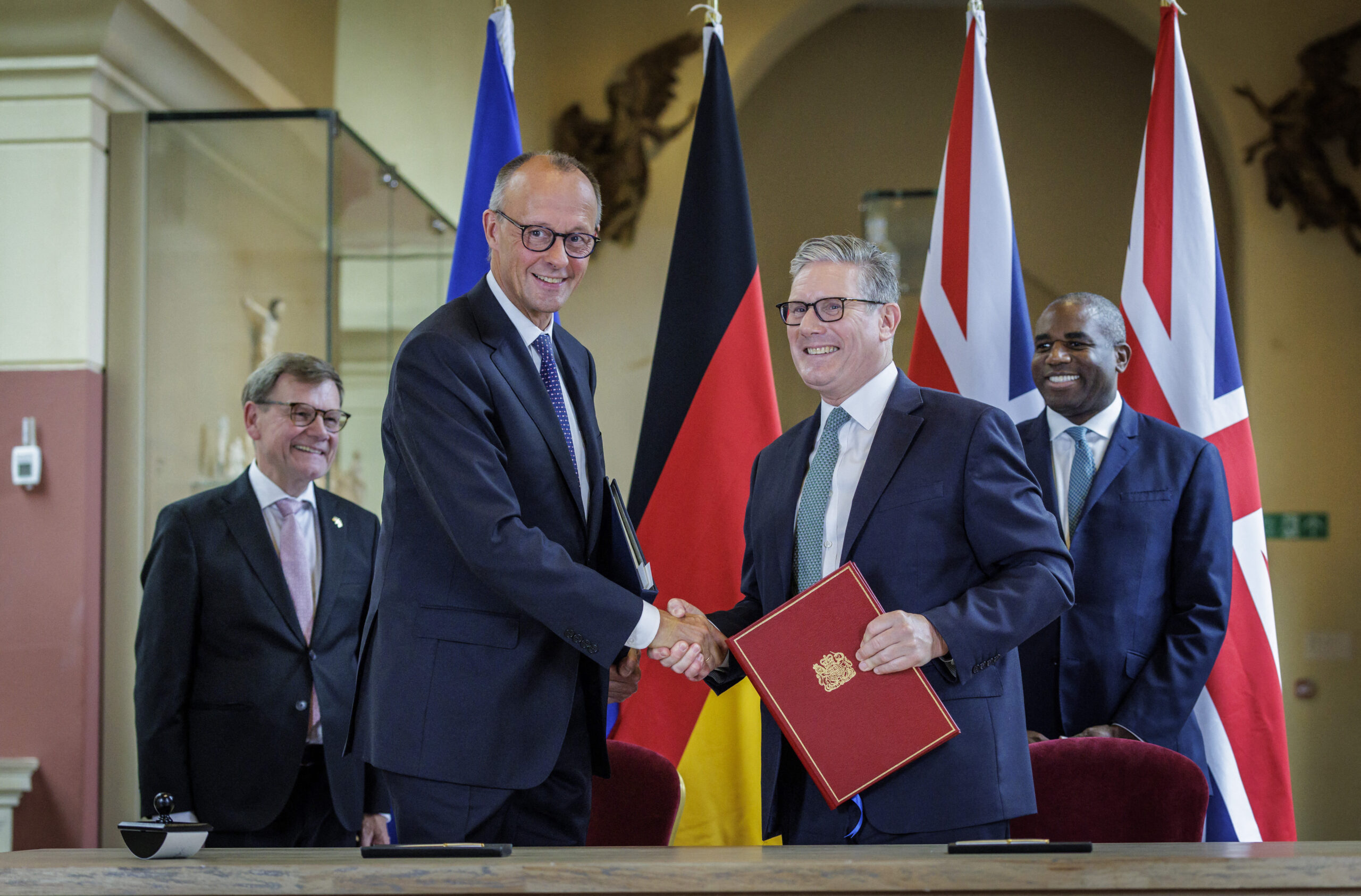
Brussels – Eighty years after the end of World War II, Germany and the United Kingdom signed the first bilateral agreement in their history today (17 July). A friendship treaty, that commits the two powers of the continent to mutual defence in the event of a crisis and identifies several areas where cooperation can be intensified, primarily the defence industry.
The Kensington Treaty was signed and presented to the public by the British Prime Minister, Keir Starmer, and the German Chancellor, Friedrich Merz, who was visiting London. After the Brexit, London signed bilateral declarations of intent with several EU countries, including Italy. However, a week after the pact on nuclear deterrence between Starmer and the President of the French Republic, Emmanuel Macron, the defence-focused agreement between London and Berlin completes, in some ways, the triangle of treaties between the E3, the format that brings together France, Germany, and the UK.
It provides for close security and defence cooperation, including nuclear deterrence. And an explicit commitment by the UK and Germany to treat a threat against one as a threat against the other, declaring that the two countries will “assist each other, including by military means, in the event of an armed attack.”

Furthermore, “we will speed up the cooperation on high-tech military weapons and equipment,” Starmer told a press conference. The two sides pledged to “promote export campaigns” to secure international orders for the equipment they jointly produce, including the Eurofighter Typhoon jet and the Boxer armoured vehicle.
The agreement, although largely negotiated by Merz’s predecessor, Olaf Scholz, is in line with the new chancellor’s push to discuss the extension of Franco-British nuclear deterrence to the rest of Europe. In May, Merz and Macron announced their intention to establish a high-level Franco-German security council. Today, the agreement with Starmer establishes similar annual strategic dialogues between the foreign ministers of the two countries.
“It is no coincidence that I am here a week after the French president’s state visit to London,” Merz said, emphasising that “Britain, France, and Germany are converging in their positions on foreign policy, security policy, migration policy, but also on economic policy issues.”
Starmer explained that the agreement outlines a “practical work plan” and “17 main projects”. In addition to defence and security, London and Berlin pledge to cooperate in the fight against the smuggling of migrants, a pet project of the new British Labour administration. Merz is said to have promised Starmer a legislative crackdown in Germany against the boats of the smugglers who fuel irregular migration across the Channel, and Macron agreed to take back on French soil migrants expelled from London. Finally, the bilateral friendship treaty covers a new direct rail link between the two countries and greater cooperation in youth exchanges.
English version by the Translation Service of Withub




![Da sinistra: il presidente del Consiglio europeo, Antonio Costa; il presidente dell'Ucraina, Volodymir Zelensky: la presidente della Commissione europea, Ursula von der Leyen [Bruxelles, 18 giugno 2024. Foto: European Council]](https://www.eunews.it/wp-content/uploads/2026/06/euco_ua260618-120x86.jpg)
![[foto: Saverio De Giglio/imagoeconomica]](https://www.eunews.it/wp-content/uploads/2026/10/cpt-120x86.png)