Brussels – At a time when the enlargement of the European Union is being discussed extensively, it is essential to prioritise civil society and social partners, and that effective structures and adequate financial resources support candidate countries in their path towards accession to the EU. This is what was explained to Eunews by Austrian trade unionist Oliver Röpke, president of the European Economic and Social Committee (EESC), in an interview on the sidelines of the plenary session that took place between yesterday and today (16-17 July) in Brussels.
The Second High-Level Forum on Enlargement was held this morning (the first edition was in October, as Ursula von der Leyen‘s first term at the helm of the EU’s executive was drawing to a close), and focused on the importance of institutionalising a structured debate between social partners and creating a solid civic space in view of the potential expansion of the European club by the end of the decade. This time around, the guests of honour were the Ministers for European Affairs of Spain (Fernando Sampedro), Montenegro (Maida Gorčević), and North Macedonia (Orhan Murtezani).
Social Dialogue and Enlargement
“A strong civil and social dialogue is the DNA of the Committee, so it is our core demand also when talking about enlargement,” Röpke explains. For him, enlargement is an “open process,” representing “not only a geopolitical imperative but also a democratic promise, a moral and social commitment.“
Indeed, the EESC President’s focus on civil society is nothing new, nor is his attention to the gradual integration of candidate countries—Albania, Bosnia and Herzegovina, Georgia, Kosovo, North Macedonia, Moldova, Montenegro, Serbia, Turkey, and Ukraine—into the EU. An approach that envisages the extension to said states of certain EU policies (such as roaming or the SEPA transfer area) and the introduction of specific cooperation instruments (see the Growth Plan for the Western Balkans) even before their formal entry into the club.

In September 2023, only a few months into being elected chairman of the advisory body, Röpke
launched the ECM Initiative (acronym for Enlargement countries members) to involve representatives of the social partners (i.e. workers and employers) and civil society from candidate countries in the works of the Committee. The basic idea is that “integration must involve not only political leaders but also those who ultimately bear the brunt of the reforms, i.e. civil society, workers, young people.”
Röpke calls the initiative ‘a success’ and assures that it will be maintained also in the next EESC term, starting next October. However, means must not be confused with the ends, so as not to create a de facto enlargement surrogate: “The ECM is a tool that must serve to facilitate accession to the Union,” he warns, “but it cannot end up substituting for it,” risking to leave candidate countries in limbo.
However, he notes, dialogue between sectors of society “is not a luxury but a structural necessity to build resilient democracies before these states join the EU.” To such an extent that the Committee has requested the EU executive to formally include social dialogue as a key conditionality mechanism in the accession negotiations.
How does one concretely promote such developments? “Of course, there is no one-size-fits-all model, but we believe that institutionalising social dialogue and giving it a clear framework, for instance with a view to strengthening collective bargaining, is crucial,” Röpke argues. For example, he tells us not without a hint of pride, “some candidate countries want to update their dialogue structures to build something similar to the EESC.“

The Committee also proposes the introduction of ‘national monitoring committees‘ in candidate countries, composed of social partners and civil society, to oversee not only pre-accession efforts and reforms but also the implementation of the various growth plans.
Progress and setback
Overall, the EESC president views ongoing developments in a positive light. “We see progress in several countries,” he says, although “much work remains to be done.” Indeed, in some cases, the standards are even higher than in EU member states. If we take press freedom, for example, we will see that North Macedonia and Montenegro fare better than Bulgaria, Croatia, Cyprus, Greece, Hungary, Italy, Malta, and Romania. Regarding the reform of the judiciary, countries like Albania are making “gigantic strides,” although problems persist in other areas, such as transparency and anti-corruption.
Unfortunately, progress is not being made everywhere. In some countries, Röpke acknowledges, “the reforms are weak and proceeding slowly, while in others there has even been backlash.” This is the case in Georgia, where the authoritarian, pro-Russian government has been brutally suppressing democratic dissent for several months now, in Aleksandar Vučić‘s Serbia and in Recep Tayyip Erdoğan‘s Turkey, two instances where civic space keeps shrinking.

Even in Ukraine—towards which the EESC president keenly reiterates the Committee’s “full support”—there are problems: “Despite the difficult circumstances Kyiv must proceed on the path of reform,” he reflects, “yet we have witnessed worrying developments such as the incarceration of several trade union leaders in recent months.”
The question of funding
It is clear that enlargement has soared in Brussels’ agenda in recent years. “I have full confidence in President von der Leyen and Commissioner Marta Kos (the commissioner for Enlargement, ed) to push forward a merit-based enlargement process and give it new life,” Röpke tells Eunews, saying he is glad that this path “was accelerated for some countries“, especially Albania, Montenegro, and Ukraine, and hoping that “if they comply with their requirements they could close negotiations by 2028.”
Then of course, it is equally clear that for enlargement to be successful adequate financial resources are need, as well as real political will in the Twenty-Seven. The EESC will soon adopt its position on the proposal for a new EU budget (the 2028–2034 MFF) put forward by von der Leyen yesterday and already rejected by the European Parliament, the regional authorities and some of the national governments.
Overall, Röpke sees the proposed plan as “a good opportunity to incorporate pre-accession funding into the EU budget in a more strategic way,” including not only technical assistance but also a more organic support for reforms in candidate countries. He reiterates a basic concept: “There can be no credible enlargement policy without sustainable and targeted financial support.”

Surely, he adds, “we call for protecting and expanding the allocations already existing for pre-accession reforms, support for civil society, and cross-border cooperation in the next MFF.”
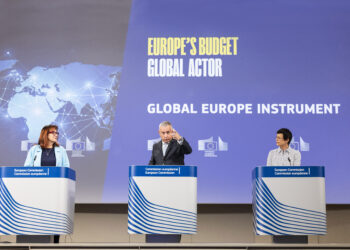
It would seem that the Global Europe fund wanted by the Berlaymont is going in this direction. This facility has a total budget of €200 billion, of which 42.6 billion earmarked specifically for enlargement (an increase of 37 per cent compared to the current budget of 31 billion).
All in all, Röpke’s assessment is positive: “I am pleased that an enhanced enlargement budget has been announced and, in general, I am satisfied with the toolkit of Global Europe,” he says. And reiterates that, as von der Leyen put it, enlargement “is not just a political objective but a strategic investment in the stability and prosperity of the whole continent.”
English version by the Translation Service of Withub