Brussels – Enlargement is a “strategic investment” for the Union, but the “precondition” for it to work is to engage civil society. This was said by Oliver Röpke, chairman of the European Economic and Social Committee (EESC), the EU’s advisory body in which the interests of workers’ organizations, employers’ organizations, the third sector and, in general, the demands of civil society organizations are represented. The Austrian, who has led the Committee since last year, insists that the integration of the candidate countries be “gradual,” allowing them to participate even before their formal entry into community life.
Civil society at the centre
At a press briefing on Tuesday (Oct. 22), Röpke explained his institution’s approach to enlargement, an issue destined to assume central importance in the coming years, starting with the institutional cycle that began with last June’s European elections. “We see enlargement as a strategic investment” and a “success story,” he told reporters, specifying that “the precondition” for achieving it properly is to “have an engagement of civil society and social partners” that is as structured as possible.
“The real problems,” the EESC president stressed, are to be found in the democratic “structures” in the candidate countries: for example, those “to protect the rule of law, to protect civic space, and to have a robust dialogue” between the social partners leading, among other things, to satisfactory collective bargaining. That is, we should “begin to strengthen these structures in the candidate countries as early as now,” even if their entry into the Union is later.
The gradual integration of candidate countries
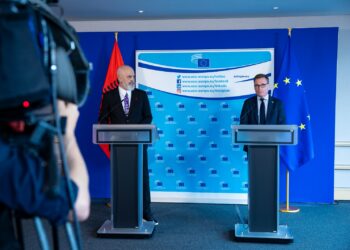
The solution, for Röpke, is what he termed “gradual integration“: allowing countries granted candidate status by Brussels to participate, as observers, in the workings of the Union, as is already the case, for example, with informal Council meetings. The EESC’s contribution to this movement of progressive inclusion took shape in the pilot project dubbed Enlargement Candidate Members (ECM), through which the Committee has engaged 146 civil society representatives from the candidate countries in its activities to help draft a dozen opinions concerning cohesion policy, the single market, sustainability, agrifood, and the rule of law, among other things. It is an initiative that is expected to end at the end of the year but has been much appreciated by those involved, as underlined by Albanian Prime Minister Edi Rama, according to whom this model should also be extended to the EU Parliament, and which Röpke has pledged to transform from extemporaneous to permanent.
This is the same path indicated by the chairwoman of the EU executive, Ursula von der Leyen, in the letters of assignment sent to the commissioners-designate: there “It is mentioned explicitly that each commissioner should promote the step-by-step integration of the candidate countries,” Röpke pointed out, which precisely coincides with one of the EESC’s main demands: “To see what each institution can do to integrate the candidate states step by step already before full EU membership.”
Progress toward membership
Different chancelleries among the nine in question (Albania, Bosnia-Herzegovina, Georgia, Northern Macedonia, Moldova, Montenegro, Serbia, Turkey, and Ukraine) would like to hit the goal of accession by the end of the decade, but it remains to be seen how their path will progress. For now, Röpke recorded “not only support from the social partners and civil society but also a great willingness on the part of at least some governments to commit” to “improve their structures” in order to “meet the criteria” for joining the European club. According to the EESC president, some of the best progress has been seen in Albania and Northern Macedonia (although Tirana and Skopje’s paths to Brussels have been recently unbundled). At the same time, there are close contacts with the Serbian government and civil society and Georgian civil society.
With regard to Moldova, a big problem—especially in some regions, such as Gagauzia—is the pervasiveness of Russian disinformation, which almost succeeded in letting the “no” vote win the popular referendum held last Sunday that questioned citizens on whether to include the goal of EU membership in the national constitution. In the end, the “yes” side prevailed, which, according to the head of the Committee, is a “remarkable achievement” given the predictions. However, there is “still a lot to be done” in the Balkan country to consolidate the democratic structures referred to.
This morning’s meeting served, among other things, as an opportunity for Röpke to present to the press the High-Level Forum on Enlargement that will be held next October 24 in Brussels under the sponsorship of the EESC (which will be in plenary session on October 23–24) and the Commission, where social issues that will be at the heart of the next season of expansion of the European club will be discussed with a range of politicians (from both candidate countries and member states), academics and civil society representatives. In turn, this event will anticipate the publication, by the EU executive, of the annual enlargement report (also known as the “Enlargement package”), which this year will fall on October 31.
English version by the Translation Service of Withub