Brussels – The agreement on tariffs between the EU and the United States, concluded on a razor’s edge before the dreaded 30 per cent tariffs threatened by Donald Trump came into effect, is “the best we could get” and certainly “much better than a trade war”. Word of Maroš Šefčovič, the EU’s Trade Commissioner, who puts on a brave face as he hails the beginning of a new era in transatlantic relations.
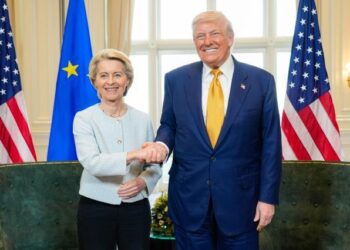
“If we had negotiated later, we would have sat at the table from a weaker position.” This sentence, uttered by Maroš Šefčovič, the EU executive’s member responsible for trade, sums up the political reading that the Commission wishes to give to the historic agreement reached yesterday in Scotland, sealed by a handshake between Ursula von der Leyen and Donald Trump.

Speaking to the press this morning (28 July), the long-serving Slovakian commissioner (in various roles, he has been in Brussels continuously since 2009) offered the journalists the Berlaymont spin, which essentially reflects the reactive approach followed by Brussels in the complex trade negotiations with the White House.
The tycoon’s tactic of constantly upping the ante (it started with 20 per cent, then more than doubled to 50, to
finish with 30) eventually paid off: “With a tariff of at least 30 per cent, our transatlantic trade would effectively grind to a halt, putting nearly five million jobs at risk” in the Old Continent, Šefčovič said.
Instead, the commissioner says, glossing over the fact that the EU was aiming for a 10 per cent flat rate, the agreement reached by the two leaders is beneficial to both sides, “brings a renewed stability and opens the door to a strategic collaboration” as a result of “months of sincere and unrelenting efforts, unparalleled in intensity and matched only by the unprecedented importance” of EU-US trade, worth some $1.700 million a year.
Šefčovič remarked that we now “understand each other and will inform each other much more frequently” with partners in Washington, emphasising that the understanding reached in Turnberry “should generate significant and mutual benefits, and I hope it will be a springboard for a broader trade and investment agreement” to be negotiated in the near future. For the time being, therefore, the measures agreed upon with the Twenty-Seven remain in mothballs.
But not all member states are in agreement in their praise of von der Leyen’s work. The Italian government is taking its time: “I judge positively the fact that an agreement has been reached,” commented Giorgia Meloni from Addis Ababa, stressing however that “we need to go and see the technical details” of the agreement, which will be put on paper in the coming days, and “verify what the exemptions are.”

Berlin—the chancellery that has been pushing hardest for a rapid agreement with Washington—is satisfied in principle with the outcome of the deal, which has made it possible to “avoid a trade conflict that would have hit the German economy hard,” notes Chancellor Friedrich Merz. However, executive sources note that “further negotiations are still needed” to reduce the 50 per cent tariffs still in place on steel and aluminium.
The governments of Denmark, Finland, Ireland, Romania, and Sweden also welcomed the deal, expressing relief that they had achieved at least a certain level of predictability in transatlantic trade relations. From Madrid, Prime Minister Pedro Sánchez says he appreciates the Commission president’s “constructive attitude,” yet expresses “unenthusiasm” about the agreement signed between the Scottish hills.
Other countries, however, are raining criticism on Brussels for its perceived weakness. From Paris, Prime Minister François Bayrou speaks of “a sad day” in which “an alliance of free peoples, united to affirm their common values and defend their common interests, resigns itself to submission.” For his Hungarian counterpart Viktor Orbán, Trump would not have “reached an agreement’ with von der Leyen but, instead, would have “eaten the president of the European Commission over breakfast.”
English version by the Translation Service of Withub