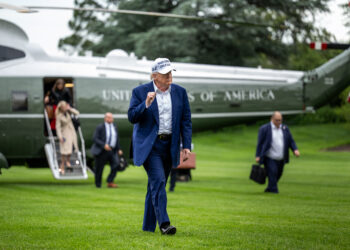
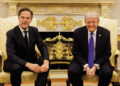
Brussels – The diplomacy has accelerated to try to put an end to the war in Ukraine. Over the past few days, leaders of various countries have met in a whirlwind of high-level meetings to define their respective negotiating positions ahead of eventual peace talks, which, however, are currently not in sight. Today, Volodymyr Zelensky and a group of European allies will meet with Donald Trump at the White House, three days after his face-to-face meeting with Vladimir Putin, to discuss mainly territorial issues and security guarantees for Kyiv.
These are busy days for international diplomacy, at least concerning the Russian-Ukrainian crisis that has dragged on since as far back as 2014 and since 2022 has escalated into all-out war with the invasion launched by Moscow. Late this afternoon (18 August), Donald Trump will welcome Volodymyr Zelensky into the Oval Office, with whom he will have a bilateral meeting before including a group of European leaders: French President Emmanuel Macron, Italian Prime Minister Giorgia Meloni, German Chancellor Friedrich Merz, British Prime Minister Keir Starmer, Finnish President Alexander Stubb, European Commission President Ursula von der Leyen, and Nato chief Mark Rutte.

Overnight, the US president again put pressure on his Ukrainian counterpart through a post on his Truth Social, claiming that the latter “can end the war with Russia almost immediately if he wants to, or he can continue fighting.” He also emphasized two key points of Moscow’s line: it will not be possible for Kyiv to either re-take the Crimean Peninsula – unilaterally annexed by the Federation in 2014 (in Trump’s narrative, “offered” by then US President Barack Obama) – or become a member of NATO.
The territorial concessions between the two belligerents and the security guarantees for Ukraine are two of the main issues on the table at today’s meeting in Washington. However, the positions of the United States and the Old Continent do not coincide entirely. The Europeans continue to mistrust Vladimir Putin and say they are ready to impose new sanctions against the Kremlin, as reiterated in recent hours by EU High Representative for Foreign Policy Kaja Kallas.
And they were clearly annoyed by the privileged channel opened last Friday (15 August) by Trump in Anchorage, Alaska, where he met his Russian counterpart in a bilateral meeting behind closed doors of enormous political and symbolic significance, recognized as much by supporters as much as by critics of the approach followed by the New York-based tycoon, seen as too condescending towards Moscow.

According to the White House special envoy, Steve Witkoff, the Tsar would be willing to consider concessions to Ukraine, including security guarantees that would mirror Article 5 of the North Atlantic Charter (NATO’s mutual defense clause), even without Kyiv joining the Alliance, as well as Ukraine’s accession to the EU.
However, as Secretary of State Marco Rubio emphasized, there is still a lot of work to do on the concrete terms of a potential peace agreement. The goal is a three-way meeting with Trump, Putin, and Zelensky at the same table, but it is unclear when that might happen.
Landing in the US, the latter reiterated that “it is Russia that must put an end to this war, which it started”, and that Kyiv needs strong and credible security guarantees to deter potential future aggression. Not like in 2014, “when Ukraine was forced to give up Crimea and part of our east, part of the Donbas”, or like in 1994, when the Budapest Memorandum was stipulated, committing Moscow not to attack the neighboring country in exchange for the return of Ukraine’s Soviet-era nuclear arsenal.
Today in Brussels, I outlined our positions on transatlantic unity, peace efforts, territorial issues, and security guarantees, including Ukraine’s EU accession.
It’s crucial that Europe remains as united as it was in 2022. This strong unity is essential to achieve a real peace. pic.twitter.com/PcT2CNgY8G
– Volodymyr Zelenskyy (@ZelenskyyUa) August 17, 2025
Over the weekend, the leaders of the coalition of the willing spoke with Zelensky via video link-up to coordinate a shared position. Yesterday, the Ukrainian president travelled in person to Brussels for a bilateral meeting with von der Leyen. “Ukraine must become a steel porcupine,” said the EU chief executive, picking up on a metaphor she has been using for months to highlight the need to “protect both Ukraine and Europe’s vital security interests.“
As for territorial concessions, which Zelensky continues to rule out (at least publicly), the Berlaymont number one emphasized that “international borders cannot be changed by force,” reiterating yet again that it is not possible to negotiate peace in Ukraine without Ukraine. And she announced a 19th package of sanctions against Russia, which the Commission would like to present in a few weeks.
English version by the Translation Service of Withub

![Il presidente dell'Ucraina, Volodymyr Zelensky (al centro) con il presidente del Consiglio europeo e la presidente della Commissione europea [Bruxelles, 6 marzo 2025]](https://www.eunews.it/wp-content/uploads/2025/03/euco-zelensky-250306-350x250.png)