Brussels – The tariff agreement that EU negotiators claimed should have given “predictability” to trade relations with the US seems to be on the verge of falling apart, just days after its presentation. The US President Donald Trump, in a post on his Truth Social last night, harshly criticized “digital taxes, legislation, rules, or regulations” that could become obstacles for “our incredible companies” in the digital sector and therefore threatened to impose tariffs on any country that imposes taxes on digital or sets regulatory limits on the operations of US technology companies.
“As the President of the United States, I will stand up to Countries that attack our incredible American Tech Companies. Digital Taxes, Digital Services Legislation, and Digital Markets Regulations are all designed to harm, or discriminate against, American Technology,” Trump wrote.
Trump did not attack the EU directly, but it is no mystery that his negotiators have done and are still doing everything to soften EU regulations such as the Digital Markets Act (DMA) and the Digital Services Act (DSA).
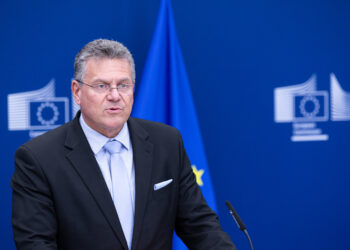
From Brussels, the answer comes from Paula Pinho, spokesperson for the Commission, who, when questioned by journalists, replies that “the Union has the sovereign right to regulate the economic activities that take place on its territory” and recalls that the DSA and DMA issues “are not part of the agreement” signed with the US. The spokeswoman insists that the agreement, despite Trump’s latest statements, “has brought stability and predictability” to the market, and we are now “working on the legislative proposal to put it into practice.” The proposal is expected to be presented, as confirmed, by the end of August.
The DMA aims to prevent large online platforms from abusing their market power; the DSA sets rules on how platforms should deal with harmful content and misinformation, “and neither of them targets any particular company. We don’t consider nationalities, look at the decisions we have taken on TikTok or Temu,” says a Commission spokesperson.
At its presentation on 21 August, the European Commission had explained that the joint declaration did not contain any commitments on EU digital regulation: “We made it clear to the United States that no changes to our digital regulation, i.e., to the Digital Markets Act and the Digital Services Act, were on the table,” a Berlaymont note stated.
“Trump has threatened ‘substantial tariffs’ and export restrictions against any country that decides to implement digital taxes or enforce European digital regulations and legislation. If anyone still had any doubts, it is now clear to everyone: no agreement was reached in Scotland, only a truce. And that truce is already broken,” said today Sandro Gozi, MEP for Renew Europe and secretary general of the European Democratic Party. According to the MEP, “the time has come for Europe to defend its interests seriously, going ahead with the full implementation of our digital legislation and activating without hesitation the anti-coercion tools.” The warning of the former undersecretary for European Affairs is that “the Union cannot afford ambiguity: our rules, our sovereignty, our future, and our freedom are at stake.”
English version by the Translation Service of Withub



![Da sinistra: il presidente del Consiglio europeo, Antonio Costa; il presidente dell'Ucraina, Volodymir Zelensky: la presidente della Commissione europea, Ursula von der Leyen [Bruxelles, 18 giugno 2024. Foto: European Council]](https://www.eunews.it/wp-content/uploads/2026/06/euco_ua260618-120x86.jpg)
![[foto: Saverio De Giglio/imagoeconomica]](https://www.eunews.it/wp-content/uploads/2026/10/cpt-120x86.png)