



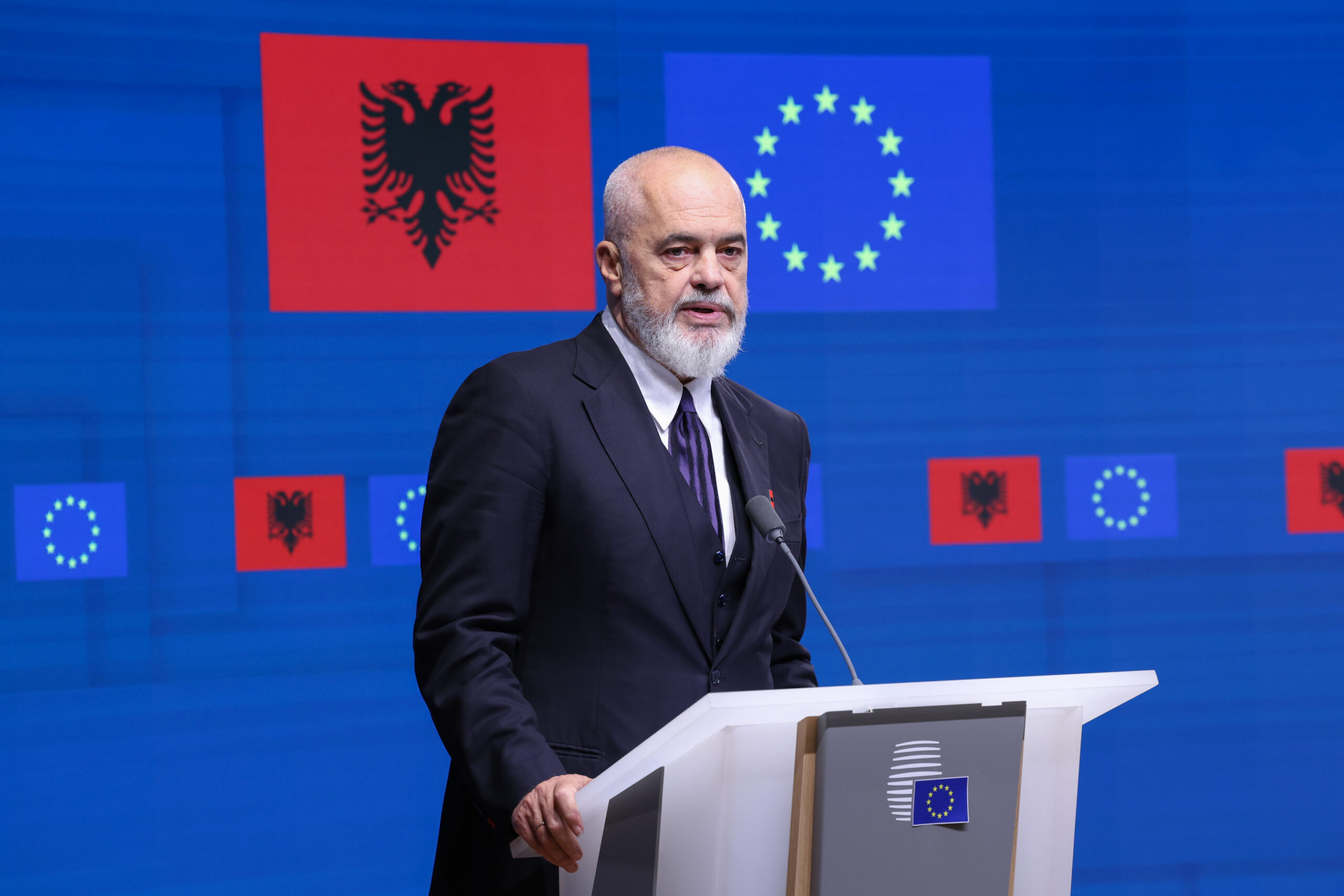
Brussels – Albania is making good progress in its quest for EU accession. Of course, there is still work to do, but according to the EU executive, the progress made by Tirana is “impressive.” Prime Minister Edi Rama aims to open the final negotiating chapters by the end of the year and close the technical work by the end of 2027.
The sixth EU-Albania Intergovernmental Conference took place this morning (16 September) in Brussels, in the presence of Prime Minister Edi Rama. Cluster number four (entitled “Green Agenda and Sustainable Connectivity” and containing four negotiating chapters) was officially opened today, thus bringing the number of clusters opened by Tirana to five out of six in just under a year for a total of 28 chapters out of the 33 that make up the acquis communautaire (the Union’s immense legal corpus, which the candidate countries must transpose into their domestic legislation).
Specifically, the chapters opened today concern transportation, energy, trans-European networks, and, finally, environmental protection and combating climate change. This leaves the five chapters of the fifth cluster (“Resources, Agriculture, and Cohesion“), which deal with, among other things, agriculture, rural development, food security, fisheries, and regional policies. Since October, Albania has already opened four clusters, in chronological order: Fundamentals, External Relations, Internal Market, and Competitiveness and Inclusive Growth.

Again, the hosts, Enlargement Commissioner Marta Kos and Danish Minister for European Affairs Marie Bjerre, were full of praise for the brisk pace with which the Social Democratic Prime Minister is implementing the pre-accession reforms, starting with the judiciary and the fight against corruption.
“The intergovernmental conference shows that the enlargement is proceeding and that the higher reforms are producing concrete results,” Bjerre emphasised when meeting journalists at the end of the proceedings. “You have done your part, and you deserve to have this recognized,” she remarked, addressing her guest, while conceding that “much work remains to be done” but reiterating that “an EU future with Albania is very important for all of us.”
Kos added that “Albania’s speed is impressive.“ According to the Commissioner, “the reforms we are demanding are not easy, but Albania shows that positive change is possible, and that the EU rewards positive change.” A message addressed to the other candidate countries, especially those where progress is slower. Like Rama, Kos is convinced that she will be able to close all negotiating chapters by the end of 2027. “It is not easy to open clusters, but it is even more difficult to close chapters,” she said, encouraging her host to “do everything” to meet this ambitious target.
The reforms that Tirana is committed to implementing with the opening of the fourth cluster, she continues, serve to “help make sure that Albania’s economic growth goes hand in hand with the protection of Albania’s remarkable natural wealth,” but also to “modernize roads, expand rail networks, and integrate Albania” fully with European mobility and connectivity systems. Finally, it will be about “promoting fair competition, expanding renewable sources, and strengthening energy security.”
Among the usual theatrics, Rama emphasized that, however difficult, reforms “are the only way” to enter the Union. “For the first time in our history, we can freely choose who we want to marry,” he continued: “We have been forcibly married to other empires in the past,” he pointed out, “but this is an empire we want to be part of, an empire of values, rights, and security.” And he concluded his series of flatteries by arguing that the EU is “the blessing of our country and others like us in the region,” since it “provides the tools to reinvent yourself as a nation, as a country, and as a state.” “We must love Europe with all our passion,” he added.
If everything keeps going this way, Albania and Montenegro will be the first to join the twelve-star club. On paper, Podgorica is ahead (it has opened all negotiating chapters and already closed seven). However, in recent months, Tirana has accelerated. At the moment of truth, however, some issues that seem overlooked for now could come to the forefront: such as the actual state of the rule of law (including judicial independence and media freedom), the opaque conduct of the last political elections, and respect for human rights as well as international law in the case of the controversial migrant centers built by Italy in Albania.
English version by the Translation Service of Withub





![[foto: Guillaume Baviere/WikimediaCommons]](https://www.eunews.it/wp-content/uploads/2026/01/Cuba_Che-120x86.jpg)
