




Brussels – More than a peace plan, it is an ultimatum to Hamas. The 20 points to end the conflict in Gaza that Donald Trump outlined last night (September 29) include all of Benjamin Netanyahu‘s war aims, with very few and vague guarantees for Palestinian self-governance in the Strip. However, at least the plan does not include the shocking ‘Riviera’ envisioned by Trump in February 2025, which would have been enough to receive the endorsement of European leaders and Arab countries. Now, the pressure is all on Hamas.
Immediate ceasefire, exchange of hostages held by Hamas for Palestinian prisoners in Israeli jails, massive entry of humanitarian aid, gradual withdrawal of the Tel Aviv army from Gaza, conditional on the demilitarization of the Strip, and a transitional government led by an international body, headed by Donald Trump himself. These are the steps outlined in the plan that the tycoon presented alongside Israeli Prime Minister Benjamin Netanyahu, a guest once again at the White House.
Netanyahu, deferential towards the “greatest friend Israel has ever had in the White House,” confirmed his support for a plan “that achieves our war aims.” A program that envisages no change of power in Tel Aviv, no clear indication for the handover between the body that will answer to Trump and the Palestinian Authority, nothing more than an indefinite horizon for a “credible path towards self-determination and the creation of a Palestinian state.”

The only passage that clashes with Tel Aviv’s objectives is the pardon – or a safe-conduct to third countries – granted to Hamas members “who will commit to peaceful coexistence and the surrender of weapons.” Trump then refuted the increasingly frequent statements by various Netanyahu government officials, who openly speak of the deportation of the Gazawi population: one of the points sets out the principle that “no one will be forced to leave Gaza, and those who wish to leave will be free to do so and free to return.”
The gradual withdrawal of the Israeli army from Gaza, on the other hand, leaves room for interpretation. Yes, the plan claims that “Israel will not occupy or annex Gaza”, but that the IDF will withdraw “based on standards, milestones, and timelines related to demilitarization that will be agreed” between the Tel Aviv army, the US, the Transitional Authority, and the ISF, a “temporary International Stabilisation Force” that is supposed to train the future Palestinian police force.
Even once there is a “complete withdrawal” from Gaza, the plan stipulates that Israel will maintain a “security perimeter presence that will remain until Gaza is properly secure from any resurgent terror threat.” Leaving Washington this morning, Netanyahu stated in a video released on his social channels that “the Israeli army will remain in most of the Gaza Strip.” The history of the region, even the very recent history, shows that Tel Aviv has occupied several Palestinian territories, as well as Lebanon and Syria, establishing “buffer zones” that have never been dismantled.
There is also some doubt on the transitional authority mandated to take control of Gaza until the Palestinian Authority has completed a “reform” program. It would be composed of “qualified Palestinians and international experts,” with oversight and supervision by a “Board of Peace,” which will be headed and chaired by Trump, with other members and heads of state “to be announced,” including Former Prime Minister Tony Blair, whose consultancy firm, the Tony Blair Institute for Global Change (TBI), has worked for several months on a development plan for Gaza on behalf of Washington.
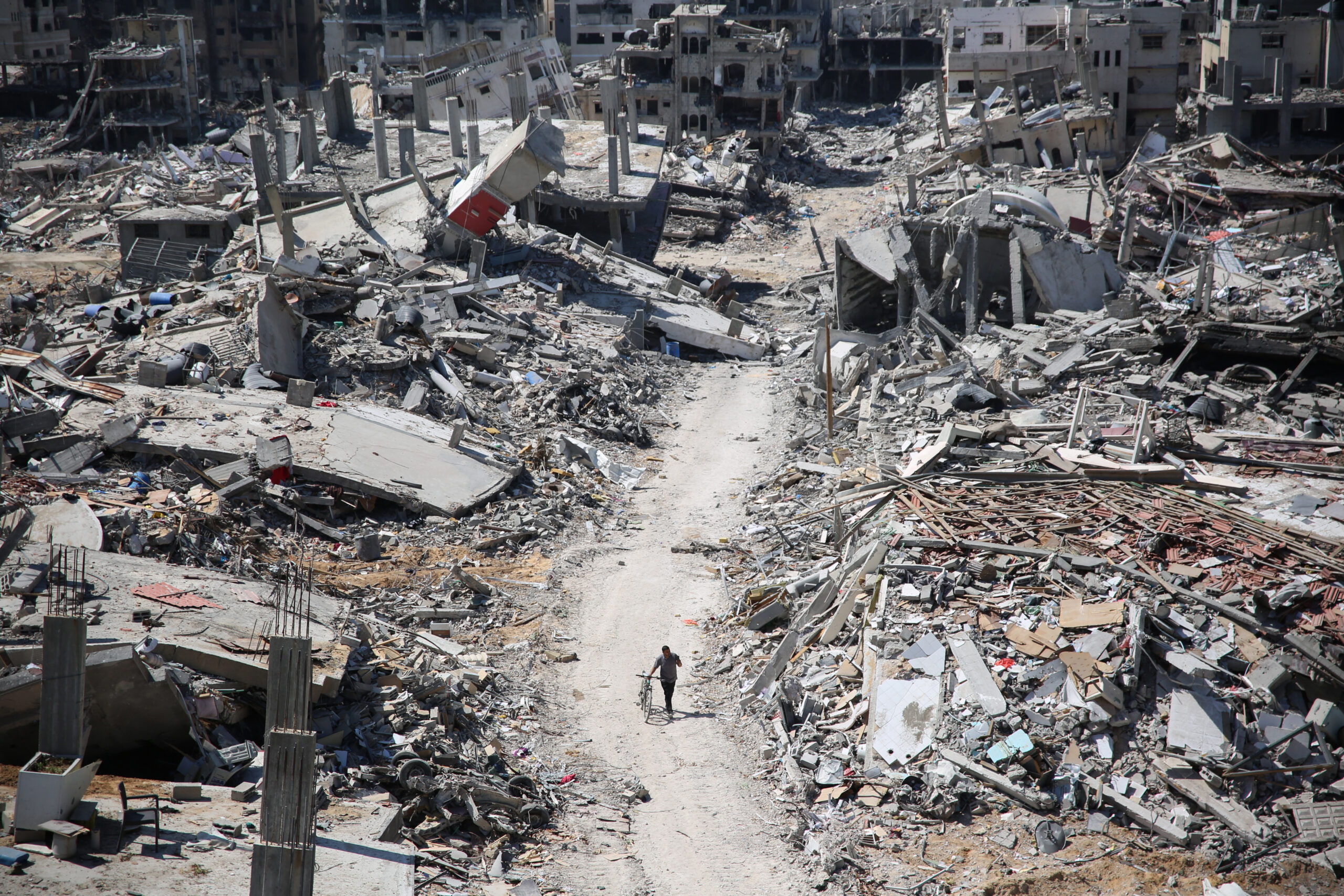
Israel reduced to rubble over half of the buildings in the Gaza Strip, including most of the critical infrastructure. To rebuild it, space would be given to a vague “Trump economic development plan,” drawn up by “convening a panel of experts who have helped birth some of the thriving modern miracle cities in the Middle East.”
Yet, European leaders immediately welcomed the plan, saying they were ready to “make their contribution.” The three EU foreign policy heavyweights spoke in chorus: Ursula von der Leyen and Antonio Costa “encouraged all parties to seize this opportunity now.” Kaja Kallas stated that “Hamas must now accept it without delay, starting with the immediate release of the hostages.” The governments of the United Kingdom, Germany, France, and Italy also gave their endorsement, as did the leaders of Saudi Arabia, Jordan, the United Arab Emirates, Qatar, Indonesia, Turkey, Pakistan, and Egypt, who said they were ready to cooperate with the US to ensure implementation.
Most of all, the support in principle of Doha, which in the complex and so far unsuccessful negotiations between Israel and Hamas acted as a counterbalance to the United States as mediator on behalf of the Palestinian terrorist group, is relevant. At least until Tel Aviv decided to bomb Doha on September 9 to eliminate some of the Hamas leaders, in defiance of the ongoing negotiations and Qatar’s territorial sovereignty. Yesterday, Netanyahu called the Emirate’s prime minister, Mohammed bin Abdulrahman bin Jassim Al Thani, “regretting” the death of a Qatari citizen in the raid and assuring that “Israel has no plan to violate your sovereignty again in the future.”
For Hamas to accept its capitulation, Qatar must necessarily be on board. However, doubts about the plan remain. As pointed out by the Green and Left Alliance MEP Benedetta Scuderi, on board the Global Sumud Flotilla, “it is difficult to imagine the outcome of the negotiations, not least because they are taking place without the participation of the Palestinian people and are being conducted by two leaders, Trump and Netanyahu, whose reliability and trustworthiness are very doubtful.”
English version by the Translation Service of Withub






![[foto: Guillaume Baviere/WikimediaCommons]](https://www.eunews.it/wp-content/uploads/2026/01/Cuba_Che-120x86.jpg)
