




Brussels – The eyes of the world are on Gaza. And then on to Egypt, to Sharm el-Sheikh. Passing through the Knesset, in Jerusalem. These are the main stages of a historic day, which began with the release by Hamas of the 20 Israeli hostages still alive, continued with the speech of the US President, Donald Trump, to the Israeli Parliament and will close with the peace summit in the famous tourist resort on the Red Sea. In addition to the leaders of 27 Arab and Western countries vying for a role in the future of the Strip, President of the Palestinian Authority Mahmūd Abbās will attend the summit. The Israeli Prime Minister, Benjamin Netanyahu, will not travel to Egypt.
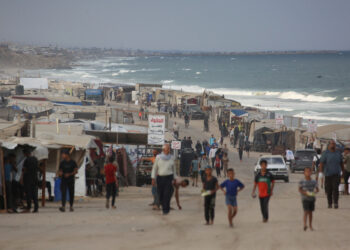
This morning, in two stages—about two hours apart—Hamas handed over to the Israeli army the 20 hostages still being held, the crux of the agreement signed last week. In the afternoon, the bodies of the 28 dead hostages are expected to be returned. In return, Israel released today some 250 Palestinian prisoners and 1,700 Gaza detainees imprisoned since 7 October. Meanwhile, humanitarian aid should finally reach the population in massive quantities: already yesterday, 173 truckloads of aid entered the Strip, according to the Gaza Health Ministry.

Donald Trump at the Knesset, Israel’s Parliament, 13/10/25. (Photo by SAUL LOEB / POOL / AFP)
The absolute protagonist can only be Trump, hailed by all Western and Arab leaders as the promoter of a peace that seemed unattainable. The tycoon planned a perfect choreography: landing in Tel Aviv in the morning, he met the families of the freed hostages before receiving an ovation from the Israeli Parliament. In the Knesset, the president stated that Israel “has won everything that could be won by force of arms” and that it is now time to translate the “victories against the terrorists” into peace and prosperity for the entire region.
At the summit in Sharm el-Sheikh, where the agreement on the first phase of the 20-point plan for Gaza will be celebrated, Trump and Egyptian President Abdel Fattah al-Sisi invited 27 leaders of Arab and Western countries. From the old continent, British Prime Minister Keir Starmer, French President Emmanuel Macron, German Chancellor Friedrich Merz, and Italian Prime Minister Giorgia Meloni have landed in Egypt. Spain’s Pedro Sanchez, Greece’s Kyriakos Mitsotakis, Hungary’s Viktor Orban and Cyprus’s Nikos Christodoulides have also confirmed their presence. In Brussels, the invitation was delivered to the President of the European Council, Antonio Costa.
Before leaving for the summit, Costa reiterated the EU’s willingness to contribute to the processes of transitional governance, recovery, and reconstruction to ensure the success of the “day after.” The President of the European Commission, Ursula von der Leyen, wrote in a post on X that the return of the Israeli hostages “means that we can turn the page” and emphasised that “Europe fully supports the peace plan brokered by the US, Qatar, Egypt, and Turkey.”

For the European Commission, “turning over a new leaf” could mean putting back in the drawer the proposals of suspending certain trade benefits to Israel and political sanctions against two Netanyahu government ministers. “If the context changes, this could eventually lead to a modification of the proposals,” admitted EU chief executive spokeswoman Paula Pinho. “But we are not there yet,” she specified, postponing an initial discussion to next week’s EU Foreign Affairs Council.
The High Representative for Foreign Affairs, Kaja Kallas, paid tribute to Trump, who “made this breakthrough possible.” Kallas announced that the EUBAM Rafah civilian mission will resume on 15 October, facilitating passage in and out of the Rafah border crossing point between Gaza and Egypt. The EU is also working on a possible expansion of the mandate of the EUPOL COPPS mission, through which it helps train Palestinian Authority police personnel.
Brussels has so far remained on the sidelines of the plan devised by Trump and former British Prime Minister Tony Blair. Yet, its leaders have supported it from the outset, immediately claiming the right to have a say given the efforts to support the Palestinian Authority—the EU has budgeted 1.6 billion for the period 2025-2027—and to bring humanitarian aid to the people of Gaza. Anouar El Anouni, spokesperson for the EU foreign affairs executive, admitted today that perhaps in the 20 points drafted by Washington, “we would like to see a greater role given to the Palestinian Authority and a clearer timetable towards the political horizon of the Palestinian state.”
In the second phase of the plan, which is to be signed and celebrated today at the summit in Sharm el-Sheikh, there is no lack of perplexities. Firstly, the question of who will form the International Stabilisation Forces, the international military presence initially planned in the Strip. Secondly, the future of Hamas, which seems unwilling to accept complete demilitarisation. Lastly, the thorny issue of the temporary governance of the Strip, on whose Governing Council, led by Trump, the aims of all Western governments are being focused.
Not to mention what is missing, for example, any mention of the responsibilities of the Israeli government, whose war against Hamas has killed at least 67,000 Palestinians and razed almost the entire Gaza Strip to the ground, including its critical infrastructure. While the European Union has been devising a plan for months to finance Ukraine’s reconstruction with the immobilised resources of Russia’s Central Bank, no one has so far proposed that Tel Aviv will bear the enormous costs of restoring a future to the Strip. “It is certainly an interesting question on which I have no comment to make at this stage,” the European Commission’s chief spokesperson glossed over.
English version by the Translation Service of Withub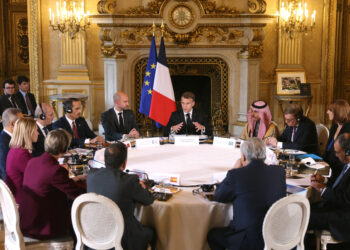



![La video riunione dell'Eurogruppo [27 marzo 2026. Foto: European Council]](https://www.eunews.it/wp-content/uploads/2026/03/eurogruppo-260327-120x86.jpg)
