



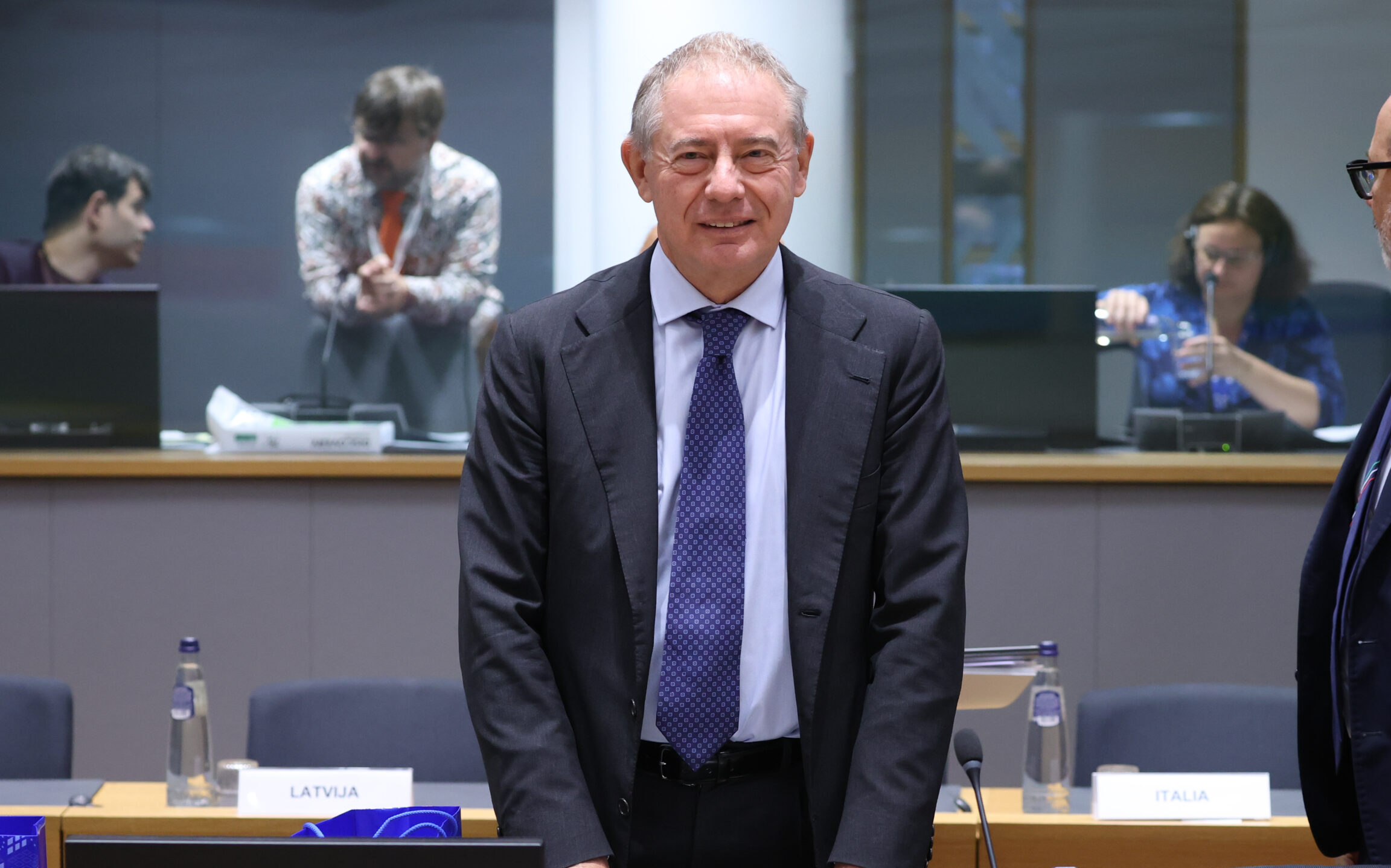
Brussels – Now that a breach has been opened in the EU Green Deal framework, Italy is determined to lead the dismantling front. “Europe is under siege; we are here to liberate it,’ proclaimed the Minister for Enterprise and Made in Italy, Adolfo Urso, in Brussels to meet six European commissioners and ask them for “radical reforms.” From the stop to internal combustion engines to the climate targets set by the EU, the revisionist fury invests the files on the green transition across the board, but above all aims at “removing the ideology that has stifled European industry and labour.”
The Italian government has been on the front line for some time, and has now found a valuable wingman in German Chancellor Friedrich Merz. The two leading manufacturers in Europe together lead “the reform front.” They showed this at last week’s European summit, where, according to Urso, “the will to change, to act now with determination, responsibility and strategic vision” finally emerged. From the automotive to the energy-intensive industries – “steel, chemistry, paper, glass, ceramics, and cement,” the minister listed – it is necessary to remove the “constraints and red tape” and “reconcile environmental sustainability with economic and social sustainability.”
After the European Council put in writing the principle of technology neutrality and called for flexibility and review clauses for the climate targets of the 27 member states, Urso wasted no time. He set off for Brussels with a packed agenda. Today, he will meet in a row the Vice-President of the EU executive in charge of technological sovereignty, Henna Virkunnen, the Vice-President in charge of cohesion, Raffaele Fitto, the Commissioner for Defence, Andrius Kubilius, the Vice-President holding the portfolio for industry, Stéphane Séjourné, and the Commissioner in charge of climate, Wopke Hoekstra. Tomorrow, on his return to Rome, the minister will finally meet Maroš Šefčovič, the European Commission vice-president responsible for trade.
There are many issues on the table: the automotive sector and the revision of the regulation that mandates an end to the production of petrol and diesel engines by 2035; the flexibility to guarantee to cut emissions by 90 percent compared with 1990 levels by 2040; and then the loosening of the rules for the CBAM — the Carbon Border Adjustment Mechanism — and for the ETS, the Emissions Trading System.
For Urso, it has “finally become clear that the Commission recognizes the value of technological neutrality, i.e., technological freedom.” A principle that Italy wants to interpret – as far as the automotive sector is concerned – by pushing for the use of biofuels, “which represent an advanced frontier precisely for the Italian production system.” On climate targets, the government’s line is that “the problem is not the targets, but how to reach them.” On the other hand, for Urso, such “targets, as they have been devised, are certainly part of the ideology.”
English version by the Translation Service of Withub





![La video riunione dell'Eurogruppo [27 marzo 2026. Foto: European Council]](https://www.eunews.it/wp-content/uploads/2026/03/eurogruppo-260327-120x86.jpg)
