Brussels – Yes to flexibility, but “limited.” European Commission President Ursula von der Leyen handed out the necessary concessions to keep the EU heads of state and government on board in order to maintain the ambitious target of a 90 percent reduction in emissions by 2040. In the end, the European Council confirms the commitment, provided it admits certain “enabling conditions,” including the possibility of using an “appropriate level of international credits” to reach the target and the inclusion of a revision clause along the way.
The debate on the the climate targets and the EU’s green agenda debate was decidedly heated at the leaders’ summit that ended late yesterday (October 23). Before leaving for Brussels, the Italian PM Giorgia Meloni had warned that she would not support the target unless it was accompanied by a “change of approach.” On his arrival, her Polish counterpart, Donald Tusk, said that “overly ambitious climate policies are a mistake and serve as fuel for extremists.” Before the summit, von der Leyen, who in July presented the amendment to the climate law that would set a target of a 90 percent reduction in emissions by 2040 compared with 1990 levels, urged in a letter to capitals consider the flexibilities included for in the proposal before rejecting the proposal.
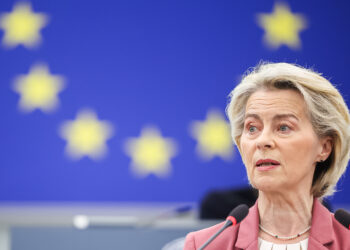
At a press conference on the sidelines of the proceedings, the EU leader seemed satisfied: “For us, the pathway to climate neutrality by 2050 was important. We are on track for 2030, and now we have to define how to reach the 2040 target in the most pragmatic but efficient way,” she explained. It means admitting that “the 27 Member States have different situations, so there is no one-size-fits-all solution,” and offering them “the possibility to reach the common goal by choosing outcomes in the most suitable sectors.”
The conclusions approved by the 27, which dictate the Union’s policy line, therefore state that “for such a fundamental transformation to succeed, it must be fair and just, pragmatic,
cost-effective and socially balanced, taking into account different national
circumstances, providing affordable solutions across the economy and for citizens
throughout the Union.” The leaders did not go much further than this shared principle, deferring discussion of the details to ministers at the forthcoming EU Environment Councils.
With regard to the possibility that the target could be achieved through a share of funding for emission-reduction initiatives in third countries — the Commission has proposed 3% — the 27 member states emphasized that the contribution of international credits must be “ambitious and cost-efficient.” And the revision clause should be foreseen “, in light of latest scientific evidence, technological
advances, and evolving challenges to and opportunities for the EU’s global
competitiveness.”
In addition to the passage on climate, the summit conclusions refer to the revision of the regulation to phasing out internal combustion engines by 2035, which will have to take into account technology neutrality and European content, but without specifying which fuels to allow.
English version by the Translation Service of Withub


![Da sinistra: il presidente del Consiglio europeo, Antonio Costa; il presidente dell'Ucraina, Volodymir Zelensky: la presidente della Commissione europea, Ursula von der Leyen [Bruxelles, 18 giugno 2024. Foto: European Council]](https://www.eunews.it/wp-content/uploads/2026/06/euco_ua260618-120x86.jpg)
![[foto: Saverio De Giglio/imagoeconomica]](https://www.eunews.it/wp-content/uploads/2026/10/cpt-120x86.png)