



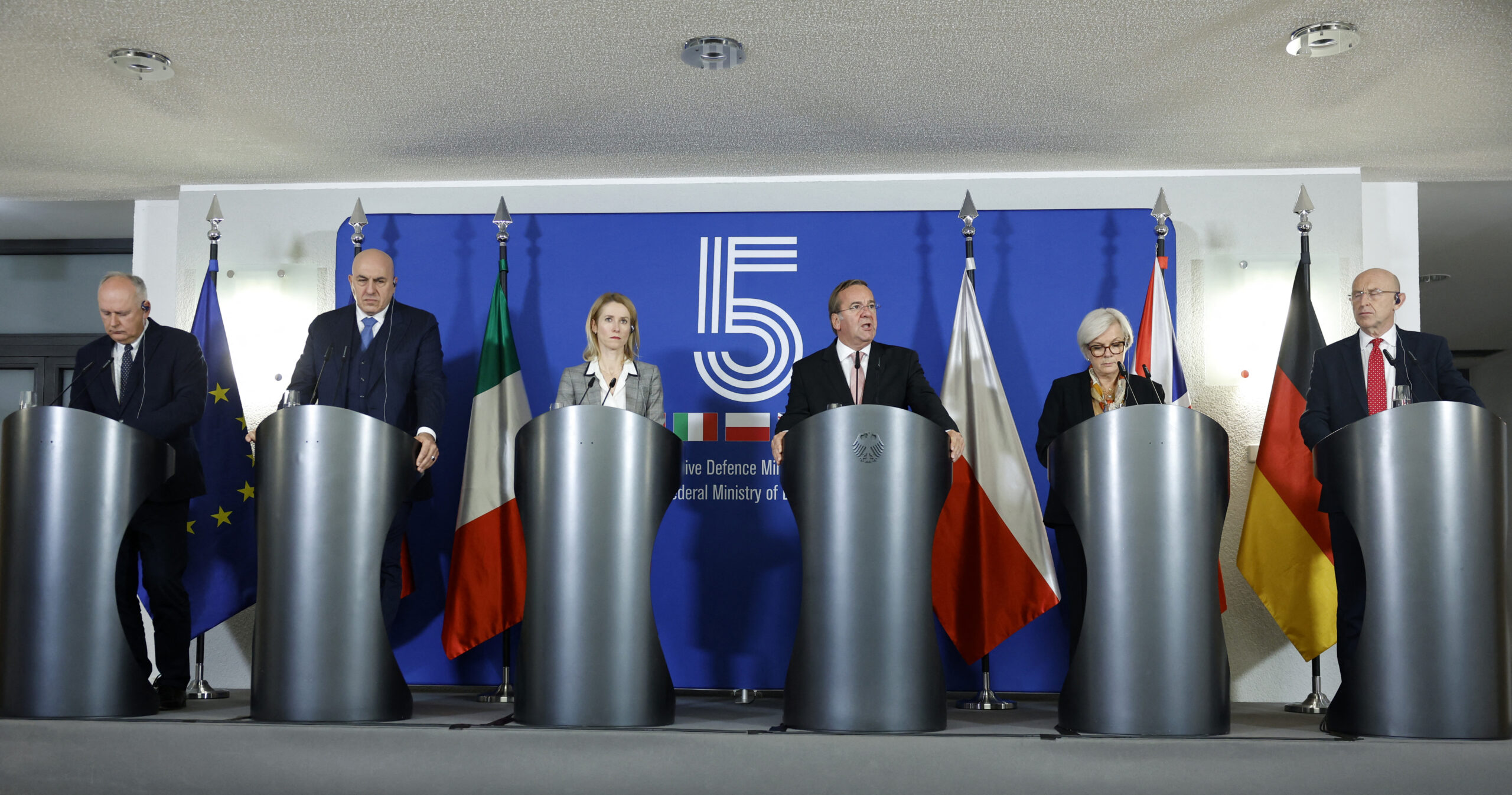
Brussels – Within hours of the new intense Russian attacks on Kyiv, the defence ministers of the United Kingdom, France, Germany, Italy, and Poland met in Berlin, together with the EU High Representative for Foreign Affairs, Kaja Kallas, to take forward the coordination inaugurated one year ago between the five countries that contribute most to the defence of the continent. Support for Ukraine was at the heart of the debate—against the backdrop of the corruption scandal raging in the country—but the E5 (this is the name of the format) wanted to send a strong signal about its response to increasingly frequent drone incursions into European skies.
“The latest attacks have made it clear: at the moment, Russia does not want to negotiate at all,” Kallas began at the press conference. The head of European diplomacy rattled off the issues on the table. The most urgent one, replenishing Kyiv’s now-empty coffers. “Ukraine will need additional funding next year. There are several options, but using immobilised Russian assets is the best way,” she made clear. The European Commission is then working on the twentieth package of sanctions on Russia—”our sanctions are hitting Russia where it hurts,” Kallas claimed—and next week will present a new plan for military mobility that will make the EU “able to move troops and military equipment where needed.” Finally, on the increase in hybrid attacks that “have become a daily occurrence,” the High Representative insisted that “we cannot accept this as the new normal.”

Boris Pistorius, German Defence Minister, said that the bombing of the Ukrainian capital shows Vladimir Putin’s “contempt for humanity.” With winter approaching—the fourth since the beginning of the aggression against Ukraine—Moscow seeks to “destroy the morale and break the will to resist” of the population, he added. Germany, Pistorius announced, will increase its support for Ukraine to over €11.5 billion in 2026.
Not only that, Berlin pledged to NATO Secretary General Mark Rutte to spend another €150 million on the PURL mechanism (Permanent Unified Resource Logistics) for the purchase of armaments from the United States: “We have a list of priority requirements for Ukraine. These are systems produced in the US that Ukraine urgently needs. For example, the Patriot system, including the necessary missiles,” Pistorius explained. Germany “delivered two new Patriot missile systems just last October,” he emphasised, “but unfortunately, it has to be said, technological development is also advancing and it is becoming increasingly difficult for Ukraine’s air defence to handle the large number of drones and cruise missiles.”
According to the German minister, Kyiv’s defence industry “is operating up to 25-30 per cent below its capacity” due to a lack of funding. Guido Crosetto, the Italian Defence Minister, also announced new aid to Ukraine: “We will deliver over 100 million in civil aid in the next month,” he said, confirming that the “twelfth military aid package” had been finalised in the meantime.
John Healey, UK Defence Secretary, assured that Her Majesty’s Army “will play an important role in defending both our homeland and our countries.” No reference was made to the friction with Brussels over London’s membership of SAFE, the EU’s 150 billion loan fund for defence spending. Rather, Healey emphasised that the UK has “responded swiftly to drone attacks” by seeking “experts in drone operations” in Belgium and Finland.
On drone incursions into European skies, views differ. For Catherine Vautrin, the newly appointed French Armed Forces Minister, one cannot name a culprit “until we are really sure who is responsible.” Her German counterpart, however, is certain that “the answer is easy.” If airports in Belgium are hit, “it has to do with frozen Russian assets,” most of which are held by Belgium.
“The scale of the challenges is immense,” Polish Pawel Zalewski finally admitted. Warsaw is on the eastern front line, and according to the provisional allocation of SAFE funds, will be the main beneficiary country, receiving €43.7 billion. But “all regions in Europe are affected,” Zalewski insisted, inviting the other four European defence “big names” to the sixth meeting of the E5 format, to be held in Poland at the beginning of the new year.
English version by the Translation Service of Withub





![La video riunione dell'Eurogruppo [27 marzo 2026. Foto: European Council]](https://www.eunews.it/wp-content/uploads/2026/03/eurogruppo-260327-120x86.jpg)
