




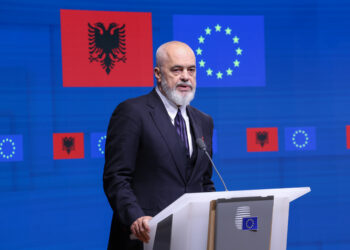
Brussels – Tirana continues to make good progress towards EU membership. In the space of just over a year, it has convinced Brussels to open all six so-called clusters of negotiating chapters. Today (17 November), it was the turn of the last one on agriculture and fisheries, food safety, and cohesion policies. “The real prize is their closure,” warned a beaming Marta Kos, EU Commissioner for Enlargement. “The next few years will be the moment of truth.”
The Albanian Prime Minister, Edi Rama, is keeping the bar high towards the 2027 horizon, the target set for concluding negotiations on all 33 negotiating chapters. Full membership in the 12-star club, as part of Rama’s plans, is expected to be achieved by 2030. The European Commission had noted only a few weeks ago in its annual report on Enlargement that everything depended “on maintaining the momentum of reform and promoting an inclusive political dialogue.”

Rama himself, on the sidelines of this morning’s inter-governmental conference, stressed that “these years have taught us to never take anything for granted in Brussels.” Albania has officially been an EU candidate country for more than a decade, dating back to 2014, when Rama was already leading the government in Tirana. After years of stalemate, “the last year was great, because it was rewarding, but without the previous years that were not, this year would not have come,” the Albanian prime minister said.
Since 15 October 2024, when the “Fundamentals” cluster was opened, negotiations on “external relations” began in December. The “internal market” and “competitiveness and inclusive growth” in the spring, and on the “green agenda and sustainable connectivity” in September. Today, the last one, cluster 5, on “resources, agriculture, and cohesion.”
In the meeting, the European Commission set the benchmarks for the provisional closure of the five chapters that belong to cluster 5: Rural Development and Agriculture, Food Safety, Veterinary and Phytosanitary Policy, Fisheries and Aquaculture, Regional Policy and Coordination of Structural Instruments, and Financial and Budgetary Provisions. “The next step for Albania is to meet the intermediate benchmarks,” explained Marta Kos. “It will not be easy, but you have something very powerful in your favour: the public support of Albanians and member states,” she added. As a rule, the European Council must unanimously endorse all steps on a candidate country’s path to accession.
“We will do everything we can to move forward with the same intensity, discipline, and commitment, to ensure that this joint project we are building, brick by brick, together with our partners in Brussels and in the Member States, does not come to a halt,” promised Rama, who has bet all his remaining political capital on EU membership.
Despite some shadows over the real health of the rule of law — including the independence of the judiciary and media freedom — as well as concerns about the fight against corruption and the opaque conduct of the latest political elections, Rama can rely on the European ambition of the overwhelming majority of the population. “A majority, like in the days of communism,” the prime minister said, “it was the same with the Ottoman Empire.” Because Albania — Rama concluded with a flourish toward Brussels — “is faithful to empires, and this (the EU, ed.) is the first empire we want to be part of.” Rama had already described it in the past as the “empire of values and rights.”
English version by the Translation Service of Withub
![La Commissione presenta il pacchetto allargamento 2025 [Bruxelles, 4 novembre 2025]](https://www.eunews.it/wp-content/uploads/2025/11/allargamento-25-350x250.png)






![[foto: Guillaume Baviere/WikimediaCommons]](https://www.eunews.it/wp-content/uploads/2026/01/Cuba_Che-120x86.jpg)
