




From the Correspondent in Strasbourg – The European Parliament reflects on Donald Trump’s drive to end the conflict in Ukraine. The President of the European Commission, Ursula von der Leyen, draws the red line of the EU bloc: “Nothing about Ukraine without Ukraine. Nothing about Europe without Europe. Nothing about NATO without NATO.” A principle that seems to have been recognized during
the debate in the restricted talks between Kyiv and Washington in Geneva. “I believe there is also an opportunity here to make real progress,” the EU leader confirmed.
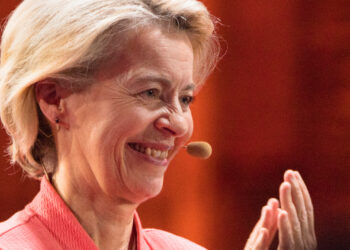
Von der Leyen opened the debate in the Strasbourg hemicycle this morning (26 November) on the EU’s position and role in the Ukraine peace plan, which was added at the last minute to the agenda of the European Parliament’s plenary session in light of the White House’s mediation initiative. She began by citing “the storm of Russian drones and missiles that rained down” on Ternopil, a Ukrainian town “closer to the Polish border than to Kyiv,” which killed 34 Ukrainian citizens and wounded a hundred. “A mindless and callous act of brutality,” von der Leyen attacked. Beyond diplomatic efforts, “this is the daily reality,” she insisted.
In the face of Trump’s “softness,” having put forward a 28‑point document that seemed drafted directly with Moscow, von der Leyen calls for remaining vigilant. “We have to keep up the pressure,” because “Russia’s playbook has not changed: every time there is serious progress towards negotiations, the violence escalates.” However, the president of the EU executive still pays her dues to the American president, who had the merit of “starting work on a text.” A step that Brussels has failed to take in three and a half years of war.
” I believe – thanks to the work of Ukraine, the United States, and us Europeans over the last few days in Geneva – we now have a starting point,” von der Leyen told MEPs. But without granting any concessions to Putin and Russia, whose imperialist mindset “has not changed since the days of Yalta.” Von der Leyen pointed out the four European priorities to be reflected in the peace plan. The first is that “any agreement should deliver a just and lasting peace. And it should ensure real security for Ukraine and Europe.” And therefore, there can be “no limitation on the Ukrainian armed forces” (Trump’s plan set a limit of 600,000). Not only that, Ukraine ” needs robust, long-term and credible security guarantees as part of a wider package to dissuade and deter any future attacks from Russia.”
The guarantees hinge on territorial integrity and the involvement of the EU and NATO in protecting the sovereignty of the partner attacked by Moscow. “If today we legitimise and formalise the undermining of borders – we open the doors for more wars tomorrow,” von der Leyen insisted. No backtracking on Kyiv’s future either: “Sovereignty also means being able to choose your own future. Ukraine has chosen a European destiny.”
Then there is the hurdle of financial coverage to be guaranteed to a state worn down by three years of conflict. About EUR 140 billion is needed for the next two years. Despite the latest developments on the diplomatic level, the Commission “is ready to present the legal text” for the use of frozen Russian assets on European territory. “To be very clear – I cannot see any scenario in which the European taxpayers alone will pay the bill,” von der Leyen made clear to roaring applause in the Chamber.
The final priority to be included in any potential agreement with Moscow, on which the EU has long been working and to which the president has personally committed herself since the start of the conflict, concerns the “tens of thousands of boys and girls” abducted from Ukraine by Russia. “There are thousands of mothers and fathers who have never stopped hoping and never stopped fighting to bring their children back. And Europe will never give up in helping to make that happen,” promised the EU leader.
English version by the Translation Service of Withub
![L'Alta rappresentante per la Politica estera e di sicurezza, Kaja Kallas, alla conferenza annuale dell'EDA [Bruxelles, 28 gennaio 2026]](https://www.eunews.it/wp-content/uploads/2026/01/kallas-eda-260128-350x250.png)





![[foto: Guillaume Baviere/WikimediaCommons]](https://www.eunews.it/wp-content/uploads/2026/01/Cuba_Che-120x86.jpg)
