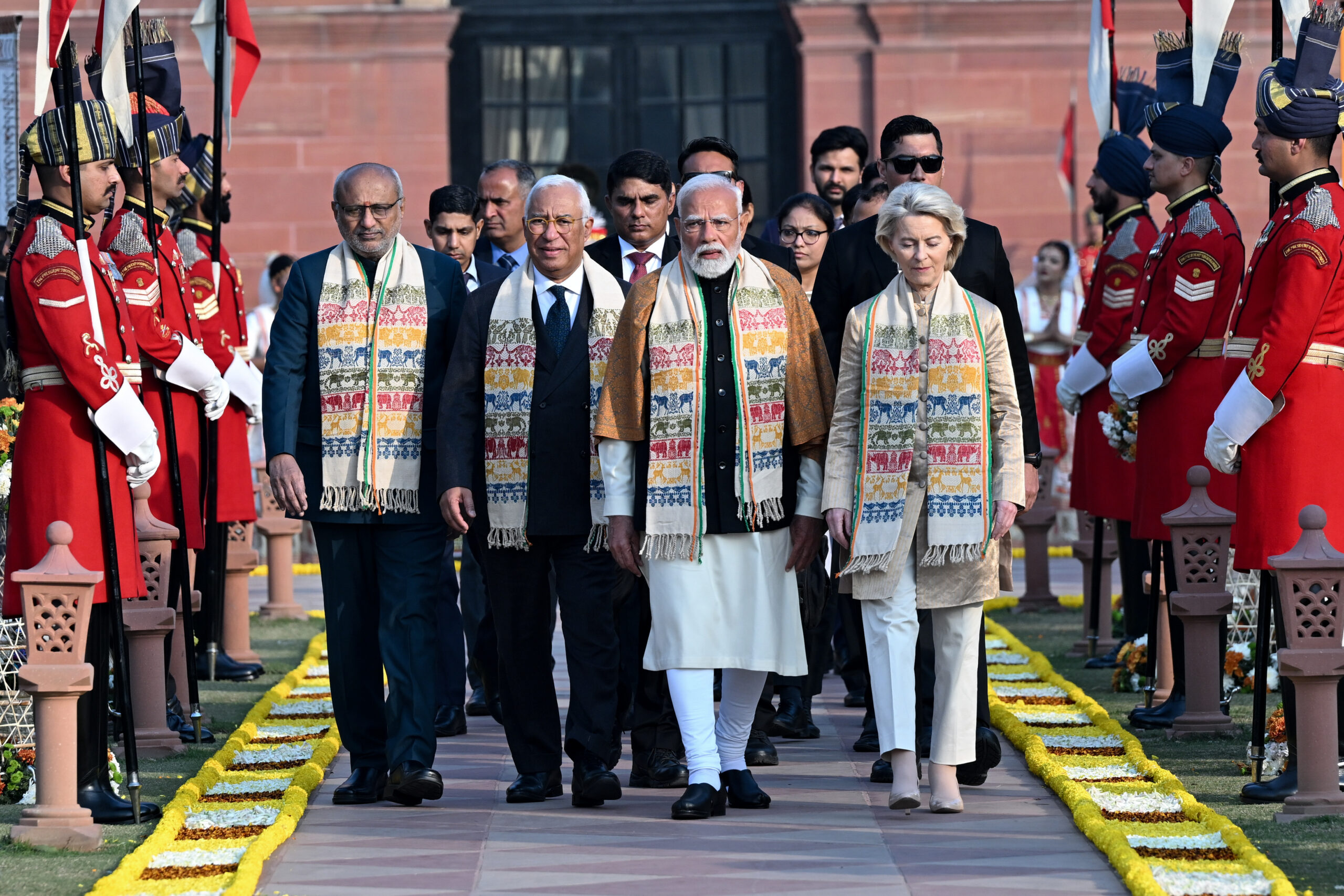
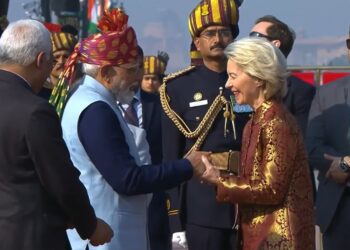
Brussels – Beyond the obstacles of the Mercosur deal and beyond Donald Trump’s global tariffs, the European Union plays its trump card and reaches a political agreement — after nearly twenty years of negotiations — with India to establish a free‑trade area covering almost 2 billion people. In New Delhi, Ursula von der Leyen, Antonio Costa, and Indian Prime Minister Narendra Modi are changing the coordinates of international trade and sending a message to the world (and to Washington): “Rules-based cooperation still delivers great outcomes.”
While talks on an EU-India trade agreement have been ongoing since 2007, there is no denying that Trump’s return to the White House has accelerated negotiations. Von der Leyen has chosen to respond to American tariffs with liberalisation measures involving emerging economies. Indonesia, the four Mercosur countries, and now India. The agreement with New Delhi could be a real game changer, “the mother of all deals”, as the President of the European Commission has described it.
We are talking about the two “largest democracies in the world”, the “second and fourth” largest economies in the world. In short, “two giants”, said von der Leyen. The 27 EU countries and India already trade goods and services worth more than 180 billion euros a year, and, according to European Commission estimates, the trade agreement will “double EU goods exports to India by 2032.” At a time when ” trade is increasingly weaponised,” the EU leader stressed, “this agreement will build on the natural complementarity of our economies.” The EU brings “technology, capital, and innovation” to the table, while India brings “skills, services, and scale.”

Brussels secures privileged access to the world’s most populous country, with nearly 1.5 billion inhabitants, and a rapidly growing economy with an annual GDP of 3.4 trillion euros. “This is the most ambitious trade opening that India has ever granted to a trade partner.” The aim is to gradually eliminate customs duties on 96.6 per cent of EU goods exports, which “will save around 4 billion euros per year.”
The exact figures will be finalised in the coming months at a technical level, but New Delhi has agreed to gradually reduce tariffs on European cars from 110 per cent to 10 per cent, and to abolish them completely for spare parts within a maximum of ten years. Tariffs on machinery, chemicals, and pharmaceuticals will also be largely eliminated within a decade. In return, the EU will facilitate imports from India, particularly steel, textiles, and pharmaceuticals.
A separate chapter is devoted to agriculture. Given the strong backlash over opening the single market to South American products, this time von der Leyen has proceeded with extreme caution. In this context, the agreement will not affect current tariffs on “sensitive” products, such as beef, rice, chicken, milk powder, honey, bananas, soft wheat, garlic, and ethanol. Furthermore, sugar, on which the economies of the former French colonies heavily depend, is also left out. Instead, the EU will open up to “calibrated quotas” for imports of sheep and goat meat, sweet corn, grapes, cucumbers, dried onions, molasses-based rum, and starches. Brussels pointed out that “all products imported from India under the agreement will have to comply” with European standards on human, animal, and plant health.
On the other hand, the potential for European agri-food exports is clear: tariffs on wine will fall from the current 150 per cent to 20-30 per cent, those on olive oil from 45 per cent to zero after five years, and those on pasta, bread, and confectionery will also fall. The European Commission has specified that the agreement includes a bilateral safeguard mechanism, to be activated – sector by sector – “in the unlikely event” of market disruption. At the same time, the EU is pushing for a separate agreement, still under negotiation, on geographical indications to eliminate unfair competition in the form of imitation.
There is still a long way to go before the agreement actually enters into force. To proceed with the signing, von der Leyen will need to obtain the green light from EU capitals by a qualified majority. At that point, ratification will pass to the European Parliament. This is perhaps the most delicate and unpredictable step, given the variable majorities in the Strasbourg chamber. This is the lesson from Mercosur.
English version by the Translation Service of Withub
![[foto: Dietmar Rabich/Wikimedia Commons, 2018]](https://www.eunews.it/wp-content/uploads/2026/01/zucchero-350x250.jpg)

![Da sinistra: il presidente del Consiglio europeo, Antonio Costa; il presidente dell'Ucraina, Volodymir Zelensky: la presidente della Commissione europea, Ursula von der Leyen [Bruxelles, 18 giugno 2024. Foto: European Council]](https://www.eunews.it/wp-content/uploads/2026/06/euco_ua260618-120x86.jpg)
![[foto: Saverio De Giglio/imagoeconomica]](https://www.eunews.it/wp-content/uploads/2026/10/cpt-120x86.png)