



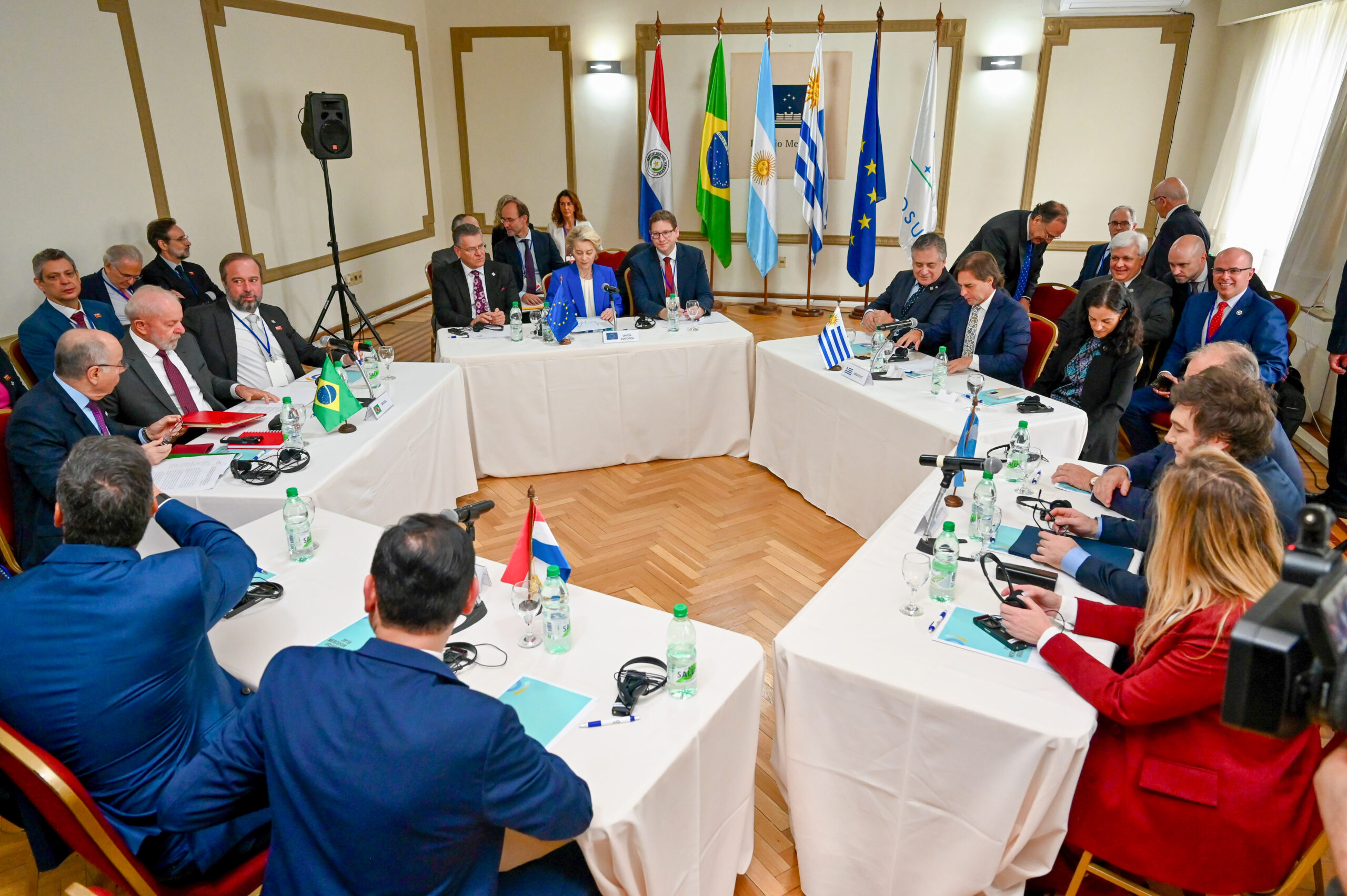
Brussels – No drama, no defeat. The trade agreement with the Mercosur countries (Argentina, Brazil, Paraguay, Uruguay, plus Venezuela, currently suspended) simply needs a bit more time to do things properly and avoid jeopardising a deal reached after a decade of negotiations. The heads of state and government of the EU countries had the opportunity to discuss the dossier during the debate on geo-economics,a topic addressed at the last European Council summit of 2025 (yesterday and tonight in Brussels), which has postponed the customary celebrations until the New Year.
“We need a few extra weeks to address some issues with Member States,” acknowledged the President of the European Commission, Ursula von der Leyen, at the end-of-summit press conference. “We have reached out to our Mercosur partners and agreed to postpone slightly the signature,” originally scheduled for 20 December. The last-minute cancellation of the appointment, however, does not mean that it is drifting off. On the contrary, there is the intention to move forward; von der Leyen has no doubt that allowing more time “will pave the way for a successful completion of the agreement in January.”
Despite the changes introduced by the European Commission to the EU–Mercosur agreement, including safeguard clauses and automatic brakes on flows in the event of market imbalances, resistance persists from France and even more so from Italy, under pressure from their own agricultural sectors. Prime Minister Giorgia Meloni, at the end of the proceedings, nevertheless expressed her readiness to sign the agreement. “We are working to postpone the Mercosur summit, which gives us three weeks to try to give the answers that are requested by our farmers, the safeguards for our products, and allow us to approve the agreement when we have all the guarantees requested by a sector that would be affected.”
Italy is therefore putting on the brakes but not vetoing, and on the contrary is working to further fine-tune an agreement “of crucial importance for Europe economically, diplomatically, and geopolitically,” von der Leyen insists. She does not name names, but limits herself to recalling a 2025 marked by “tariff increases and new trade restrictions,” in the face of which the EU-Mercosur agreement delivers a “positive impact.” Translated: it is a response to the policies of Donald Trump in the US and of China.
The EU-Mercosur agreement should be viewed in this light, and it is in this light that the Commission, negotiating on behalf of all 27 member states, has managed the not easy talks with the bloc of South American countries, proving itself adept at seizing the political opportunity of the moment (in Brazil, at the time of the signing, there was no longer the ultra-conservative Jair Bolsonaro but the Labourist Lula, ed.) After the agreement with Canada, which allowed the EU to gain a foothold in the NAFTA area, now UMSCA (following the entry of Mexico, with which the EU has signed a free trade agreement), the agreement with Mercosur also positions the EU in South America, an area traditionally of US interest. It is no coincidence that the US, and Trump even more specifically, are declaring war on the EU.
Trump was already the US president when, in 2017, the EU entered the US-Canada free trade area through the deal with the Ottawa government, and it was in anticipation of Trump’s return to the White House that von der Leyen and her team pushed to close the deal with the Mercosur countries. In this way, the European Union is repositioning itself and expanding its presence worldwide. Not torpedoing the agreement is also good news for the EU’s credibility: sinking the Mercosur deal would mean undermining and delegitimising the Commission, diminishing its authority and its political, institutional and negotiating weight.
While farmers are on the warpath, the agreement with Mercosur is well-received by businesses. It is no coincidence that BusinessEurope, the confederation of European Confederations of European Industries, “regrets the decision to postpone the signing of the agreement,” complains the secretary general of the European Association of Industrialists, Markus Beyrer. For the secondary sector, “the EU-Mercosur agreement is crucial to strengthen the competitiveness and strategic autonomy of the European Union,” he emphasised. “In a geo-economic context increasingly characterised by uncertainty, it is essential to diversify trade relations and offer new opportunities to European companies, in particular SMEs.”
English version by the Translation Service of Withub




![[foto: Guillaume Baviere/WikimediaCommons]](https://www.eunews.it/wp-content/uploads/2026/01/Cuba_Che-120x86.jpg)
