

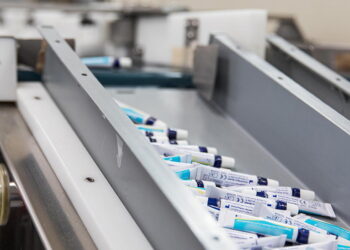
Brussels – Tariffs of 100 percent on imported drugs and medicines, effective as of 1 October. The president of the United States, Donald Trump, returns to threaten new additional tariffs, which could also affect the European Union. Brussels, for now, is projecting confidence. It is understood in the European Commission that “the United States intends to ensure at an early stage that the tariff rate applied to EU-originated pharmaceuticals, semiconductors, and timber does not exceed 15 percent,” said Olof Gill, the spokesman responsible for trade matters.
There is, however, one aspect that remains unclear at this stage, and that is being acknowledged softly in Brussels: whether Trump’s announcement is related to the conclusion of the ongoing trade reviews Section 232 of the 1962 Trade Expansion Act gives the US president broad discretion on tariffs if it is deemed that imports from other countries “threaten to compromise” national security. A review under Section 232 was underway regarding the EU, and the services of the EU executive could not confirm whether these verifications had been completed or not.
Essentially, it can be inferred, based on the agreements reached with the United States and even more so on the joint statement, that the EU will not be affected by tariffs on drugs and medicines. However, it is indeed an assumption, which says a lot about how and to what extent the EU has negotiated with the US administration and how reliable and trustworthy the White House occupant is. Brussels is trying to keep a straight face, thinking in terms of business as usual. Having received no explicit communications, “the EU and the US remain committed to the implementation of the commitments of the Joint Declaration,” continues Olof Gill, assuring that, at the same time, the two sides are “exploring further areas for tariff exemptions and broader cooperation” on trade.
Trump’s announcements are not causing concern, as evidenced by the fact that the focus is on the benefits of the deal. The comprehensive 15 percent tariff cap on EU exports, including the pharmaceutical sector, “represents an insurance policy ensuring that higher tariffs will not be imposed on European businesses,” unless, of course, the US reviews show otherwise.
English version by the Translation Service of Withub

![Da sinistra: il presidente del Consiglio europeo, Antonio Costa; il presidente dell'Ucraina, Volodymir Zelensky: la presidente della Commissione europea, Ursula von der Leyen [Bruxelles, 18 giugno 2024. Foto: European Council]](https://www.eunews.it/wp-content/uploads/2026/06/euco_ua260618-120x86.jpg)
![[foto: Saverio De Giglio/imagoeconomica]](https://www.eunews.it/wp-content/uploads/2026/10/cpt-120x86.png)