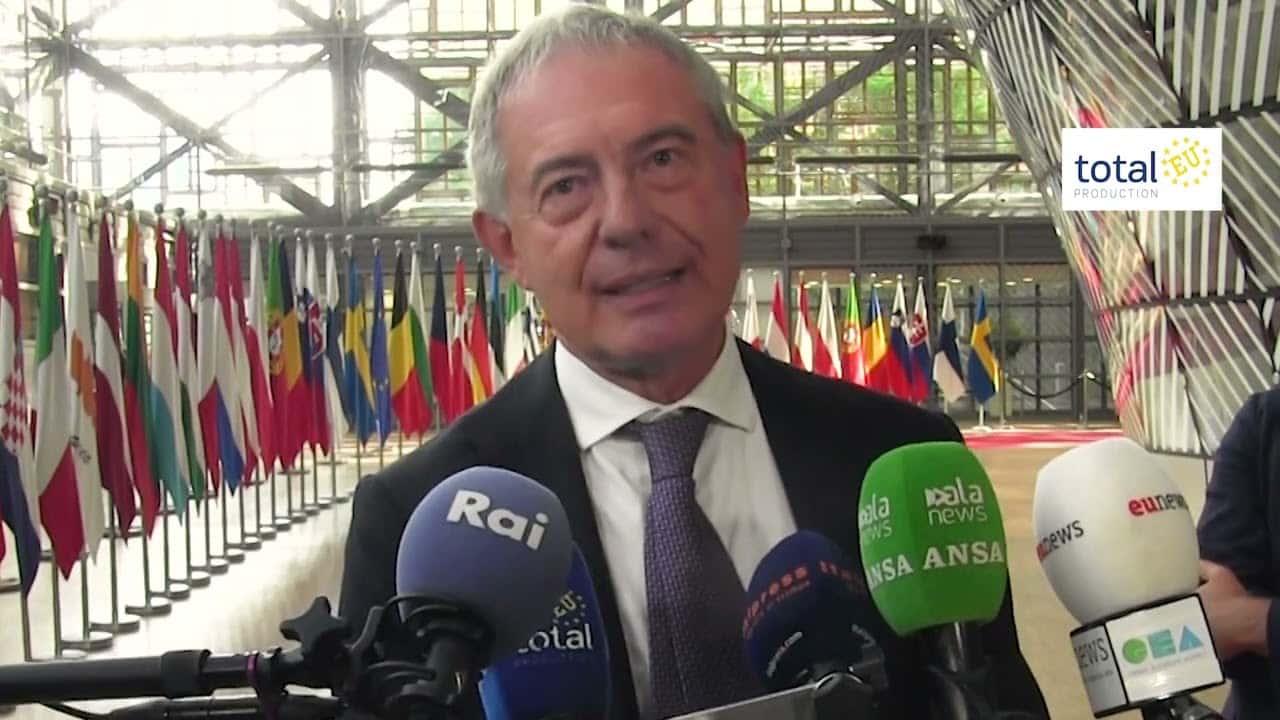
Brussels – The trade agreement between the European Union and Mercosur countries—Argentina, Brazil, Paraguay and Uruguay—must come into force as soon as possible, because Italy, the world’s fourth-largest exporter, has always benefited from market openings. The Minister for Enterprise and Made in Italy, Adolfo Urso, has no doubts: the path forward for Europe is to protect production while, at the same time, establishing powerful new trade relationships.
In Brussels for a two-day institutional mission, Urso met with the Italian delegation to the European Parliament to discuss the main issues under discussion—automotive, CBAM, competitiveness, regulatory simplification, and strategic autonomy —with the aim of promoting the definition of a shared Italian position on the most relevant issues on the European agenda. This was an opportunity for dialogue aimed at strengthening coordination between the Italian government and European parliamentary representatives at a decisive moment for the future of the Union. “2026 will be a year of reforms in Europe, and Italy can play a leading role in the decisions that will determine the future of our continent. We need a clear and pragmatic approach, without ideological rigidity, which Italy is ready to put forward in order to combine transition and industrial competitiveness,” he said when meeting reporters at the European Parliament.
Tomorrow, Urso will meet with the executive vice-president of the Transition Commission, Teresa Ribera, for “the last of the meetings” because “the final loan granted and voted on by Parliament in the ex-Ilva decree needs to be authorised.” To this end,” he pointed out, “I have a meeting, which I hope will be decisive, with Commissioner Ribera.”
For Urso, the trade agreement between the European Union and Mercosur “must come into force as soon as possible.” “We cannot delay. Other global players are moving at an unexpected speed and, in this disorder and global chaos, with Europe surrounded by armed conflicts and trade wars, Italy, together with other players such as Germany, France, and the other major founding countries, must steer our common Europe on a safe and stable course beyond the stormy seas,” he added, emphasising his hope that other agreements will be made “as soon as possible with the Emirates, the Gulf Cooperation Council, Indonesia, and other Southeast Asian countries.”
Essentially, according to the minister, “Europe must work to protect domestic production and the internal market, but at the same time also open up new markets.” Therefore, the conclusion of the negotiations with India today is also a positive development. “Italy, a major exporter and the fourth largest exporter in the world, and Germany, which is still the leading exporter in Europe, have the same interest in opening up new markets, as was done with Mercosur, which is very important and significant because it is capable of receiving the demands and products of our continent and our country, and this morning with the agreement reached by the European Commission with India, creating the world’s largest market with two billion people,” he added. “This is the path we want to take: on the one hand, to protect industry, production, and the internal market from unfair competition in order to safeguard adequate levels of employment and the well-being of our families and our citizens, and at the same time to open up new markets because we know that Italy has everything to gain and that it must come into force as soon as possible,” he pointed out.
In particular, regarding the agreement between Brussels and New Delhi, Urso points out that it is too early to make assessments, but the path is promising. “We have only seen a few statements so far; we need to see the documents, analyse them with our business associations, and discuss them with the government and other European colleagues. A process has begun, but it is heading in the right direction,” he said. “We still need to see the details, and there will certainly be room for improvement. However, agricultural production on both sides has already been set aside by mutual agreement. As for certain Italian products, including agricultural products such as wine and oil, important markets are opening up, especially for our mechanical engineering sector, which is our main export item,” he noted.
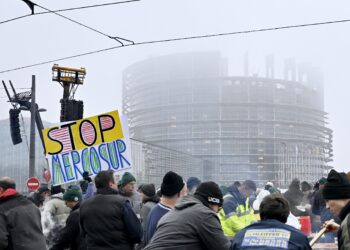
Finally, with regard to the strong criticism from the agricultural sector of the agreement with Mercosur, Urso reiterates that “Italy is a country that always benefits from the opening of markets,” as “demonstrated by other agreements that have been successfully negotiated,” such as “the one with South Korea and, before that, with Chile, but also the results of the agreement with Canada.” Therefore, “I think everyone understands how important it is to open Mercosur to Italian products, Italian agri-food products, and geographical indications that are finally recognised.” He reassured: “We have an interest in opening up markets, obviously under conditions that are not penalising,” and “this is happening with Mercosur, it will happen even more with India, and I think that a policy can be developed that will finally restore a role to our Europe,” he continued.
English version by the Translation Service of Withub
![[foto: Dietmar Rabich/Wikimedia Commons, 2018]](https://www.eunews.it/wp-content/uploads/2026/01/zucchero-350x250.jpg)