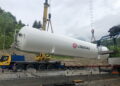
![Nave per il trasporto di Gnl [foto: Wikimedia Commons]](https://www.eunews.it/wp-content/uploads/2024/01/LNG_ship.jpg)
Brussels – The European Commission published today (2 February) in the Official Journal the regulation providing for the definitive abandonment of Russian gas by autumn 2027. To replace it, the EU has turned to US LNG. Due to Donald Trump’s trade threats to some member states—and the concerned statements of some European commissioners—Brussels is questioning the risk of becoming stuck in a new energy dependency with an unreliable partner.
The Executive Vice-President of the European Commission, Teresa Ribera, admitted in recent days that the EU “is significantly increasing its dependence on LNG imported from the United States.” Energy Commissioner Dan Jørgensen was more explicit, calling the clash over Greenland “a wake-up call.” Speaking to a group of international media outlets, he explained: “When I talk to energy ministers and heads of state across Europe, I clearly sense a growing concern, which I share, that we risk replacing one dependency with another.”
Before Russia’s invasion of Ukraine, the EU imported 45 per cent of its total gas imports from Moscow. In 2024, this figure will be around 11 per cent. Taking into account pipeline gas and liquefied natural gas, imports from Russia still account for 19 per cent of the total. The regulation that comes into force tomorrow requires this figure to be reduced to zero by autumn 2027. Today, Norway is the EU’s leading supplier: one third of the gas imported by member states comes from Oslo. According to the Institute for Energy Economics and Financial Analysis, imports from the United States already account for 27 per cent of total imports. And more than 50 per cent of LNG imports: since 2021, the cubic metres of liquefied natural gas from Washington have more than doubled.

And they will increase further: the tariff agreement signed by Ursula von der Leyen and Donald Trump last summer stipulates that the EU will spend $750 billion over the next three years to purchase US oil, gas, and nuclear technology. Yet this morning, during its daily press briefing, the European Commission corrected Ribera and Jørgensen’s statements: “LNG imports from the United States cannot be compared to the dependence we had on Russia before the war,” clarified Energy Spokesperson Anna-Kaisa Itkonen.
There are several reasons for this. First of all, because the European Union has learned its lesson and now has a “well-developed framework for security of supply.” This is based on diversifying suppliers and using renewable energy produced on European soil. The spokesperson then highlighted a substantial difference: imports from Moscow “took place via dedicated pipelines controlled and owned by a single state-owned company subject to government control,” whereas LNG imports “do not depend on physical infrastructure connecting point A to point B.” The LNG market “offers greater options for diversification,” she insisted.
The European Commission has given assurances: “We are monitoring supply, global markets, and demand very closely to avoid excessive dependence on a single supplier. The data currently available does not indicate any cause for concern in this regard.” In the meantime, it is already in contact with potential LNG suppliers, such as Qatar, Canada, and North Africa. Trust is good, mistrust is better.
English version by the Translation Service of Withub

![[foto: IPA agency]](https://www.eunews.it/wp-content/uploads/2026/01/vdl-trumo-350x250.png)