




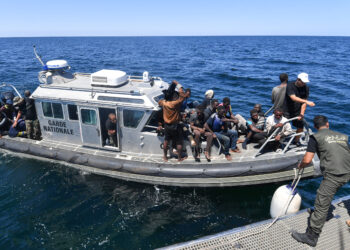
Brussels – People continue to die in the Mediterranean: this time off the coast of the island of Chios, in Greece, where at least 15 people travelling on a boat lost their lives on the evening of 3 February in an incident involving the Greek Coast Guard. Prompted by questions from journalists in Brussels, the European Commission emphasised that “every life lost at sea is a tragedy caused by traffickers” and reiterated the importance it attaches to the European Union’s work with third-country partners.
The Greek Coast Guard explained in a press release that there were 15 fatalities and 24 injuries. “The pilot of a speedboat travelling at high speed and without navigation lights, with foreign passengers on board, did not comply with our light and sound signals,” the Greek authorities said in the press release. In particular, according to the Coast Guard’s reconstruction, the pilot suddenly reversed course and collided with the patrol boat’s right side. Furthermore, “due to the violence of the impact, the motorboat capsized and sank.”
In Brussels, the Berlaymont Building reiterated—through its spokesperson for Home Affairs, Markus Lammert, in the daily press briefing—that “every life lost at sea is a tragedy caused by traffickers.” He reiterated that “too many people are risking their lives and losing them” and that “this is what we are working on” with the aim of “preventing” such tragedies. “And this is also why our work with partner countries is so important,” Lammert added.
In the European Parliament, Greek MEP Kostas Arvanitis of the European Left called for “a full, independent, and transparent investigation into the deadly collision between boats off Chios involving the Coast Guard and migrants. Maritime law, he continued, requires rescue, not pursuit or refoulement. Greece must stop being a country of tragedies. The truth must come out.” Echoing him, Spanish MEP Estrella Galán (The Left) said that “the shipwreck off the Greek coast, in which at least 15 people lost their lives, is not an isolated incident“, but rather “adds to the approximately 1,000 victims who died in the Mediterranean during cyclone Harry.” For Galán, “these tragedies are the result of the EU’s lack of search and rescue mechanisms and safe legal routes, while NGOs that save lives are criminalised and billions of dollars end up at Frontex”. For the MEP, this is the “most lethal political failure.”

Meanwhile, at next week’s plenary session in Strasbourg, the European Parliament will vote on the final outcome of negotiations on the so-called “safe third country” and “safe countries of origin” reports. These two dossiers risk undermining the right to asylum within the EU. While people continue to die in the Mediterranean without interruption, the tragedy of 3 February in the eastern Aegean Sea is unfortunately not the first (foreseeable) tragedy of 2026: last month, due to Cyclone Harry, the disappearance of 380 migrants was reported by the authorities. However, according to the NGO Mediterranea Saving Humans and Refugees in Libya and Tunisia, around a thousand people died in the Mediterranean during the days when the cyclone struck. For Mattia Ferrari, Chaplain of Mediterranea, “all this is caused by global injustice, the closure of legal channels of access, the absence of structural search and rescue mechanisms at sea and obstacles to civil society rescue vessels.”
English version by the Translation Service of Withub







![La video riunione dell'Eurogruppo [27 marzo 2026. Foto: European Council]](https://www.eunews.it/wp-content/uploads/2026/03/eurogruppo-260327-120x86.jpg)
