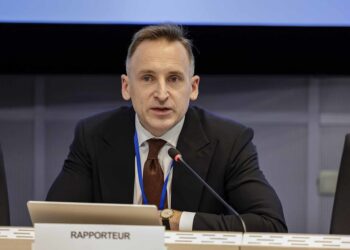
Brussels – Stefano Palmieri is the new president of the External Relations Section (REX) of the EESC, the European Economic and Social Committee. The section is responsible for dialogue between European civil society organisations and their counterparts in countries with which the European Union has formal relations.
Your appointment comes at a time when the gap between EU-US relations and trade cooperation is widening.
It is clear that Trump’s second administration has suddenly broken all the moulds. However, this change of course does not end with Donald Trump; it involves a whole series of figures around him, starting with Vice President J.D. Vance. Within this phenomenon, there is a well-established doctrine that has brought together Trump’s supporters: the great technocrats on one side and the American proletariat on the other. This has led to the development of a new geopolitical strategy in the US that is proving to be a real game-changer in various scenarios.”
Did you expect such a significant change?
“This is not unexpected. In fact, it had already been announced in February at the Munich Security Conference by Vice President J.D. Vance, who had the audacity to criticise the European Union’s democracy, denouncing an alleged decline in democracy and freedom of expression on our continent. That speech represented the official announcement of the Trump administration’s imperialist and predatory turn and its attempt to make the European Union a vassal state of the United States. The lack of reaction signalled how weak the EU was.”
We then saw it in a series of events throughout the year.
This summer, tariffs were imposed, once again with no reaction from Europe except for signs of weakness. Then, in November, came the national security strategy, further evidence of the critical nature of relations between the United States and the EU. Next, we saw the invasion of Venezuela and the reaffirmation of the Monroe Doctrine. Added to this is the issue of Greenland, with Donald Trump having no qualms about talking of “vital space”, a term that evokes particular ghosts of the past in Europe.”
What is the political and social cost of this instability?
“The cost is primarily political, represented by Europe’s declining relevance. The problem is that the European Union, with its current institutional structure, cannot resolve the challenges it faces on various fronts. The treaties have worked well for fifty years, but at this point, I believe change is needed. Either through a substantial amendment to the treaties, which I fear is impossible with the current majority in the Commission and Council, or through a form of cooperation between those willing to achieve a higher level of cohesion among EU Member States.”
What about the social costs?
“These are certainly costs that we will see in the coming months and years. The first of these will be due to increased military spending. It is clear that US disengagement from Europe means Europe must develop its own military strategy. But increasing military spending means reducing spending elsewhere. Unfortunately, the expenditure destined to be reduced is social spending. This is also a problem for the stability of the EU: when, at the national level, it becomes clear that cuts will have to be made to health or education, I don’t know how long the project can hold out.”
How can the REX section help to stabilise relations with non-EU partners in this crisis context?
“We have a multi-year programme that continues—in line with the previous mandate—to focus particularly on neighbouring countries and countries involved in enlargement. We also intend to strengthen relations with developing countries that could be strategic partners. There are two directions: Africa and Latin America. We will work on issues such as the Global Gateway, the major programme through which the EU plans to implement projects to improve energy networks, education programmes, dam construction, and the extraction of critical materials. These are all projects for which we are calling for the involvement of local civil society. Another priority is to promote the conditions for the full realisation of peace and health, and to implement a series of interventions to affirm gender equality, workers’ rights, a sustainable environment, poverty reduction, and to guarantee water supply for those suffering as a result of climate change.
You mentioned Latin America. Today, the partnership agreement between the European Union and Mercosur is on hold.
“My position until 2021 was particularly critical. But things have changed. First of all, negotiations began, strongly pursued by President Lula, who introduced a series of important measures: a binding legal commitment to stop deforestation, a commitment to promote women’s empowerment, to promote sustainable supply chains, and to fight child labour. In short, I believe that the agreement has changed and that it should be considered.”
What are your main hopes for this presidency?
“A major diplomatic effort is needed from everyone, and this effort must also come from the EESC. As the home of civil society organisations—entrepreneurs, workers, and NGO operators—we must, at all costs, try to make a diplomatic effort. Civil society must also do so through relations with other non-EU countries. What we want to do with this mandate is to try to reaffirm global public goods, peace above all else.”
English version by the Translation Service of Withub