- Europe, like you've never read before -
Tuesday, 21 April 2026
No Result
View All Result
  • it ITA
  • en ENG
Eunews
  • Politics
  • World
  • Business
  • News
  • Defence
  • Health
  • Agrifood
  • Other sections
    • Culture
    • Diritti
    • Energy
    • Green Economy
    • Finance & Insurance
    • Industry & Markets
    • Media
    • Mobility & Logistics
    • Net & Tech
    • Sports
  • Newsletter
  • European 2024
    Eunews
    • Politics
    • World
    • Business
    • News
    • Defence
    • Health
    • Agrifood
    • Other sections
      • Culture
      • Diritti
      • Energy
      • Green Economy
      • Finance & Insurance
      • Industry & Markets
      • Media
      • Mobility & Logistics
      • Net & Tech
      • Sports
    No Result
    View All Result
    Eunews
    No Result
    View All Result

    Home » Diritti » European Parliament approves tighter rules on asylum seekers, opens the door to the ‘Albania model’

    European Parliament approves tighter rules on asylum seekers, opens the door to the ‘Albania model’

    The Strasbourg Chamber has given final approval to the first EU list of safe countries of origin and to the revision of the criteria for designating safe third countries. It will be possible to deport asylum seekers to third countries with which bilateral agreements have been signed.

    Simone De La Feld</a> <a class="social twitter" href="https://twitter.com/@SimoneDeLaFeld1" target="_blank">@SimoneDeLaFeld1</a> by Simone De La Feld @SimoneDeLaFeld1
    10 February 2026
    in Diritti
    CENTRO  D'ACCOGLIENZA   MIGRANTI ALBANIA DALL'ALTO

    CENTRO D'ACCOGLIENZA MIGRANTI ALBANIA DALL'ALTO

    Brussels – The European Parliament has dealt the final blow to the EU asylum system as it has been constructed over the last twenty years. In two separate votes, the right-wing and far-right majority in the Chamber gave the final green light to the first European list of safe countries of origin and to the revision of the criteria for applying the concept of safe third countries. This is a victory for the “Albania model” that outsources asylum procedures and international protection. The losers are migrants, whose right to asylum – and other fundamental rights – will be significantly curtailed. And ultimately, Europe itself is thus betraying some of the values that have so far distinguished it on the global stage.

    The EU list of safe countries of origin, which will initially include Kosovo, Bangladesh, Colombia, Egypt, India, Morocco, and Tunisia, was approved by 408 votes in favour, 184 against, and 60 abstentions. The same majority, with a few defections, confirmed the most controversial regulation, the one relating to the application of the safe third-country concept, approved with 396 votes in favour, 226 against, and 30 abstentions. The outcome of the vote was almost a foregone conclusion: the two measures, proposed by the European Commission last spring, had already been approved by the European Parliament and confirmed in inter-institutional negotiations. Today’s vote is the final step in the legislative process.

    In addition to the three far-right groups – Europe of Nations (ESN), Patriots for Europe (PfE), and European Conservatives and Reformists (ECR) – the European People’s Party also supported the crackdown on asylum seekers. The Renew liberals were divided in both votes, and even among the ranks of the Socialists and Democrats, around 20 MEPs approved the measures. There were no surprises among the Italian party delegations: the League, Fratelli d’Italia, and Forza Italia were in favour of the hard line, while the Democratic Party, the Five Star Movement, and the Green and Left Alliance opposed it.

    Both regulations were provided for in the Migration and Asylum Pact, which will come into force in June. With regard to the EU list of safe countries of origin, Member States will be required to implement accelerated or border procedures for all citizens from the countries listed by Brussels. Asylum applications will be assessed within a maximum of three months, rather than six, and migrants will be detained throughout the procedure.

    The EU list becomes binding, but it does not prevent Member States from drawing up larger national lists. In practice, EU countries will be able to speed up the examination of asylum applications for all citizens coming from countries whose recognition rate is below 20 per cent, and they may designate as safe third countries and safe countries of origin even those that are not safe for everyone or in every part of their territory. EU accession candidate countries will also be considered safe countries of origin provided there is no war on their territory, no EU sanctions have been imposed on them, and their asylum‑recognition rate does not exceed 20 per cent. It will be up to the individual asylum seeker to prove that the accelerated procedure (and, therefore, the likely rejection of the asylum application) should not apply in their case because of a well-founded fear of persecution or the risk of serious harm on return.
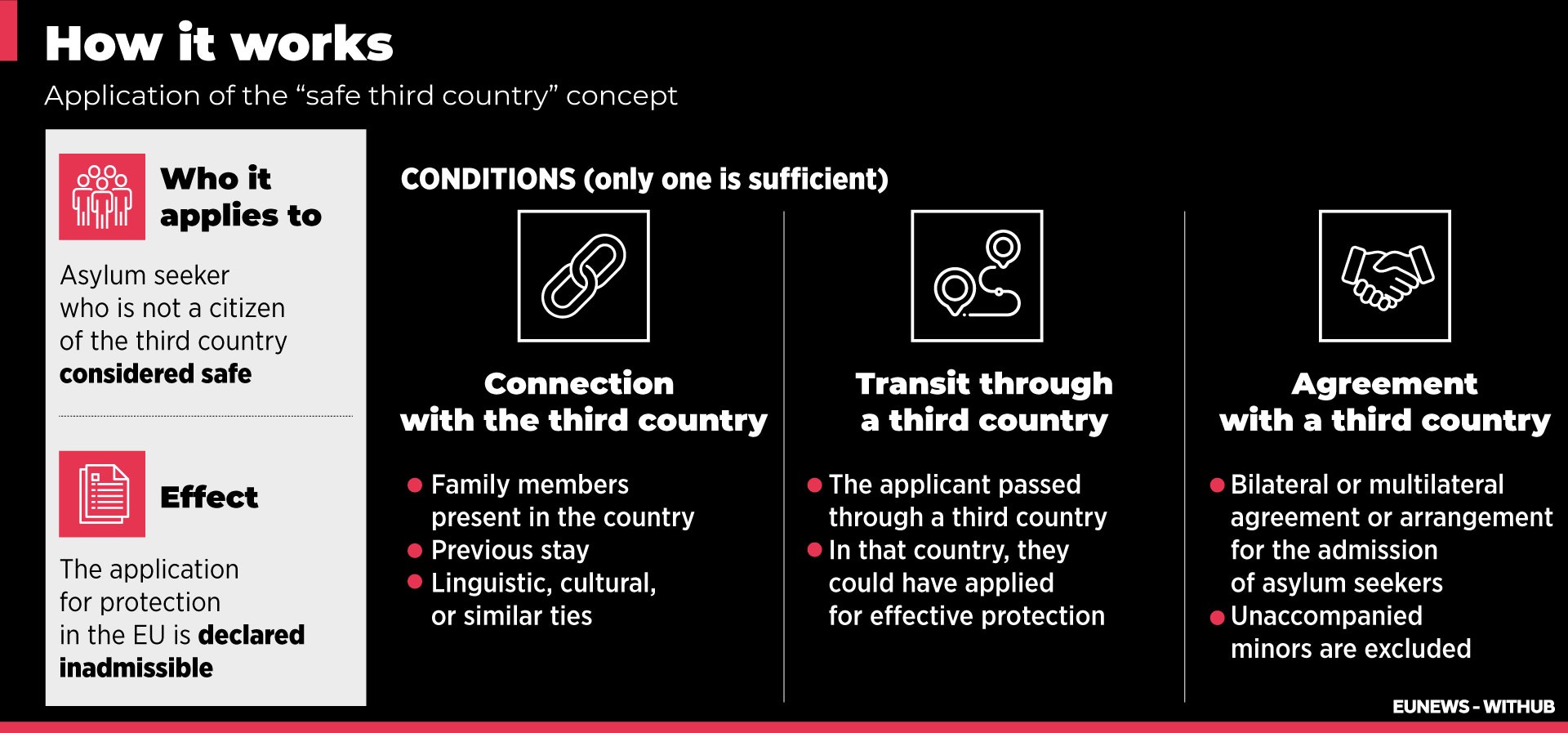
    Revising the concept of safe third countries will also enable faster asylum procedures. However, it will also open the door to the outsourcing of international protection. In essence, the obligation for national asylum authorities to prove the existence of a link between the applicant and the safe third country to which they wish to transfer them will be removed. Member States will be able to apply the concept of safe third country to an asylum seeker who is not a national of that particular country, and thus declare their application for protection at the EU level inadmissible.

    Not only will transit through a safe third country during the journey to the EU become sufficient grounds for denying protection, but asylum seekers may be deported – with the sole exception of unaccompanied minors – to any other non-EU country with which a bilateral or EU-level agreement has been signed, provided that this third country meets a series of conditions that qualify it as safe.

    European institutions have already anticipated a likely surge in appeals against forced transfers and have taken steps to regulate the procedures governing them. The regulation will eliminate the automatic suspensive effect of appeals to “help reduce procedural delays in the application of the concept of safe third countries and prevent potential abuse of the possibilities for appeal by applicants.” However, this means that migrants who appeal against the rejection of their asylum applications will risk being deported even before the final decision is made.

    English version by the Translation Service of Withub

    Tags: asylum seekerseu safe countries listmigrants

    Related Posts

    August 4, 2024, Italy: A boat carrying 47 people from Bangladesh and Syria plus two others who appeared to be smugglers, they drove the boat away again and were found in the Central Mediterranean. More than 30,000 people have died or gone missing in the Mediterranean Sea since 2014 while trying to reach Europe, according to figures collected by the International Organisation for Migration. (Credit Image: © Sally Hayden/SOPA Images via ZUMA Press Wire)
    General News

    Hundreds of migrants missing in the Mediterranean and the EU’s “intolerable silence”

    5 February 2026
    (credits: Tiziana Fabi)
    Diritti

    Migrants, 15 victims off Chios after conflict with Greek Coast Guard. EU: Traffickers responsible for tragedy

    4 February 2026
    visti rimpatri
    Diritti

    EU now focusing on migration diplomacy. Starting with visa restrictions for those who do not cooperate on repatriation.

    29 January 2026
    Politics

    Migrants: hardline stance wins in Strasbourg: socialists and greens in minority

    21 January 2026
    map visualization

    Russia: EU blacklists Euromore and Pravfond, calling them “propaganda outlets”

    by Renato Giannetti
    21 April 2026

    Accused of spreading the Kremlin’s narrative on the war in Ukraine. The two entities’ assets have been frozen. Europeans are...

    ©Nicolas Liponne/MAXPPP - Budapest 28/06/2025 Des personnes de la communauté LGBTQIA+ participent à la gay pride, intitulé Pride for Freedom, à Budapest le 28 juin 2025. Plus de deux cent mille personnes ont défilé malgré l'interdiction de la manifestation par Viktor Orban, premier ministre à la tête du gouvernement hongrois, justifié par la loi de protection de l'enfance qui interdit les livres, films ou produits culturels qui "encouragent ou représentent une identité différente de celle du sexe de naissance, un changement de genre ou l'homosexualité". La manifestation s'est déroulée sans incidents malgré les menaces de contre-manifestation de l'extrême droite.
People from the LGBTQIA+ community take part in the gay pride event, entitled Pride for Freedom, in Budapest on June 28, 2025. Over two hundred thousand people marched despite a ban on the event by Viktor Orban, Hungary's prime minister, justified by a child protection law that bans books, films or cultural products that “promote or represent an identity different from that of one's birth sex, a change of gender or homosexuality”. The demonstration went off without a hitch, despite threats of counter-demonstrations from the far right.

    EU Court of Justice rules against Orbán’s legacy: his anti‑LGBTQ+ law breaches EU law

    by Giorgio Dell'Omodarme
    21 April 2026

    The judges in Luxembourg have upheld the European Commission’s appeal in full: the EU’s fundamental values and internal market rules...

    Sigarette - Corte

    EU Court rules cigarette emissions tests must be freely accessible to all

    by Ezio Baldari @eziobaldari
    21 April 2026

    The case originated in the Netherlands: in 2018, a foundation working to prevent smoking among young people asked the relevant...

    An Israeli soldier tries to prevent Palestinians from reaching their houses in Nur Shams refugee camp in the West Bank city of Tulkarm, Nov. 18, 2025. Palestinians took part in a demonstration demanding the right to return to their houses at the entrance of Nur Shams refugee camp, while Israeli soldiers assaulted the crowd and forced them to leave the area. Photo by Nidal Eshtayeh/Xinhua/ABACAPRESS.COM

    France and Sweden call for EU sanctions against Israeli settlements in the West Bank

    by Emanuele Bonini emanuelebonini
    21 April 2026

    In a joint statement, the two delegations call for restrictions on trade with the settlements: "The ever and fast deteriorating...

    • Director’s Point of View
    • Opinions
    • About us
    • Contacts
    • Privacy Policy
    • Cookie policy

    Eunews is a registered newspaper
    Press Register of the Court of Turin n° 27


    Copyright © 2025 - WITHUB S.p.a., Via Rubens 19 - 20148 Milan
    VAT number: 10067080969 - ROC registration number n.30628
    Fully paid-up share capital 50.000,00€


    No Result
    View All Result
    • it ITA
    • en ENG
    • Politics
    • Newsletter
    • World politics
    • Business
    • General News
    • Defence & Security
    • Health
    • Agrifood
    • Altre sezioni
      • Culture
      • Diritti
      • Energy
      • Green Economy
      • Gallery
      • Finance & Insurance
      • Industry & Markets
      • Media
      • Mobility & Logistics
      • Net & Tech
      • News
      • Opinions
      • Sports
    • Director’s Point of View
    • Draghi Report
    • Eunews Newsletter

    No Result
    View All Result
    • it ITA
    • en ENG
    • Politics
    • Newsletter
    • World politics
    • Business
    • General News
    • Defence & Security
    • Health
    • Agrifood
    • Altre sezioni
      • Culture
      • Diritti
      • Energy
      • Green Economy
      • Gallery
      • Finance & Insurance
      • Industry & Markets
      • Media
      • Mobility & Logistics
      • Net & Tech
      • News
      • Opinions
      • Sports
    • Director’s Point of View
    • Draghi Report
    • Eunews Newsletter

    Attention