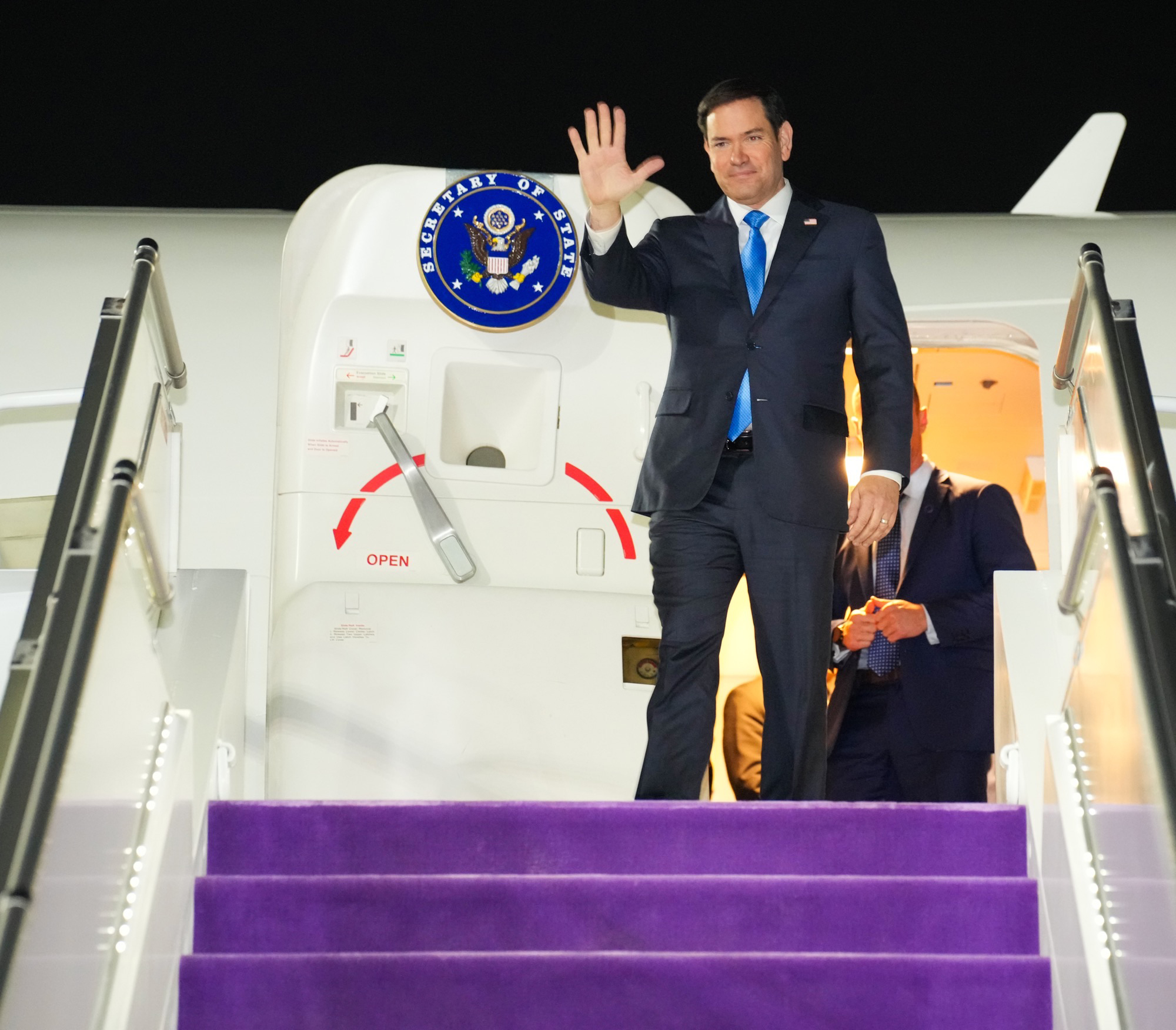
Brussels – While last year was a cold shower for the European Union, targeted by JD Vance’s aggressive speech, the Munich Security Conference, which ended yesterday (15 February), instead marked a cool, deliberate distancing between the two sides of the Atlantic. European leaders declined the invitation from US Secretary of State Marco Rubio to build a new world order together.
In his speech on Saturday, Rubio emphasised that the two continents belong together and described America as “a child of Europe.” Despite the more conciliatory tone, the message remained the same: transatlantic relations will essentially depend on the EU’s willingness to adapt to American leadership and MAGA ideology. “We want Europe to be strong,” he said. “This is the path that President Trump and the United States has embarked upon. It is the path we ask you here in Europe to join us on,” Rubio told the audience at the Bavarian event. Washington’s offer is conditional, almost an ultimatum: either the EU bows and embraces the new aggressive American policy, or it will be forced to step aside.
“Under President Trump, the United States of America will once again take on the task of renewal and restoration, driven by a vision of a future as proud, as sovereign, and as vital as our civilization’s past. And while we are prepared, if necessary, to do this alone, it is our preference and it is our hope to do this together with you, our friends here in Europe,” Rubio said.
The President of the European Commission, Ursula von der Leyen, said she was “very reassured” by the US Secretary of State’s speech. “We know him, he is a good friend. He is a powerful ally. Within the Administration, some use very harsh tones. He was very clear. He said that the United States wants a strong Europe. We must be an independent Europe, not a Europe that relies on someone else… but we must build it,” said the EU leader.
Yesterday, 24 hours after Rubio, the EU High Representative for Foreign Affairs, Kaja Kallas, spoke at the conference. And her response was decidedly sharp. “Coming from a country that ranks second in the world press freedom index, hearing criticism of press freedom from a country (the United States, ed) that ranks 58th is… interesting,” the former Estonian prime minister said sarcastically. Kallas rejected the American narrative that European civilisation is at risk: “Contrary to what some may say, woke and decadent Europe is not facing the cancellation of civilisation. In fact, people still want to join our club, and not just our fellow Europeans. In Canada, I was told that over 40 per cent of Canadians are interested in joining the EU,” retorted the head of EU diplomacy.
The leaders of Germany and France were even harsher. According to German Chancellor Friedrich Merz, “a rift has opened up between Europe and the United States.” Merz cited Vance’s controversial attack last year: “He was right. The cultural battle of the MAGA movement is not ours,” said the Christian Democrat, rejecting the offer of vassalage from across the Atlantic. “Great power politics in Europe is not an option for Germany,” the Chancellor pointed out. “Partnership-based leadership – yes; hegemonic fantasies – no. We Germans will never again go it alone,” he said.
Emmanuel Macron also got something off his chest: “Europe has been vilified as an aging, slow, fragmented construct sidelined by history, as an over-regulated, listless economy that shuns innovation, as a society preyed to barbaric migration that would corrupt its precious traditions,” recalled the President of the French Republic, as if to unmask Rubio’s conciliatory tone. “And most curiously yet, in some quarters, as a repressive continent where free speech or, I would say, where speech would not be free and alternative facts could not claim the same right of place as truth itself. That old-fashioned and cumbersome concept,” he added.
The difficult three days of the Munich Security Conference ended on that note. With the clear and embarrassing evidence of an ever‑widening rift between Washington and Brussels. Italy’s Prime Minister Giorgia Meloni was absent; for more than a year, she has been trying, with considerable difficulty, to legitimize the ideology associated with Donald Trump and its threats to Europe. The tough words chosen by Kallas, Macron, and Merz also had the effect of isolating von der Leyen, the only one to feel “very reassured” by Marco Rubio’s sugar‑coated message.
English version by the Translation Service of Withub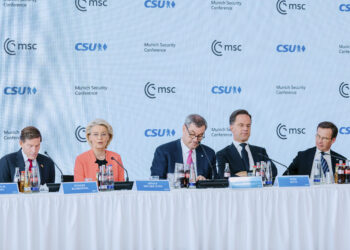

![[Copyright: European Union]](https://www.eunews.it/wp-content/uploads/2026/10/euco-261015-120x86.png)