



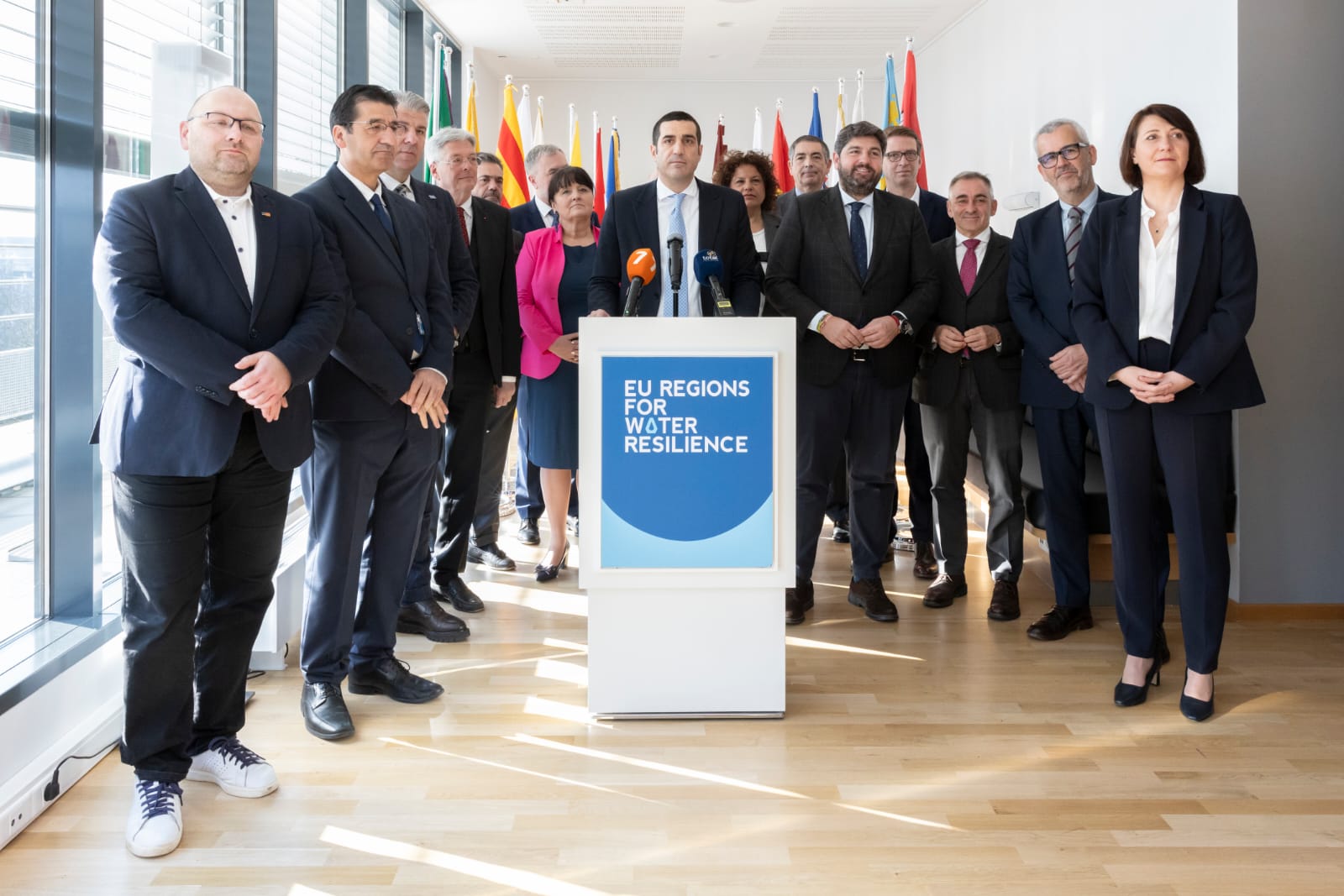
Brussels – Driven by the urgency to act against environmental disasters and extreme weather events, eighteen regions from nine Member States gathered today (4 March) in Brussels to officially launch the new Alliance of European Regions for Water Resilience and climate change preparedness. The Emilia-Romagna region, represented by its president Michele De Pascale, is promoting the union of the delegations.
The initiative stems from a shared emergency to combat the extreme weather events that have hit Europe, including the floods in Emilia-Romagna in 2023 and 2024, as well as Cyclone Harry, which affected Spain, Portugal, Italy, Malta, and Greece in January 2026. In addition to Emilia Romagna, the Alliance includes the Spanish regions of Andalusia, the Balearic Islands, the Basque Country, Catalonia, Murcia, and Valencia, the Belgian region of Flanders, the Austrian regions of Carinthia, Styria, Lower Austria, and Upper Austria, the French regions of New Aquitaine and Occitania, the Greek regions of Eastern Macedonia and Thrace, the German region of Hesse, the Czech region of South Moravia and the Polish region of Wielkopolska.
The Alliance aims to establish interregional dialogue and greater coordination with European actors. The objectives are to invest in water resilience and infrastructure to help prevent and combat floods and extreme weather events, accelerate research and innovation, and raise public awareness of the impact of climate change.
“Water resilience is a key factor in protecting our citizens and ensuring competitiveness. Floods and extreme weather events in recent years have affected European regions, highlighting the need for cooperation and coordination between institutions,” De Pascale explained at a press conference. “The initiative launched today represents a permanent forum for dialogue between regions and European institutions, with the aim of sharing experiences, promoting investment in water resilience, and addressing climate change,” he added.
The initiative is also supported by the President of the European Committee of the Regions (CoR), Kata Tüttő of Hungary, who clarified that the CoR is “one of the main supporters” of the European Alliance for Water Resilience. “Our task is to influence the decision-making process in the European Union and ensure that these initiatives become a reality. We must act in collaboration with those who work every day on water management and resilience to protect our environment, citizens, and infrastructure. This is not just a question of ambition, but also of how these projects will be financed: investments must be made now,” concluded Tüttő.
In the afternoon, the initiative will be presented during the CoR plenary session and discussed with European Parliament President Roberta Metsola, Executive Vice-President for Cohesion Raffaele Fitto, and EU Environment Commissioner Jessika Roswall. The European Commission has been working for some time on an integrated climate resilience framework. It was European Commissioner for International Cooperation, Humanitarian Aid, and Crisis Response Hadja Lahbib who raised issue in the plenary session at the European Parliament in Strasbourg, noting that “the climate assessment carried out in 2024 by the European Union showed that we are not ready.” The strategic water resilience framework will be accompanied by a support programme to “build resilience from the design stage: it will include a streamlined legislative proposal and support measures,” Lahbib announced.
English version by the Translation Service of Withub





![La video riunione dell'Eurogruppo [27 marzo 2026. Foto: European Council]](https://www.eunews.it/wp-content/uploads/2026/03/eurogruppo-260327-120x86.jpg)
