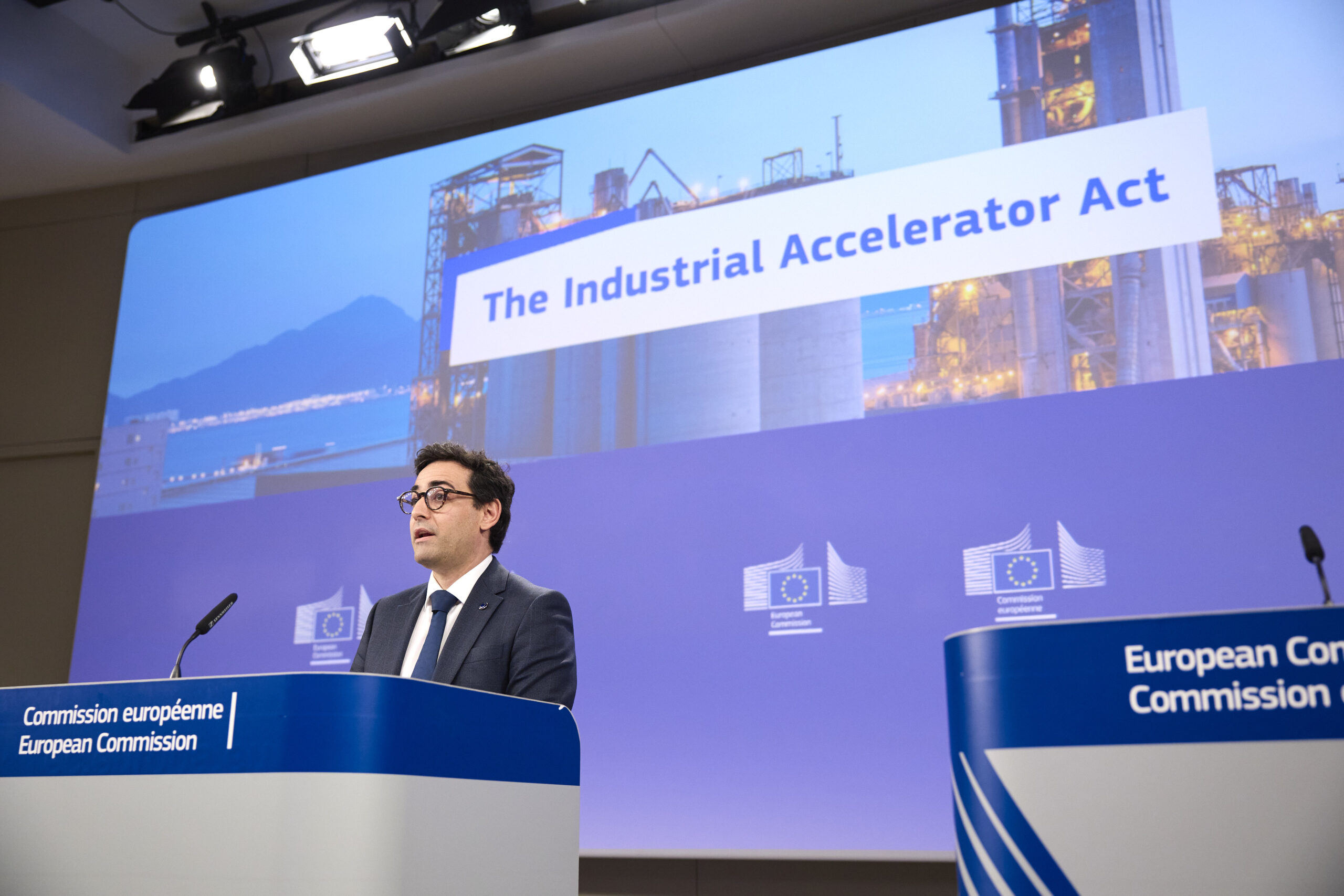
Brussels – After weeks of discussions, amendments and revisions, the European Commission today (4 March) presented the long-awaited Industrial Accelerator Act, the regulation with which Brussels aims to accelerate (and protect) the decarbonisation of European industry. “More than just a change in modus operandi, it is a change in doctrine,” announced Executive Vice-President for Industry, Stéphane Séjourné, immediately claiming its protectionist nature: “Today, ‘made in Europe’ makes its grand entrance into European law.”
At the heart of the “Clean Industrial Deal”, the EU’s new compass for combining competitiveness and decarbonisation, the Industrial Accelerator Act has the dual objective of “increasing demand for European-made low-carbon technologies and products” and “boosting manufacturing, growing businesses, and creating jobs in the EU.” It does so, says a senior official, “with measures targeted at key industrial sectors, without affecting the economy as a whole.”
Steel, concrete, aluminium, automotive, net-zero emission technologies (batteries, solar energy, wind energy, heat pumps, and nuclear energy): the Commission is starting from here, “while establishing a framework that can be extended, if necessary, to other energy-intensive sectors such as chemicals”. The imperative is to strengthen strategic sectors and avoid dangerous dependencies; otherwise, Séjourné asked, “how can we explain to our citizens that decarbonisation is an opportunity if 100 per cent of our batteries are made in China?”
There are essentially three lines of action: simplifying authorisations and procedures to speed up industrial projects, introducing “targeted and proportionate Made in Europe” requirements for public procurement and public support schemes, and tightening requirements for foreign investment in strategic sectors.
With regard to the first point, the Industrial Accelerator Act requires Member States to establish a single digital authorisation process to accelerate and simplify production projects and introduces the principle of tacit approval at intermediate stages of the authorisation process for energy-intensive decarbonisation projects. However, the core of the regulation, and the real novelty claimed by Séjourné and championed most strongly by France, is something else.
“When public money is at stake, we will impose European preference,” said the EU Executive Vice-President and former French Foreign Minister. To identify third countries to be granted equal access to public procurement, auctions, and national support schemes in strategic sectors, Brussels starts from a very simple concept: reciprocity.
“Many of our partners apply national preferences in their countries,” Séjourné pointed out. The idea is “simple,” he insisted: “Our trusted partners, i.e. those with whom we have trade commitments, will be integrated into the system if they respect their commitments in terms of reciprocity.”
In principle, it starts with the 22 countries (plus the 27 EU Member States) that are parties to the GPA, an agreement signed at the WTO that guarantees “fair, transparent and non-discriminatory” conditions for international competition in public procurement. There are three partners of the European Economic Area (Iceland, Norway, and Liechtenstein), as well as the United States, the United Kingdom, Switzerland, Canada, Japan, South Korea, Australia, Israel, and New Zealand. In reality, the list is longer: there are 40 countries with which the EU has public procurement agreements, a senior official pointed out. Through delegated acts, the Commission will be able to remove, “in whole or in part,” countries “that do not play by the rules or that pose a risk to our economic security,” Séjourné explained.
In the Commission’s proposal, the “Made in Europe” principle for participating in public procurement and support schemes applies across the board, but with different quotas, to all strategic sectors. For example, in the automotive sector, Brussels wants all electric cars (battery, plug-in, full-hybrid) to be assembled in the European Union, and at least three of the battery components (including cells) and at least 70 per cent of non-battery components to be produced in the EU. Without these requirements, companies will be excluded from tenders.
Then there is the issue of foreign investment. “We want to avoid a race to the bottom among our Member States,” said one source. The Industrial Accelerator Act tightens the conditions for authorising foreign investment in strategic sectors exceeding €100 million, where a single third country controls more than 40 per cent of global production capacity. The requirements include a majority European shareholding, technology transfer, integration into EU value chains, and job creation, ensuring a minimum employment level of 50 per cent for European citizens.
The text, which Séjourné admitted was the subject of lengthy negotiations within the Commission itself, will now be passed on to the EU Council and the European Parliament. It is mainly in the Council that a battle is expected, and the regulation is likely to be significantly altered. Not everyone likes “Made in Europe”: several Member States are concerned that it will backfire, discouraging investment and ultimately damaging the EU’s competitiveness.
English version by the Translation Service of Withub



![Da sinistra: il presidente del Consiglio europeo, Antonio Costa; il presidente dell'Ucraina, Volodymir Zelensky: la presidente della Commissione europea, Ursula von der Leyen [Bruxelles, 18 giugno 2024. Foto: European Council]](https://www.eunews.it/wp-content/uploads/2026/06/euco_ua260618-120x86.jpg)
![[foto: Saverio De Giglio/imagoeconomica]](https://www.eunews.it/wp-content/uploads/2026/10/cpt-120x86.png)