- Europe, like you've never read before -
Thursday, 16 April 2026
No Result
View All Result
  • it ITA
  • en ENG
Eunews
  • Politics
  • World
  • Business
  • News
  • Defence
  • Health
  • Agrifood
  • Other sections
    • Culture
    • Diritti
    • Energy
    • Green Economy
    • Finance & Insurance
    • Industry & Markets
    • Media
    • Mobility & Logistics
    • Net & Tech
    • Sports
  • Newsletter
  • European 2024
    Eunews
    • Politics
    • World
    • Business
    • News
    • Defence
    • Health
    • Agrifood
    • Other sections
      • Culture
      • Diritti
      • Energy
      • Green Economy
      • Finance & Insurance
      • Industry & Markets
      • Media
      • Mobility & Logistics
      • Net & Tech
      • Sports
    No Result
    View All Result
    Eunews
    No Result
    View All Result

    Home » Mobility & Logistics » Transport: less than half of EU railways are double-track, electrification and high-speed grow: Eurostat data

    Transport: less than half of EU railways are double-track, electrification and high-speed grow: Eurostat data

    More than half of the European railway system is still single-track, while electrification stands at 57.6 per cent, and high-speed rail is experiencing a boom led by Spain and Italy

    Caterina Mazzantini by Caterina Mazzantini
    9 March 2026
    in Mobility & Logistics
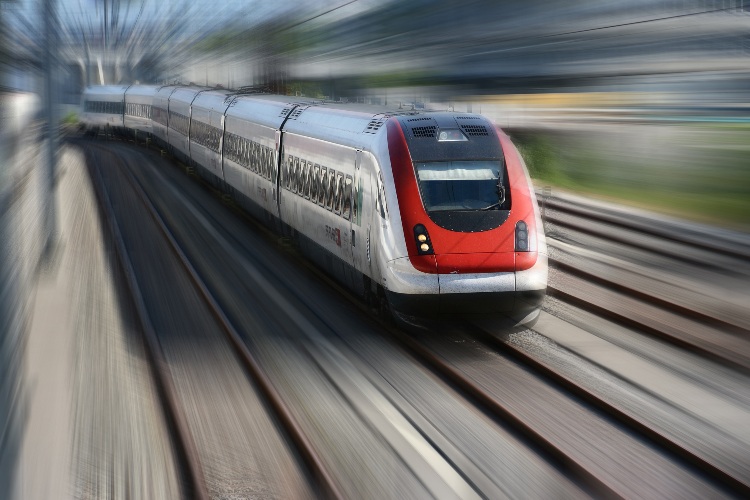
    Treno - ferrovie

    Brussels – Europe has increased the scope and electrification of its railway system, but has reduced its length. This is what has happened over the last 35 years or so: according to a press release by Eurostat, the Statistical Office of the European Union, in 2024, 40.8 per cent of European railway tracks were at least double-track, representing a 31.8 per cent improvement compared to 1990. Furthermore, although the length decreased by 8% from 220,410 to 201,314 kilometres between 1990 and 2024, data show a slight increase in the percentage of electrified lines, which rose from 39.9 per cent in 1990 to 57.6 per cent in 2024. 

    Italy, with 46 per cent, ranks fifth—after Belgium (81.2 per cent), the Netherlands (70.5 per cent), France (62.8 per cent), and Germany (48.6 per cent)—in terms of the percentage of its total railway lines that are double-track, and recorded the highest growth in absolute terms (+2,040 km) after Spain (+3,550 km) in the same period. The peninsula, again alongside Spain, also marks another significant figure: the increase in high-speed lines from 2008 to 2024: Spain recorded +1,948 km (equal to +56.6 per cent), and Italy +565 km (equal to +106.2 per cent). Among other European countries, France saw an increase of 883 km (47.3 per cent) and Germany 295 km (34.1 per cent). In general, high-speed networks in the EU grew by more than 80 per cent between 2008 and 2024. 

    Although the length decreased by 8 per cent between 1990 and 2024 (from 220,420 km to 201,314 km), data show a slight increase in the percentage of electrified lines: in 1990 it was 39.9 per cent, and in 2024 it rose to 57.6 per cent. Among the leaders in electrification are Luxembourg with 96.7 per cent (the highest in the EU), Belgium 88.0 per cent, Sweden 75.1 per cent, Bulgaria 74.6 per cent, and the Netherlands 74.4 per cent. Among the countries with the lowest electrified line rates are Ireland (only 53 kilometres, 2.6 per cent), Lithuania (8.1 per cent), Estonia (12.0 per cent), and Latvia (13.7 per cent). 

    The highest railway network density is found in areas with relatively high freight transport volumes. In 2024, the Czech Republic had the highest railway network density with 123.2 metres of railway lines per km² of land area, ahead of Belgium (118.7 m/km²) and Germany (110 m/km²). The lowest densities were recorded in Greece (14 m/km²), Finland (19.4 m/km²), and Sweden (26.8 m/km²). 

    Finally, with regard to safety parameters, Eurostat reports the European Railway Agency (ERA) figures of the European Union Agency for Railways (ERA) according to which, in 2025, Luxembourg was the only country fully equipped with ETCS, the European Train Control System, a standard based on equipment installed in the driver’s cab that can supervise train movements. Luxembourg is followed by Belgium (90.3 per cent of railway lines) and Denmark (51.6 per cent), while the least equipped countries were Hungary (1.6 per cent), Croatia (3.0 per cent), Germany and Romania (both with 3.2 per cent). Italy ranks just above the bottom of the table with 6.8 per cent of railway lines equipped with ETCS.

    English version by the Translation Service of Withub
    Tags: railwayssistema ferroviario

    Related Posts

    Il porto di Genova
    Business

    The EU bets—again—on the sea: Strategies for the maritime industry and ports presented

    4 March 2026
    Briefs

    No independent rail regulator, Hungary referred to EU court

    7 May 2025
    map visualization
    Da sinistra: l'ex-premier bulgaro, Boyko Borissov, il presidente russo, Vladimir Putin, l'omologo turco, Recep Tayyip Erdoğan, e serbo, Aleksandar Vučić, all'inaugurazione del gasdotto TurkStream nel 2020

    War in Iran boosts Russia: March oil and gas exports surge, driven by China and India

    by Emanuele Bonini emanuelebonini
    16 April 2026

    The CREA think-tank: "Exports up 52 percent in a month, generating revenues of 713 million euros a day". The EU...

    Terza conferenza umanitaria per il Sudan, Berlino, 15 aprile 2026. Fonte: Imagoeconomica via Esteri.it

    EU, member states pledge over 812 million euros to ease Sudan crisis

    by Giulia Torbidoni
    16 April 2026

    The Commission’s contribution amounts to 360.8 million euros, while 16 countries, including Italy, pledged the remaining Team Europe funds

    SCOMMESSE GIOCO D'AZZARDO MINORE MINORENNE GIOVANE LUDOPATIA LUDOPATICO GENERATE AI IA MINORI MINORENNI RAGAZZO RAGAZZI ON LINE ONLINE LUDOPATICI

    Online gambling: players may recover losses from games banned in their country

    by Ezio Baldari @eziobaldari
    16 April 2026

    A Member State may ban online casino games, including slot machines, as well as certain forms of online betting. The...

    SALVATAGGIO MIGRANTI AD OPERA DI MEDICI SENZA FRONTIERE GEO BARENTS ONG SOPRAVVISSUTO SOPRAVVISSUTI MIGRANTE MIGRANTI PROFUGO PROFUGHI

    Brunner: “The Middle East poses significant challenges, including on migration”

    by Emanuele Bonini emanuelebonini
    16 April 2026

    The Commissioner for Home Affairs: "For the time being, there are no increased migratory flows to the EU, but the situation...

    • Director’s Point of View
    • Opinions
    • About us
    • Contacts
    • Privacy Policy
    • Cookie policy

    Eunews is a registered newspaper
    Press Register of the Court of Turin n° 27


    Copyright © 2025 - WITHUB S.p.a., Via Rubens 19 - 20148 Milan
    VAT number: 10067080969 - ROC registration number n.30628
    Fully paid-up share capital 50.000,00€


    No Result
    View All Result
    • it ITA
    • en ENG
    • Politics
    • Newsletter
    • World politics
    • Business
    • General News
    • Defence & Security
    • Health
    • Agrifood
    • Altre sezioni
      • Culture
      • Diritti
      • Energy
      • Green Economy
      • Gallery
      • Finance & Insurance
      • Industry & Markets
      • Media
      • Mobility & Logistics
      • Net & Tech
      • News
      • Opinions
      • Sports
    • Director’s Point of View
    • Draghi Report
    • Eunews Newsletter

    No Result
    View All Result
    • it ITA
    • en ENG
    • Politics
    • Newsletter
    • World politics
    • Business
    • General News
    • Defence & Security
    • Health
    • Agrifood
    • Altre sezioni
      • Culture
      • Diritti
      • Energy
      • Green Economy
      • Gallery
      • Finance & Insurance
      • Industry & Markets
      • Media
      • Mobility & Logistics
      • Net & Tech
      • News
      • Opinions
      • Sports
    • Director’s Point of View
    • Draghi Report
    • Eunews Newsletter

    Attention