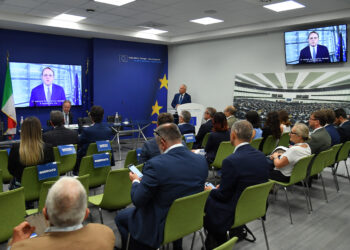
Brussels – Improved access to medicines for European citizens; promotion of innovation; simplification of regulatory procedures; enhanced monitoring and management of medicine shortages across the EU. MEPs from the European Parliament’s Committee on Public Health have approved the agreements reached with the Council of the European Union—and thus with the Member States—on the pharmaceutical package (comprising a directive and a regulation). For the European Parliament’s rapporteur on the directive, the Spanish MEP Dolores Monserrat, who is also vice-president of the European People’s Party (EPP), this is the “most ambitious reform of EU pharmaceutical legislation ever undertaken.”
The European Parliament and the Council have outlined a new regulatory framework designed to balance pharmaceutical innovation with access to treatments, introducing criteria for data protection and market protection. The established framework provides for a standard eight-year period of data protection, during which third parties cannot access product information, followed by a further year of market protection preventing the sale of generic or biosimilar medicines. However, this timeframe may be extended if companies meet specific public interest requirements. To ensure access to medicines across the EU, the package provides for the inclusion of a QR code on the medicine’s packaging: by scanning it, patients can verify the medicine’s authenticity through translations of the name and package leaflet into all EU languages.
To facilitate the timely entry of generic and biosimilar medicines, the new provisions clarify the scope of the “Bolar” exemption, a derogation from patent law that allows generic and biosimilar companies to conduct studies, clinical trials, and administrative procedures while the originator medicine’s patent is still in force. This measure allows manufacturers to carry out preparatory activities, such as studies, clinical trials, and procedures for obtaining pricing and reimbursement information or participating in tenders, without these activities constituting an infringement of patent rights.
As part of the fight against bacterial resistance, a transferable data exclusivity voucher for priority antimicrobials has been introduced. This instrument grants an additional twelve months of protection, which may be used once by the marketing authorisation holder or transferred to third parties for other centrally authorised medicinal products. At the same time, antimicrobial management is becoming stricter: a medical prescription is now mandatory for all products in this category, and companies must provide specific management plans and environmental risk assessments. Information for patients is being enhanced through detailed information requirements and the obligation to provide a paper leaflet when the package leaflet is available only in electronic format.
The modernisation process also involves the internal workings of the European Medicines Agency (EMA), with the aim of speeding up application reviews by adopting a common electronic format. A significant change concerns the validity of marketing authorisations, which will be unlimited by default, eliminating the administrative burden of periodic renewals, whilst retaining the EMA’s power to limit their duration for safety reasons.
Finally, the European Commission will be able to establish regulatory sandboxes to test innovative therapies under strict supervision. To tackle medicine shortages, marketing authorisation holders are now required to draw up and update prevention plans for prescription medicines. Stock monitoring will take place at both national and EU levels, leading to the creation of a European list of critical shortages to ensure the constant availability of the treatments citizens need.
English version by the Translation Service of Withub