- Europe, like you've never read before -
Tuesday, 12 May 2026
No Result
View All Result
  • it ITA
  • en ENG
Eunews
  • Politics
  • World
  • Business
  • News
  • Defence
  • Health
  • Agrifood
  • Other sections
    • Culture
    • Diritti
    • Energy
    • Green Economy
    • Finance & Insurance
    • Industry & Markets
    • Media
    • Mobility & Logistics
    • Net & Tech
    • Sports
  • Newsletter
  • European 2024
    Eunews
    • Politics
    • World
    • Business
    • News
    • Defence
    • Health
    • Agrifood
    • Other sections
      • Culture
      • Diritti
      • Energy
      • Green Economy
      • Finance & Insurance
      • Industry & Markets
      • Media
      • Mobility & Logistics
      • Net & Tech
      • Sports
    No Result
    View All Result
    Eunews
    No Result
    View All Result

    Home » Energy » The EU is grappling with energy costs. However, imported oil and natural gas still account for 60 per cent of the energy mix

    The EU is grappling with energy costs. However, imported oil and natural gas still account for 60 per cent of the energy mix

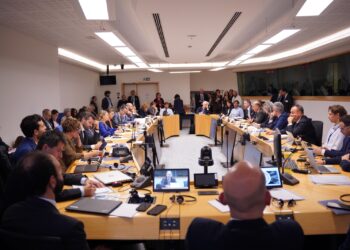
    Tomorrow, EU heads of state and government will call on Brussels to introduce “targeted” short-term measures to curb prices, which have been driven up by the conflict in the Middle East. Italy and nine other countries are insisting on a “thorough review” of the ETS

    Simone De La Feld</a> <a class="social twitter" href="https://twitter.com/@SimoneDeLaFeld1" target="_blank">@SimoneDeLaFeld1</a> by Simone De La Feld @SimoneDeLaFeld1
    18 March 2026
    in Energy

    Brussels – The escalation of the conflict in the Middle East has brought the spectre of an energy crisis back to Europe, four years after the one triggered by the fallout from Russia’s invasion of Ukraine. Over the past four years, the EU has gradually moved away from its dependence on Moscow, diversified its suppliers and increased domestic production of renewable energy. However, this has not been enough to insulate it from soaring oil and gas prices, which, according to data released today by Eurostat for 2024, still account for 60 per cent of the Union’s energy mix.

     In 2024, the EU produced 43 per cent of its energy, whilst 57 per cent was imported. This is the picture painted by the EU Statistical Office. However, whilst member states mainly produce renewable energy (48 per cent of the total) and nuclear energy (28 per cent), they import almost exclusively oil and petroleum products (67 per cent of the total), natural gas (24 per cent) and coal (4 per cent). Thus, the EU’s energy mix, combining domestic production and imports, consists of crude oil (38 per cent), natural gas (21 per cent), renewable energy (20 per cent), nuclear energy (12 per cent), and solid fuels (10 per cent). 

    Since the start of the conflict in Iran, gas prices have risen by 50 per cent and oil prices by 27 per cent. However, the damage to numerous oil and gas infrastructure facilities in Iran and the Gulf states targeted by Tehran’s reprisals, and the closure of the Strait of Hormuz—through which a fifth of the world’s oil supply passes—are having an asymmetrical effect on EU countries. So much so that, on the eve of a European summit in which energy costs will once again dominate the agenda, leaders appear to be far apart. For everyone, high energy costs, higher than in the United States and China, are a structural problem. But not everyone perceives the urgency of the situation amid the new conflict. 

    In Sweden, Latvia, and Denmark, where renewable energy already accounted for over 40 per cent of the energy mix in 2024, citizens’ bills were less affected. The same is true in France, where 40 per cent of the available energy comes from nuclear power stations. In Italy, natural gas accounts for 36 per cent of the energy mix, and costs have skyrocketed. Italy is pointing the finger at the Emissions Trading Scheme (ETS): Giorgia Meloni, together with the leaders of Austria, Bulgaria, Croatia, the Czech Republic, Greece, Hungary, Poland, Romania, and Slovakia, has sent a letter to the President of the European Commission, Ursula von der Leyen, and the President of the European Council, Antonio Costa, insisting on a “thorough review of the ETS, aimed at mitigating its impact on electricity prices and reducing the risk of carbon price volatility.” 

    A diplomatic source explained that the priority is not the suspension, or the “fundamental overhaul”, of the ETS itself, but the reduction of costs, to be achieved by any means necessary. In the summit’s conclusions, leaders will call on the European Commission to implement short-term, targeted measures to ensure affordable energy. The debate over decoupling the electricity market is also resurfacing, which would allow electricity prices to be separated from natural gas prices. 

    The fact remains that, however you look at it, the Eurostat report reveals a worrying figure: within the EU, the rate of dependence on energy imports stands at 57.2 per cent. Twenty years ago, in 2004, it was 56.9 per cent. This means that almost 60 per cent of the Union’s energy needs are still met by net imports. Von der Leyen herself, speaking a few days ago at the European Parliament in Strasbourg, pointed to the only sustainable solution: “We have domestic energy sources: renewables and nuclear power. Their prices have remained unchanged.”

    English version by the Translation Service of Withub
    Tags: energiaeuropean councileurostat

    Related Posts

    tassa sul carbonio emissioni ETS
    Energy

    The EU Commission proposes new parameters for the ETS: 4 billion for industry

    11 May 2026
    Banconote da 50 euro. Fonte: Mattia Calaprice, via Imagoeconomica
    Business

    Euro dominates extra-EU trade in primary goods

    11 May 2026
    GAS AUMENTI SOLDI ECONOMIA  CARO ENERGIA
    Energy

    EU gas and electricity costs for businesses and services fell in the second half of 2025

    8 May 2026
    ALESSANDRA TODDE POLITICA
    Briefs

    Todde (Sardinia): Defending territorial continuity and autonomy in renewable energy

    6 May 2026
    CARO BOLLETTE UTENZA UTENZE SPESE BOLLETTA LUCE ENERGIA ELETTRICA COSTO BOLLETTA AUMENTO CALCOLO CALCOLI CALCOLATRICE
ELETTRICITA' GAS
    Business

    Iran: the ECB calls it an “unprecedented energy crisis”. Risks for investment, consumption and aviation

    6 May 2026
    FORNELLO GAS FORNELLI
UTENZA UTENZE DOMESTICA DOMESTICHE
DOMESTICO USO
    Energy

    Gas bills in the EU rose by 7.4 per cent in the second half of 2025

    5 May 2026
    map visualization
    Riunione di alto livello della Coalizione internazionale per il ritorno dei bambini ucraini. Da sinistra a destra l’Alta rappresentante dell’Unione europea per la Politica estera e di sicurezza, Kaja Kallas, la commissaria all'allargamento, Marta Kos, il ministro degli Affari esteri ucraino, Andrii Sybiha e il ministro degli Affari esteri canadese, Anita Anand. Crediti: Consiglio Unione Europea.

    The EU Commission allocates €50 million to support the return of Ukrainian children abducted by Moscow

    by Iolanda Cuomo
    11 May 2026

    The EU, Canada, and Ukraine have met in Brussels to coordinate measures aimed at helping the government in Kyiv to...

    tassa sul carbonio emissioni ETS

    The EU Commission proposes new parameters for the ETS: 4 billion for industry

    by Annachiara Magenta annacmag
    11 May 2026

    Under the proposal, industries will continue to receive, on average, a free allocation equivalent to around 75 per cent of...

    Il ministro degli Esteri ucraino, Andriy Sybiha, con l'Alta rappresentante per la politica estera e di sicurezza dell'UE, Kaja Kallas [Bruxelles, 11 maggio 2026. Foto: European Council]

    Ukraine: the EU is considering its representative for the (distant) negotiations with Moscow. Kallas puts herself forward

    by Emanuele Bonini emanuelebonini
    11 May 2026

    Russia has put forward the name of former German Chancellor Gerhard Schröder for the peace talks, but foreign ministers are...

    hantavirus

    ECDC: “Further cases of hantavirus are possible in the coming weeks”

    by Valeria Schröter
    11 May 2026

    The European Commission: "According to the latest assessment by the World Health Organisation, the risk to the general European population...

    • Director’s Point of View
    • Opinions
    • About us
    • Contacts
    • Privacy Policy
    • Cookie policy

    Eunews is a registered newspaper
    Press Register of the Court of Turin n° 27


    Copyright © 2025 - WITHUB S.p.a., Via Rubens 19 - 20148 Milan
    VAT number: 10067080969 - ROC registration number n.30628
    Fully paid-up share capital 50.000,00€


    No Result
    View All Result
    • it ITA
    • en ENG
    • Politics
    • Newsletter
    • World politics
    • Business
    • General News
    • Defence & Security
    • Health
    • Agrifood
    • Altre sezioni
      • Culture
      • Diritti
      • Energy
      • Green Economy
      • Gallery
      • Finance & Insurance
      • Industry & Markets
      • Media
      • Mobility & Logistics
      • Net & Tech
      • News
      • Opinions
      • Sports
    • Director’s Point of View
    • Draghi Report
    • Eunews Newsletter

    No Result
    View All Result
    • it ITA
    • en ENG
    • Politics
    • Newsletter
    • World politics
    • Business
    • General News
    • Defence & Security
    • Health
    • Agrifood
    • Altre sezioni
      • Culture
      • Diritti
      • Energy
      • Green Economy
      • Gallery
      • Finance & Insurance
      • Industry & Markets
      • Media
      • Mobility & Logistics
      • Net & Tech
      • News
      • Opinions
      • Sports
    • Director’s Point of View
    • Draghi Report
    • Eunews Newsletter

    Attention