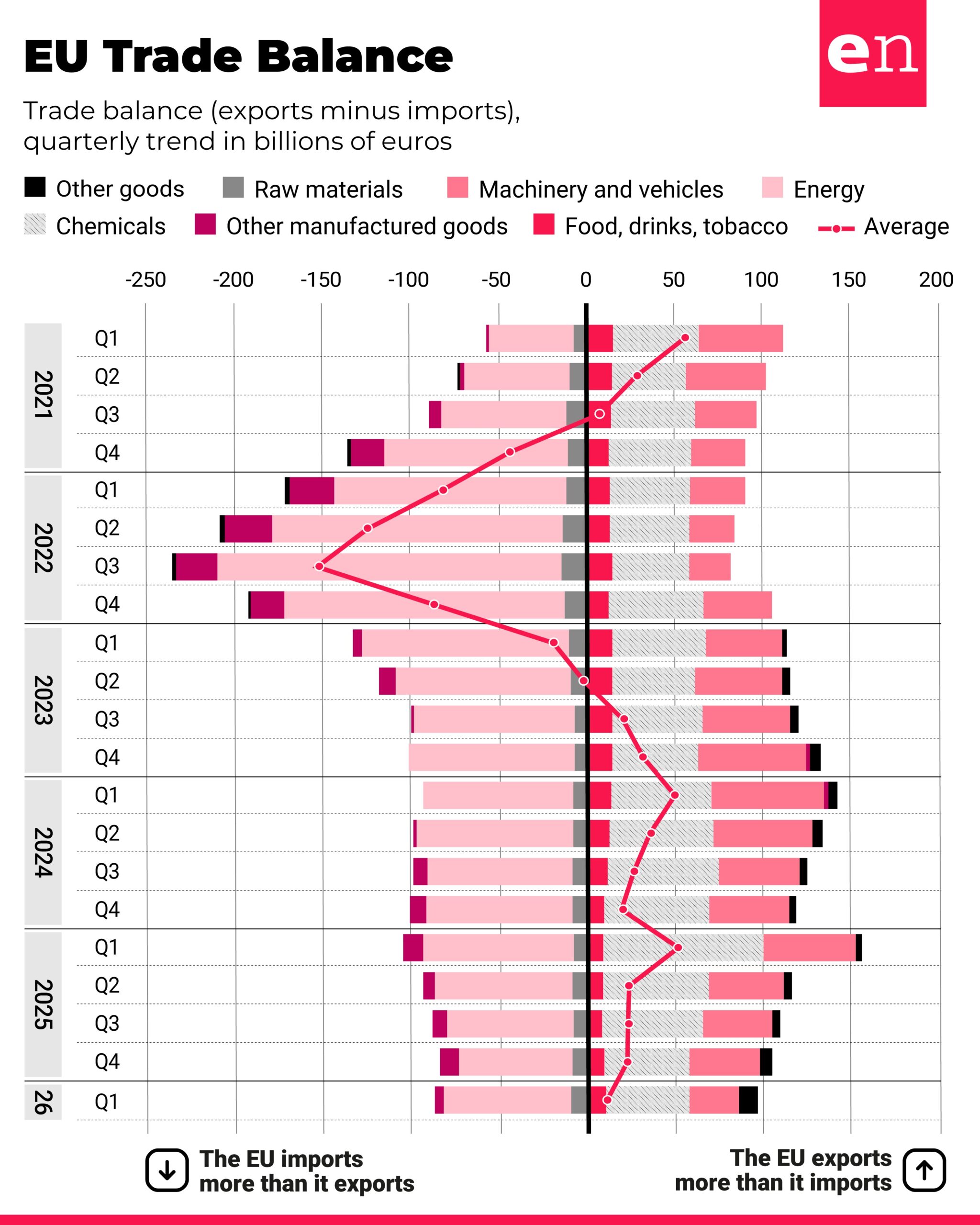
Brussels – Rising energy costs and a fall in exports to the US have put pressure on the European Union’s trade and accounts in the first quarter of 2026. According to the latest figures released by Eurostat, the EU’s statistical office, in the first quarter of 2026, the EU’s trade surplus fell to €12.7 billion, marking a sharp decline from the €23.6 billion recorded in the final quarter of 2025. Although the balance remains positive—a trend that has continued since the third quarter of 2023—the decline is stark compared with the same period of the previous year, when the surplus from the difference between exports and imports stood at €52 billion.
Analysing seasonally adjusted data (i.e., stripped of periodic fluctuations caused by weather, public holidays or commercial practices), the EU Statistical Office reveals that the slowdown in the European trade balance is attributable to two key factors: tariff tensions with the United States and rising energy costs. Following a peak in exports in the first quarter of 2025, driven by fears of new tariffs, exports to the US gradually declined, eroding the trade balance in subsequent quarters. Furthermore, in the first quarter of 2026, a sharp rise in energy prices, following the crisis in the Strait of Hormuz, caused import values to soar, further depressing the overall surplus.
Looking at the last nine months, while imports returned to a 1.7 per cent growth—for the first time after three quarters of decline—exports, by contrast, recorded a slight 0.1 per cent fall, marking the fourth consecutive quarterly decline. Compared with a year ago, the figure is even more pronounced: exports have plummeted by 8.8 per cent, while imports have fallen by 3.3 per cent.
The deterioration in the trade balance was driven mainly by two sectors: machinery (and vehicles) and energy. Compared with the final quarter of 2025, the surplus in the former fell from €39.8 billion to €27.8 billion, while the energy deficit worsened from €64 billion to €72.2 billion. These losses were partially offset by an improvement in the “other manufactured goods” sector, where the deficit narrowed from -€10.9 billion to -€5 billion.
In terms of global trading partners, the EU maintains substantial surpluses with the UK and the US, driven by machinery and vehicles, and other manufactured goods. Conversely, these same two product groups are at the root of the substantial deficit with China that has persisted since 2021. Furthermore, since the first quarter of 2025, a significant European trade deficit for energy products has continued, particularly with the United States and Norway: in the first three months of 2026, it stood at -€17.78 billion (-€3.21 billion compared to the last quarter of last year) and -€10.90 billion (-€1.58 billion from Q4 2025) respectively.
In particular, among Europe’s major importers of energy products, the United States has remained the leading supplier (19.3 per cent) and Norway the second (11.9 per cent), a position they have held since the first quarter of 2023, when they overtook the Russian Federation as a result of Brussels’ policy of distancing itself from Moscow following the invasion of Ukraine. In this first quarter of 2026, Saudi Arabia (6.8 per cent) took third place in this ranking for the first time, overtaking Kazakhstan. Eurostat highlights that the map of energy suppliers has changed significantly since 2021: from January to March 2026, the share of imports from Russia plummeted from 26.61 per cent to 3.6 per cent, compared with the first quarter of 2021, when Russia was Europe’s top energy supplier; it is now seventh.