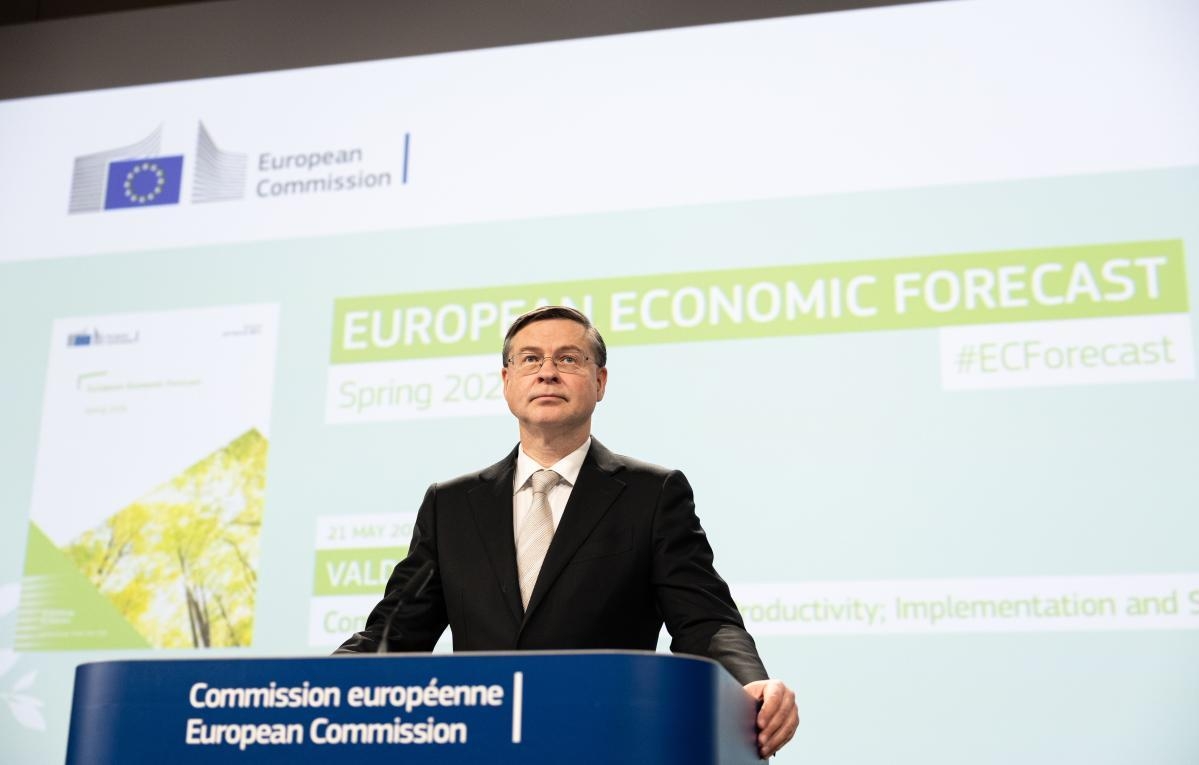
Brussels – It’s all down to Donald Trump and Benjamin Netanyahu, and their wars in the Middle East. The political message underlying the Commission’s spring economic forecasts is all there, in the not-so-veiled condemnation that the Commissioner for the Economy, Valdis Dombrovskis, directs at the military manoeuvres of the United States and Israel. “The conflict in the Middle East has triggered a major energy shock, further testing Europe as it navigates an already volatile geopolitical and trade environment,” Dombrovskis said as he presented the figures, which confirm what the ECB had already anticipated, namely a loss of one-third of a percentage point in growth.
Due to rising energy prices caused by the war in Iran, the European Commission has revised down its growth forecasts for the EU and the eurozone. For the European Union as a whole, growth is now expected to be 1.1 per cent in 2026 (compared to the 1.4 per cent forecast in November), and 1.4 per cent in 2027 (compared to the previously expected 1.5 per cent). The eurozone has also seen its forecast cut by 0.3 percentage points: growth is now expected to be 0.9 per cent by the end of 2026 (instead of 1.2 per cent) and 1.2 per cent in 2027 (instead of 1.4 per cent).
“The EU economy will continue to grow, but at a slower pace,” summarises the European Commission, and this is due to the actions of actors traditionally considered EU partners, whose behaviour now calls everything into question. The note accompanying the economic forecasts clarifies “before the end of February 2026, the EU economy was set to keep expanding at a moderate pace alongside a further decline in inflation, but the outlook has changed substantially since the outbreak of the conflict“ in Iran. This is where the blame is pointed at the United States and Israel. Due to their actions, “inflation started picking up a few weeks after the outbreak of the conflict, driven by the sharp increase in energy commodity prices, and economic activity is losing momentum.” For Brussels, the situation “is set to improve slightly in 2027 if tensions on energy markets ease.” In other words, peace is needed in Iran.
The Commission fears the worst: calls for reforms and spending restraint
The major risk surrounding the forecast concerns the duration of the conflict in the Middle East and its implications for global energy markets: this is the real wildcard of economic forecasts drafted with so many question marks. “Given the unusually high degree of uncertainty, and the narrowing window for a rapid normalisation of supply conditions,” the baseline forecast is complemented by an alternative scenario assuming more prolonged disruptions.
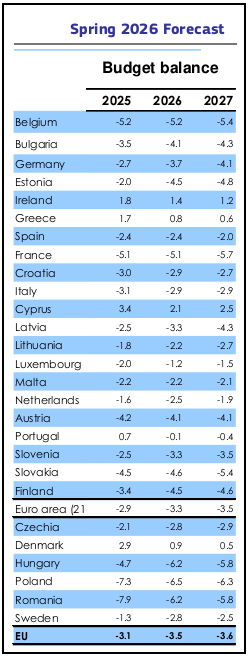
Furthermore, “the energy shock is also shaking economic sentiment, with households tempted to increase their savings, thereby exposing businesses to weaker demand,” Dombrovskis warned. Faced with this situation, Member States should take appropriate precautions and implement suitable policies. The Commissioner for the Economy explains what this means: “Acting with unity and determination, Europe should accelerate reforms, remove barriers to growth, and safeguard sound public finances.” More generally, Dombrovskis continues, “The EU must learn from past crises by keeping fiscal support temporary and targeted, and further reducing its reliance on imported fossil fuels.”
![Il commissario per l'Economia, Valdis Dombrovskis [Atene, 23 aprile 2026]](https://www.eunews.it/wp-content/uploads/2026/04/dombro-260423-350x250.png)