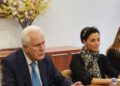

Brussels – “We believe it is necessary to introduce appropriate adjustments to the ETS emissions trading system in order to avoid a further increase in production costs compared to international competitors.“ This statement was made by the Italian Minister for Agriculture, Food Sovereignty and Forestry, Francesco Lollobrigida, during a public session of today’s Agriculture and Fisheries Council (26 May). “The crisis in Hormuz marks one of the many critical issues facing the global system, for which Europe is not prepared. On fertilisers, we are calling for an industrial strategy and the use of digestate, which is entirely in line with environmental sustainability,” he added during a press briefing. “The time for delays, excessive bureaucracy, and endless waits for answers is over. We have reiterated this, and I must say that many nations today have expressed support for our request,” commented the minister.
In response to the rise in fertiliser prices caused by the war in Iran, the Commission adopted a Fertiliser Action Plan on 19 May. This is an initiative aimed at supporting farmers, addressing rising costs and fertiliser shortages, with a view to strengthening domestic production and reducing Europe’s dependence on imports. Among the various measures, the plan provides for the Commission to provide exceptional support through existing instruments under EU agricultural policy, to mobilise the EU budget to significantly increase the agricultural reserve and to adopt measures to support the domestic fertiliser industry. However, according to the Commission, this must be reintegrated into the forthcoming review of the Emissions Trading System (ETS), the main European instrument for decarbonisation.
At a meeting today, European agriculture ministers expressed their views on the plan. The Minister of Agriculture of Cyprus—the country currently holding the six-month presidency of the EU Council—Maria Panayiotou described it as “a toolbox, a roadmap,” but reservations were expressed. On the subject, Lollobrigida noted that “the time for delays and excessive bureaucracy, for endless waits for answers, is over,” emphasising that other nations also agreed with Italy’s requests.
For Minister Lollobrigida, however, this is not enough. “I welcome the initiative leading to a one-year suspension of customs duties on the main nitrogen-based fertilisers, although we believe it is completely insufficient,” he explained. “For this reason, at the national level, we have taken action to support the sector with a temporary measure aimed at offsetting the rise in the cost of fertilisers used in agriculture,” he added. For the minister, “the issue of the availability and affordability of fertilisers is now central to European food security and the competitiveness of our agricultural sector”, and “the measures set out by the Commission in its 2022 communication must be adapted to the changed geopolitical context, and quickly,” he stated.
In particular, “in the short term, it is necessary to incentivise the production and marketing of innovative fertilisers, including those derived from the recovery of by-products, in line with the principles of the circular economy.” This is a process that “we believe needs to be accelerated”, he added. For Lollobrigida, “alternatives to chemical fertilisers are necessary to pursue environmental sustainability as a common goal.” But this “cannot, in our view, ever be separated from ensuring the vitality and economic and social resilience of agricultural systems and rural areas,” he continued. “With this in mind, we welcome the priorities identified by the Fertiliser Action Plan, including nutrient circularity, domestic fertiliser production and the development of alternatives of biological origin.”

![[Copyright: European Union]](https://www.eunews.it/wp-content/uploads/2026/10/euco-261015-120x86.png)