
Brussels – The European Commission has responded to Pope Leo XIV’s call for stricter regulation of artificial intelligence (AI) systems, as set out in the encyclical letter “Magnifica Humanitas” presented at the Vatican on 22 May. Or rather, according to the EU executive, Brussels has already heeded the Holy See’s exhortations by launching the process to amend the
Artificial Intelligence Act
(AI Act), on which the European Parliament and the Council announced on 7 May that they had reached an agreement.
The core of the encyclical letter dedicated to “the protection of the human person in the age of artificial intelligence”, the first document of its kind in Robert Prevost’s pontificate, is the appeal to all the world’s governments to impose stricter limits on the development and use of AI technologies, described by Leo XIV as “yet another Babel.” Just as those who sought to build a tower reaching to the heavens to defy God – so the Pope argues – the tech giants too are driven “by the idolatry of profit that sacrifices the weak, by uniformity that erases differences, and by the demand for a single language.” All of these are negative values that open the door to the risk of “dehumanisation.”
During the usual midday briefing with journalists, the European Commission’s spokesperson on technological issues, Thomas Regnier, stated that the Berlaymont Building fully shares the Vatican’s position. “In Europe, an effective legal framework on AI is already a reality,” he explained, citing some of the EU measures on artificial intelligence: first and foremost, the AI Act, but also the Digital Services Regulation, the one on Digital Markets, and the one on Data protection.
According to the spokesperson for the European Commission, these rules already address some of the critical issues surrounding AI that Leone highlighted. For example, Regnier emphasised, “thanks to our legal framework, we can protect minors, but also women, from the use of nudifier apps”, those AI systems capable of virtually undressing people without their consent and creating artificial child pornography. “This content,” Regnier insisted, “has no place in Europe.”
While the European Commission has fully endorsed the general thrust of Leone’s appeal, it remains to be seen what Brussels’ position is on a far more contentious issue: the role of the owners of major tech companies in the United States and their fundamental hostility to stricter rules and controls.
While it is true that there are some exceptional cases of tech giants who have demonstrated that they share the Pope’s vision of a more ethical and “human” AI—for example, the co-founder of the US company
Anthropic, Christopher Olah, attended the launch ceremony for Magnifica Humanitas and has repeatedly referred to the moral dimension of his work—the general trend is diametrically opposed. The main owners of AI companies in Silicon Valley view the new European regulations and the Vatican’s appeals with scepticism, to say the least.
In this regard, one of the figures most hostile to Pope Leo is Peter Thiel, founder of the payment system PayPal and the data analytics company Palantir. A staunch Trump supporter and aspiring “guru”, Thiel has even gone so far as to describe the technological regulation of AI systems as one of the “more or less occult forces” representing the Antichrist and which “work tirelessly to destroy what remains of the West.”
In light of this, during today’s briefing, Regnier was explicitly asked whether the Commission is prepared to include Palantir on the list of AI companies classified as “high-risk”. This would be a particularly significant decision, as these companies will be required to comply with higher safety standards from 2 December 2027 (a deadline postponed by the new version of the AI Act from the original deadline of 2 August this year).
“I don’t want to go into the specific details of any individual company,” Regnier cautioned, “but I can assure you that there is no legal loophole in our legislation and that every high-risk model must meet much stricter criteria and provide a risk analysis.” Otherwise, the Berlaymont spokesperson concluded, “it will be completely banned within the EU.”
Let’s hope that’s the case, given the “troublesome clients” to whom Thiele’s company offers its services. According to an investigation by the weekly magazine Internazionale, Palantir has carried out data analysis for the Israeli army in the Palestinian territories and for ICE, the US immigration enforcement agency responsible for numerous acts of violence and the killing of two American citizens during a series of protests in January this year.
English version by the Translation Service of Withub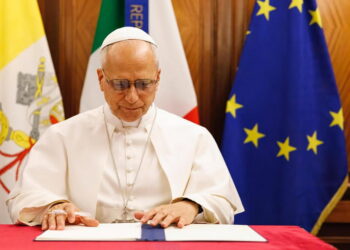
![Wojciech Rafal Wiewiórowski [foto: ]](https://www.eunews.it/wp-content/uploads/2026/05/dpd26-opening-remark-ww-350x250.jpeg)



![La presidente del Parlamento europeo, Roberta Metsola, con il presidente del Consiglio europeo, Antonio Costa [Bruxelles, 15 ottobre 2026. Foto: European Council]](https://www.eunews.it/wp-content/uploads/2026/10/metsola-costa-120x86.png)