The encyclical Magnifica Humanitas: how it measures up against the European Union’s ongoing work on artificial intelligence, and against the perennial, unresolved question of the ethical foundations of lawmaking. This is the substance of the low-key presentation of Pope Leo’s first theoretical and theological exercise, broadcast this morning by Vatican TV.
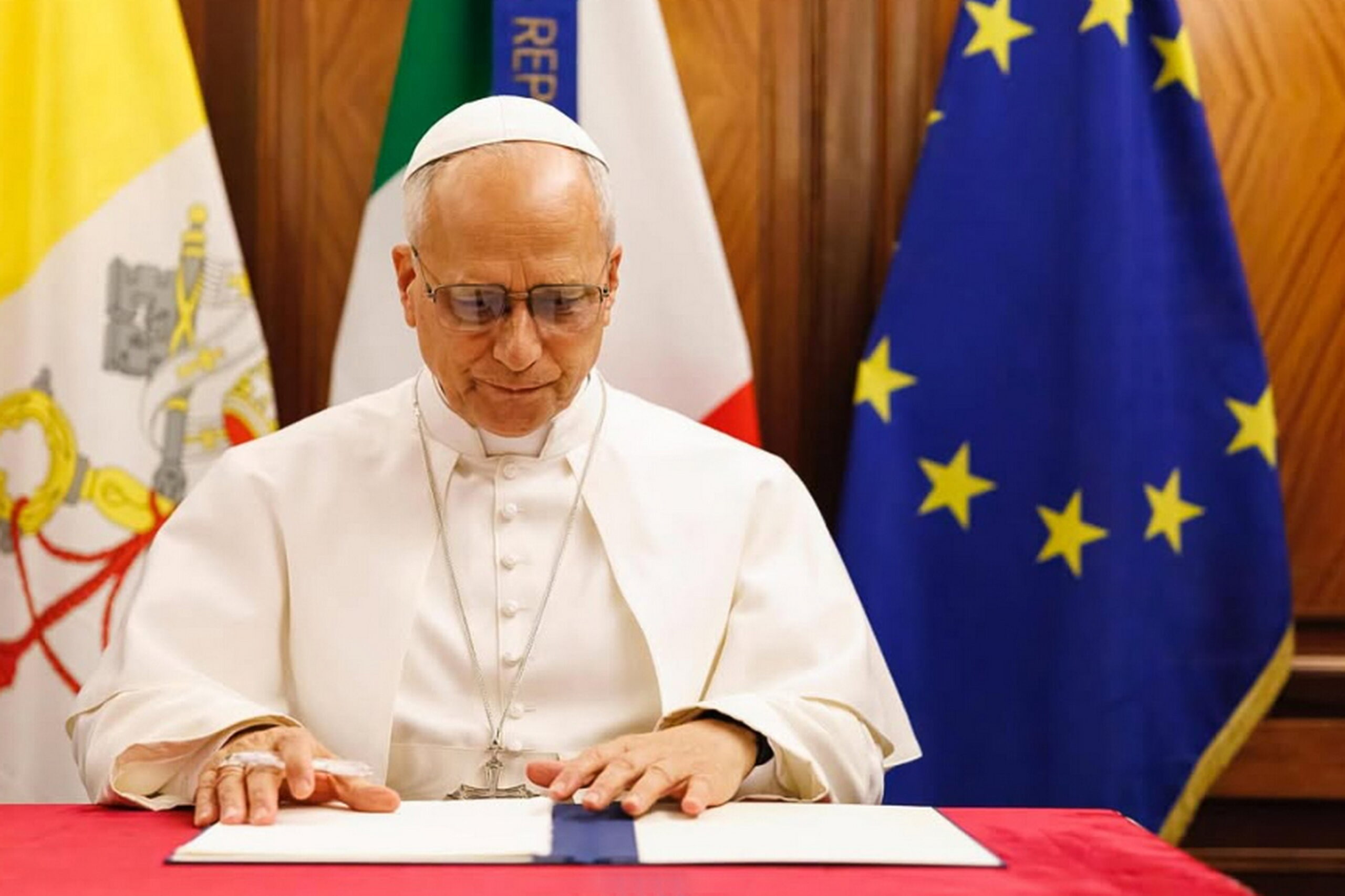
Two texts, two institutions, two vocabularies. On one side, Leo XIV signed (on 22 May, to be precise) his first social encyclical, Magnifica Humanitas, devoted to “the guardianship of the human person in the age of artificial intelligence”: 105 pages, five chapters, a theoretical and philosophical, theological and moral genealogy tracing back to Leo XIII and Rerum Novarum of 1891. On the other, Brussels, with its institutions (or the institution?) in the midst of one of the most crowded legislative construction sites in its history: the AI Act in its implementation phase, the Digital Omnibus provisionally approved on 7 May, the deadlines for high-risk systems pushed back to 2027 and 2028, transparency guidelines still under consultation. Two parallel processes that graze each other at precise points and ignore each other, or contradict each other, at others. To measure the distances, it is worth asking who, in concrete terms, sits at the two tables.
Who is Catholic in Brussels? The question is not straightforward. At the general demographic level, according to the 2021 Eurobarometer, 45.3 per cent of European Union citizens identify as Catholic, making it the largest denomination across the entire EU. The countries that have historically produced the greatest number of officials, commissioners and Members of the European Parliament (Italy, France, Spain, Poland, Belgium, Portugal, Ireland) are traditionally Catholic majority, albeit with very different trajectories of secularisation, and in some cases trajectories that have accelerated and been transformed over the past fifteen years.
At the institutional level, the academic project RelEP (Religion at the European Parliament), conducted by the Université Libre de Bruxelles in two phases between 2009 and 2024, is the only available source on what Members of the European Parliament actually believe, and on how those beliefs bear upon their work. The research found significant continuity between the two phases: many profiles coexist, many views diverge, sometimes openly colliding, sometimes ignoring each other, rarely surfacing explicitly in political debate. Within the research sample, there is a majority of representatives from Catholic societies, a minority from Protestant traditions, and a significant presence of MEPs from countries with Orthodox traditions: Romania, Bulgaria, Greece.
The sharpest interpretive point is captured in a concept developed by Professor François Foret, the project coordinator: “In the European parliamentary context, secularism performs the same function that religion performs in the United States.” This produces what Foret calls a “secular canopy,” a secular covering beneath which MEPs are very reluctant to express their personal beliefs, regardless of what those beliefs actually are. When it comes to day-to-day work, the great majority of MEPs treat religion as a social reality to be taken into account in lawmaking, not as a direct source of normative inspiration. A very small minority describe it as the driving force of political action.
Almost all of them say they have encountered it as a lobbying force. And that lobby exists, structured and formally recognised. COMECE (the Commission of the Bishops’ Conferences of the EU), founded in 1980, has its permanent headquarters in Brussels and officially represents the episcopal conferences of the twenty-seven member states before the European institutions. It is a registered actor with regular access to the Commission and Parliament, and intervenes with written positions on dossiers ranging from bioethics to migration policy, from child protection to ethical frameworks for emerging technologies, including space.
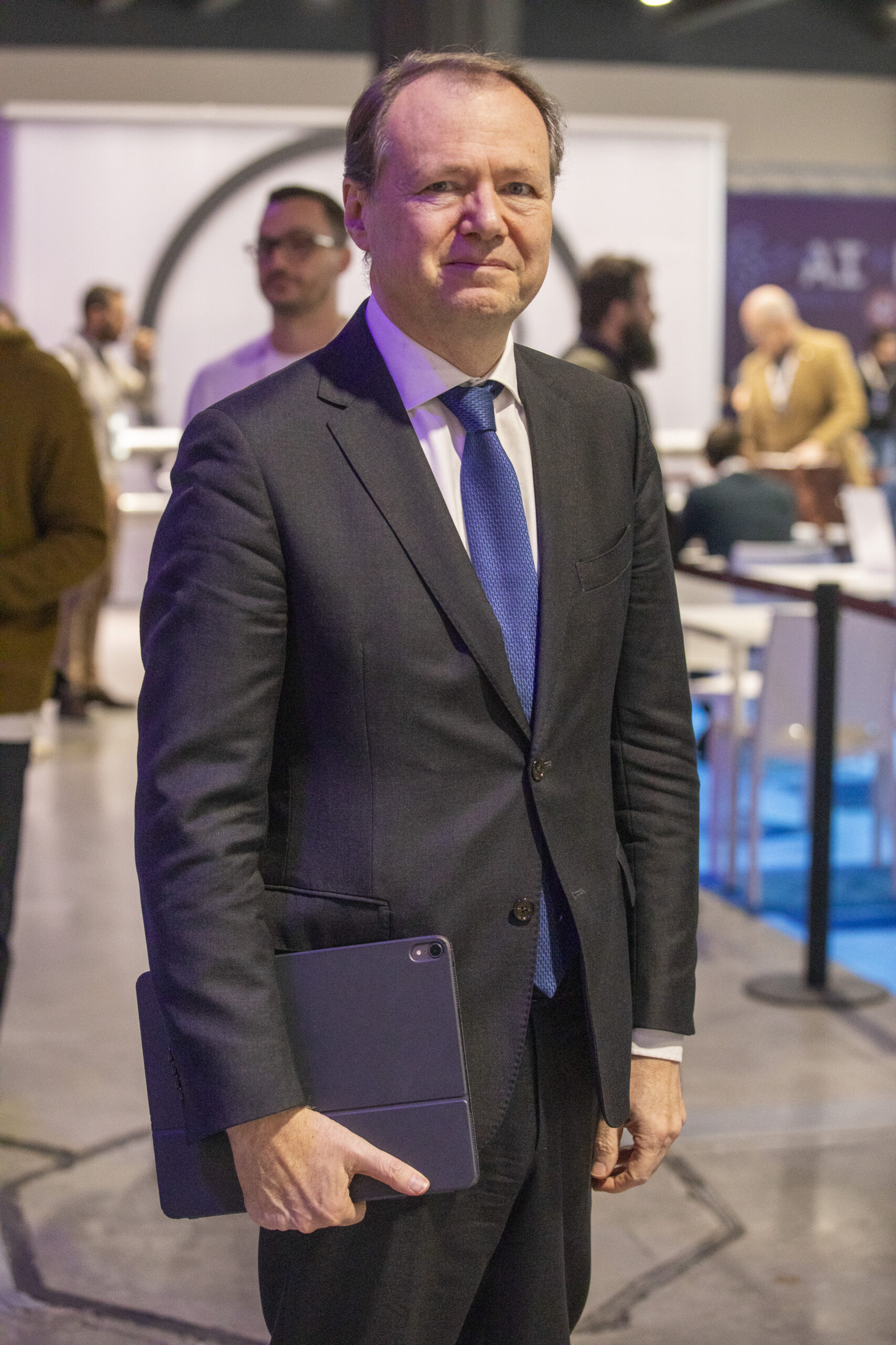
At the level of individual biographies, the case of Roberto Viola, Director General of DG CONNECT and the person responsible for the technical architecture of European digital regulation, illustrates the limits of any investigation rather well: there is no public documentation on his religious affiliation or practice. Italian, with a degree in electronic engineering from La Sapienza in Rome, a linear technocratic career spanning ESA, AGCOM and the Commission, no public statements, no profile indicating any explicit confessional affiliation. The question therefore remains unanswered. Viola was born in 1958: like the overwhelming majority of his contemporaries, he will have been raised as a Catholic, but his profile is indicative of an entire generation of senior European officials formed in Catholic countries, secularised in their professional lives, culturally steeped in a tradition they no longer name.
Nevertheless, it is undeniable that the Catholic tradition has already shaped European law. The most consolidated and least visible channel is that of the Christian democratic tradition. Subsidiarity, solidarity and the common good are terms that appear in the Union’s Treaties and in the DNA of the EPP, which was the largest parliamentary group for decades; they are also the vocabulary of Catholic social doctrine, transferred into Europe’s institutional grammar from the outset by the founding fathers Adenauer, De Gasperi and Schuman. When Leo XIV uses those terms in the encyclical, he is not using language that is foreign to Brussels: he is speaking partly in “the original ideological idiom of the European project itself,” as a retired senior official observes. A language that Brussels has secularised, made operational and, in some cases, rendered almost autonomous.
The more recent channel concerns ethical policies in biomedical and digital areas. In many European countries the Catholic Church continues to play a significant role in shaping educational policies and in the legal choices concerning ethical issues and bioethics, including, explicitly, artificial intelligence, abortion, end-of-life questions and freedom of religion. COMECE submitted written positions in the consultation process on the AI Act, insisting on the need to protect human dignity, to “ensure algorithmic transparency” and to provide for “mandatory human oversight in high-impact decisions.” Some of these observations found their way into the final text. It is not possible to establish the specific weight of that pressure relative to other actors, but the direction is verifiable. Denominational affiliation operates as a form of “path dependence,” influencing the attitudes and behaviour of MEPs, though the degree of integration into a religious system makes a considerable difference: a Polish Catholic and a Belgian Catholic do not vote the same way on almost anything. Yet on certain bioethics and personal protection dossiers, the cross-party coalition between the Catholic centre-right and conservatives of other persuasions produces majorities that political calculation alone would not explain.
The most solid point of convergence between the encyclical and the European regulatory framework concerns responsibility distributed across the AI chain. The papal document explicitly uses the English term accountability, meaning traceable answerability: every stage in the lifecycle of a system, from design to use, must be traceable and contestable. The AI Act, in its version amended by the AI Omnibus, has codified obligations of transparency and human oversight for systems classified as high-risk, requiring that automated decisions on employment, credit and access to services remain open to challenge. The grammar differs; the problem is the same: who answers when the algorithm fails and causes harm?
There is comparable alignment on the non-neutrality of digital tools. The encyclical states plainly that “every technical artefact carries with it choices and priorities: what it measures, what it ignores, what it optimises.” The AI Act, by classifying as high-risk the systems used for personnel selection, credit assessment and the scoring of natural persons, implicitly acknowledges that certain applications create asymmetries of power that technical efficiency alone cannot neutralise. The Vatican calls this “moral discernment”; Brussels calls it “assessment of the risk to fundamental rights.” The practical outcome is not far apart, even if the paths taken are different.
On the environmental front, Leo XIV’s text signals the energy cost of large language models (LLMs), data centres as energy-hungry infrastructure and water consumption as a hidden externality. The Commission, through the AI Continent Action Plan and recent allocations for innovation in health and online safety, has begun to integrate sustainability as an evaluation criterion, though still in embryonic form compared to the urgency the encyclical considers warranted.
As regards the protection of minors, according to the Commission’s most recent findings, 92 per cent of Europeans consider the online safety of children a high priority. The political agreement of 7 May explicitly introduced a ban on so-called nudification applications, AI systems that generate non-consensual intimate images, an area in which the papal text insists on the commodification of the body as a form of reduction of ontological dignity. On this specific point, moral and legal language overlap almost perfectly, despite proceeding from different premises.
There are, however, significant divergences, and here the ground becomes more treacherous; analysis requires caution precisely because these are, by definition, distinct normative planes: one moral, the other legal. But the overlap is deliberate on both sides. The encyclical addresses itself explicitly to legislators; the European legislation explicitly declares the protection of fundamental rights as its purpose. When two texts claim the same terrain on different foundations, the divergences become politically significant.
The first point of friction concerns the pace of regulation. Leo XIV calls, in a direct passage, for “the courage to slow the adoption of AI” when ethical maturity does not keep pace with technical development. Brussels has made the opposite choice: the European institutions have worked with declared urgency to extend deadlines and reduce administrative burdens for businesses, in the name of competitiveness. The Digital Omnibus was born in response to industry pressure and lobbying from companies complaining of regulatory overload. The Vatican asks for restraint; the Commission asks for faster simplification. This is not a negligible shade of opinion; it is a strategic choice pointing in the opposite direction.
The second point of divergence strikes at the core of the digital economy. Leo XIV argues that “the ownership of data cannot be entrusted to private parties alone,” invoking John Paul II on the “universal destination of collective goods.” According to a senior EU digital expert consulted on the matter, “European legislation on this, from the GDPR to the Data Act, regulates the use of personal data but does not call into question its ownership structure. The Digital Omnibus, by simplifying data access and harmonising so-called incident notifications, operates according to a logic of market fluidity, not the redistribution of informational assets.” These are two philosophies that are incompatible in the long run: the Pope regards data as a common good from which everyone derives value and to which everyone should have access; the other treats them as assets to be regulated in their use, without touching the ownership regime.

Third round: artificial intelligence in military applications. Magnifica Humanitas devotes a specific section to “weapons and artificial intelligence,” denouncing the normalisation of war as a collateral effect of the technocratic paradigm. The AI Act, which entered into force on 1 August 2024, explicitly excludes from its scope systems for military use and national security: a gap that the encyclical, without directly citing European legislation, illuminates as an intolerable evasion of political responsibility. At a moment when the Commission is discussing strategic autonomy and European rearmament, this exclusion does not look “technical”; it is a deliberate choice of alignment.
Fourth: democratic participation in defining the values of AI. The papal document denounces the fact that the ethical alignment of systems, if decided by the few, becomes “invisible infrastructure of those systems,” imposing a private morality with public force. The principal European instrument for the ethical governance of large platforms and generative models is the Code of Conduct for GPAI models. Drawing on Wired’s explanation (the Condé Nast magazine dedicated to advanced technology, first published in 1993), these are General Purpose AI: “foundational artificial intelligence systems trained on vast quantities of data, capable of performing a wide variety of different tasks (generating text, creating images, writing computer code) and adaptable to countless applications.” The code is still in its second draft and has been written largely by the very entities it is intended to regulate. The distance from the “shared responsibility” invoked by Leo XIV is considerable, and the fact that the principal contributors to the code are the same companies that hold the data, the infrastructure and the computational capacity only deepens the concern, further widening the grey area of interest representation governance within an ecosystem as complex as Brussels.
Yet the subtlest point of friction is this. When the Vatican proposes an AI ethics rooted in Christian anthropology, and Brussels responds with a procedural risk framework, both believe they are speaking about human dignity. But they are using the term on incompatible foundations: one moral and religious, the other functional. For Leo XIV, dignity is “infinite, inalienably grounded in the very being” of every person, independent of any performance or utility. For the AI Act, dignity is a fundamental right to be protected procedurally, verifiable through impact assessments, technical documentation and redress mechanisms. This fundamental incompatibility makes the convergences almost momentary and opportunistic, while the divergences risk becoming structural.
In any future legislative agenda on AI, the divergence could emerge with force on issues such as the decisional autonomy of systems in healthcare and social care, the definition of the “person” as relevant to algorithmic rights, the governance of genetic data, or the regulation of AI systems applied in educational and care contexts. Across all these areas, the boundary between “moral discernment” and “technical risk assessment” is not a question of competence but of who decides which vision of the human is to be encoded in the systems.
The religious affiliation of MEPs, real but operating beneath the “secular canopy,” offers no automatic answer to that question. It produces instead a diffuse sensibility, a predisposition towards certain arguments, a familiarity with a vocabulary that surfaces at moments of normative crisis. That is not nothing, but it is not enough to bridge the gap between an ethics of the person and the regulation of the product.
It would be wrong to reduce this confrontation to a clash between ethics and the market, or between Rome and Brussels. The encyclical is not hostile to technology; Brussels is not indifferent to human dignity. The Vatican knows the Treaties well; the Commission knows social doctrine well. Both are seeking a balance between innovation and protection. But they are seeking it with radically different tools and time horizons: one reasons, as we know, across centuries of tradition and a vision of humanity that does not change with every electoral cycle; the other reasons, as we see, across five-year mandates and today under competitive pressures directed at Washington and Beijing, through a bureaucratic apparatus that, to survive, must demonstrate that it does not hold back growth.
The sharpest point of overlap is perhaps also the most productive for those who work where these worlds intersect. It is also the most uncomfortable for both sides: both the encyclical and the European regulatory corpus recognise that the real problem is not technical but is one of power governance. Who holds the data, who trains the models, who sets the standards, who or what one can turn to when harm occurs. Between the 105 pages of Leo XIV and the recitals of the Digital Omnibus, aspects emerge that reach well beyond regulatory compliance and the inter-institutional dialogue between the Holy See and the Commission. We need to understand which “idea of the human being” will be encoded into the systems we already inhabit and into those yet to be developed, and how far the derivative of that idea will be negotiable. On this question, the “secular canopy” covering the European Parliament may not hold, or may not hold for long.
English version by the Translation Service of Withub