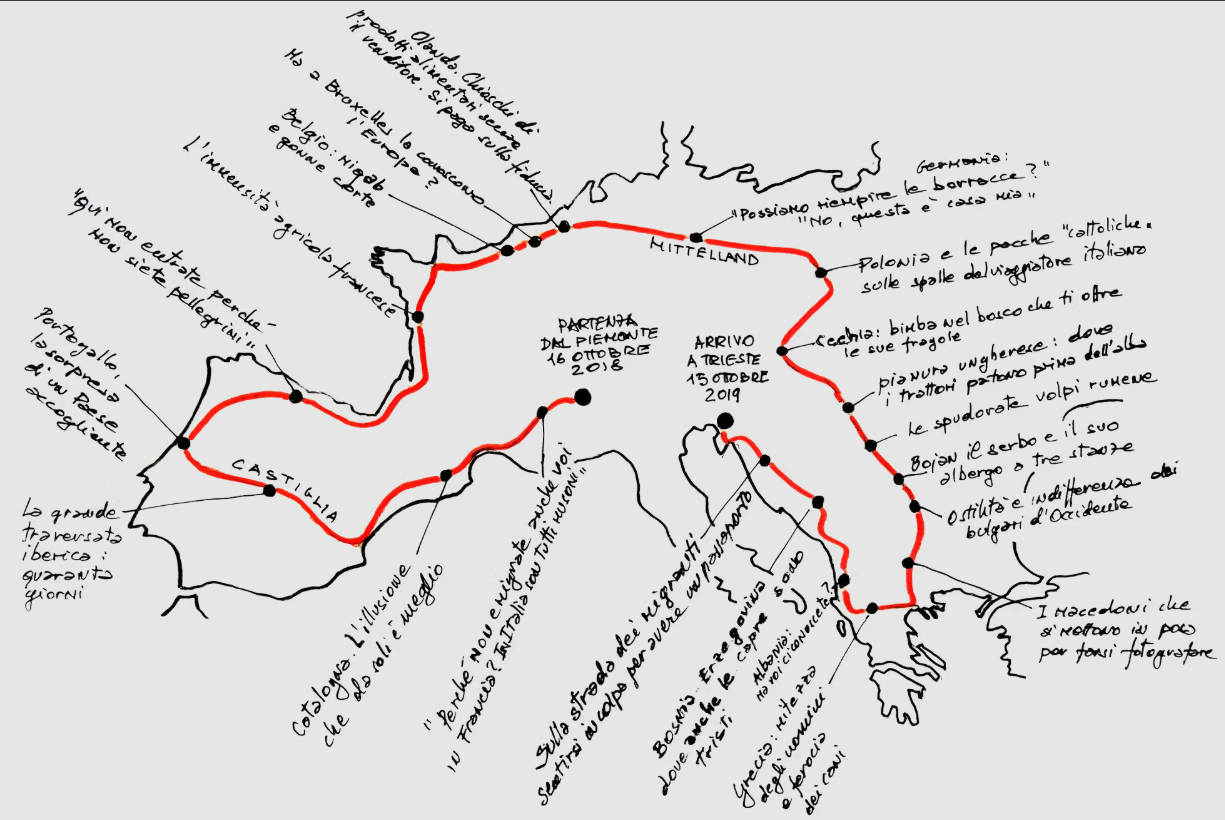
Brussels –A year-long journey across Europe, or rather, “behind the scenes” of Europe. Twenty‑two countries visited, over 10,000 photos taken and even more faces encountered. Curiosity and warmth, but also closure, distrust and even rejection — these were the reactions. Enchanted places were admired, as well as others that were painful to look at. Anna Rastello and Riccardo Carnovalini closed the door of their home in the Graian Alps on 16 October 2018 to return to Italy, arriving in Trieste, exactly one year later, on 15 October. Having sorted out the paperwork for a year’s absence, they shouldered twenty kilos (her) and twenty-four (him): human snails ready for a slow journey, entirely self-sufficient, to discover Europe, its landscapes and its people. A journey “lived in the here and now” and, for that very reason, “never shared on social media” so as not to miss a single second of it. “Each of those 365 days has its own identity, its own strength, and a wealth of experiences that cannot be compared to 365 days spent in an office,” Riccardo tells Eunews on the sidelines of the opening of the photography exhibition at the Committee of the Regions in Brussels, entitled “365 times Europe.”
Eunews: On 16 October 2018, you set off and let your feet run free – what obstacles did you encounter?
Riccardo: “The only real limitation when travelling on foot should be water – a river or the sea. Beyond that, however, there are administrative restrictions and the issue of private property. Up until halfway through the journey, we didn’t encounter any particular obstacles, apart from having to cross rivers – which, incidentally, served as excellent guides for us. In the second half, political barriers emerged: borders you can’t cross, the ones you don’t expect.”
Anna: “I’d also add the way people looked at us as we passed them. In some areas, their glances were fearful and unwelcoming; they made us feel unwelcome and neither at ease nor safe. They made it clear that we weren’t welcome. Spain was the first country where we felt this. People explained to us that it was obvious we were neither tourists nor pilgrims: “So you’re vagabonds,” they’d say. For them, it was the logical conclusion, and quite a few people treated us as vagabonds. This issue of how people looked at us then became much more pronounced further east, because there we were mistaken for migrants both by the people who reported us and by the police we encountered on the street. At the same time, however, I’m reminded of Albania, where people were very curious to see these two old men, haggard and tanned, with this rucksack on our shoulders. They called out to us, invited us to sit down and tell our story. Curiosity dispels fear because it sparks a dialogue. A dialogue that, in many countries, we were able to have thanks to Google Translate.”
E: Did you meet the ‘others’ – the migrants?
R: “We’ve also shared parts of our journey with them. They are people seeking a normal life, normal happiness; they are fleeing from impossible situations. We spoke to two Afghans who had left their country after bombs had exploded above their heads and they had seen their closest relatives die. We felt a deep connection with them, and our decision to go to Thessaloniki paid off because the final two months on the Balkan route were interesting and painful, complex, but in this way we saw from the inside that world which is on the move and which makes us – and should make us – remember when we ourselves were on the move. Because we are all migrants.”
E: Riccardo, what equipment did you use for your photos, and how is the exhibition organised?
A: My kit weighed just 2 kilos. I had a mirrorless camera and three lenses: a standard lens, a wide-angle zoom and a telephoto zoom. I couldn’t take a tripod, so all the photos where we’re pictured together were taken using the self-timer, propping the camera up as best I could somewhere. Selfie is a word that makes me shudder because it implies that you are the centre of attention and everything else is merely the backdrop. Whereas I photographed the backdrop, we were just a small part of the whole – certainly not the main subjects. Narrowing down the 10,700 photos I took to the 319 in the book – which also include the 80 from the exhibition – was a huge sacrifice. But this tour of Europe in 80 photos attempts to tell a story through dates and place names, and is organised into three parts. “Walking through Europe,” which is a catalogue of the landscapes traversed – from the Alps to the Balkans via other mountain ranges, from cultivated hills to rivers and sea coasts, and in all this, “beauty” and “ugliness” go hand in hand; then there is a second part dedicated to the protagonists of the journey – the faces and the lives; and then there is the ‘third eye’, which is the detail – a very important element that can only be captured by taking one’s time, because it is those subtle landscapes that, if you’re travelling quickly or driving past, you simply cannot see.”
E: You have photographed Europe, and now you are bringing it ‘to Europe’ – that’s how it’s always put, as if the other countries weren’t part of Europe. Do you think there is enough sensitivity here to appreciate this gift you are bringing?
R: “Getting here is an extraordinary achievement for us, and what’s special, in my view, is bringing the outskirts of Europe into the heart of Europe. Because we’re telling the story of what goes on behind the scenes – the things nobody else talks about and which perhaps aren’t given enough consideration in the decisions made in Brussels. We do this with the courage to show both sides of the coin: the places where there’s still a balance between nature and opportunities for life, and the places that have been devastated and lost. Because, after all, Europe is a continent consuming fertile land at several square metres per second, squandering a heritage of fertility and the capacity to produce food, resulting in ever-increasing soil sealing at a time of severe climate change we have experienced first-hand. There is a very rapid transformation taking place, with alarming consequences. So it’s not just poetry, but also the stark reality.”
A: “My impression is that some people have picked up on it, while others haven’t. We are certainly honoured to have brought it here, to the heart of Europe. We probably need to start working from here because, at the end of our journey, we’ve come away with the impression that the Europe of the people demands something different from the Europe of the politicians. And the Europe that we discovered during those years, as we travelled, has since revealed itself.”
E: Any examples?
A: “In eastern Germany, we experienced first-hand a sense of rejection that was stronger than anywhere else in the West. For example, a lady refused to fill our water bottles. Or, one evening, we pitched our tent in a spot near a field that had already been cultivated and harvested. In less than a quarter of an hour, a couple in their forties arrived in a pick-up truck. He got out, very angry, and said to us in a loud, rude voice: “It’s mine” – meaning this is my land. So we explained that we were just pitching the tent for the night, but he was very angry and kept repeating, “This is mine.” His partner then persuaded him to let us stay, but “absolutely only for the night.” Over the years, that part of Germany has tended to vote for far-right parties, hasn’t it?”
E: What did you discover, and what does it mean – as the exhibition introduction puts it – to “be modern explorers in a world where there seems to be nothing left to explore but ourselves”
R: I devoted my life to getting to know and helping others to get to know Italy in particular – a country that is unknown even to Italians – and then Europe. I was there in person to witness the pickaxes chipping away at the barrier between the two Germanys, particularly along the stretch of the River Elbe. Back then, I saw in people’s eyes a desire for change, a sense of enthusiasm, and I wanted to understand whether, years on, those eyes were still so bright. They are no longer. Perhaps the dream they once had has been dashed; perhaps I found a dull look in their eyes because their lives have since changed – but evidently not for the better, as they had imagined. The modernity of this journey, however, lies in the way this exploration sets the mind aside for a while, freeing the other senses. Because my memories of this journey also come to me through the smells or stinks, the sounds or the silences, and the taste of the different food we tried.”
A: “I’d say we weren’t modern explorers, but ancient ones – that’s why we travelled on foot, and why we wanted to make ourselves available to others without any preconceptions. We tried as much as possible to set aside all preconceptions. Whenever we met someone who spoke to us, it was an opportunity to learn. And the conclusion of our journey led us to think that Europe is a child, a spoiled little child, without a clear sense of where it is headed. But it is up to us, as European citizens, to help it grow and become the person of peace that was envisaged on the island of Ventotene.”
English version by the Translation Service of Withub

![Il ministro dei Trasporti, Matteo Salvini [Bruxelles, 5 dicembre 2024. Foto: Emanuele Bonini per Eunews]](https://www.eunews.it/wp-content/uploads/2024/12/salvini241205-120x86.jpeg)