



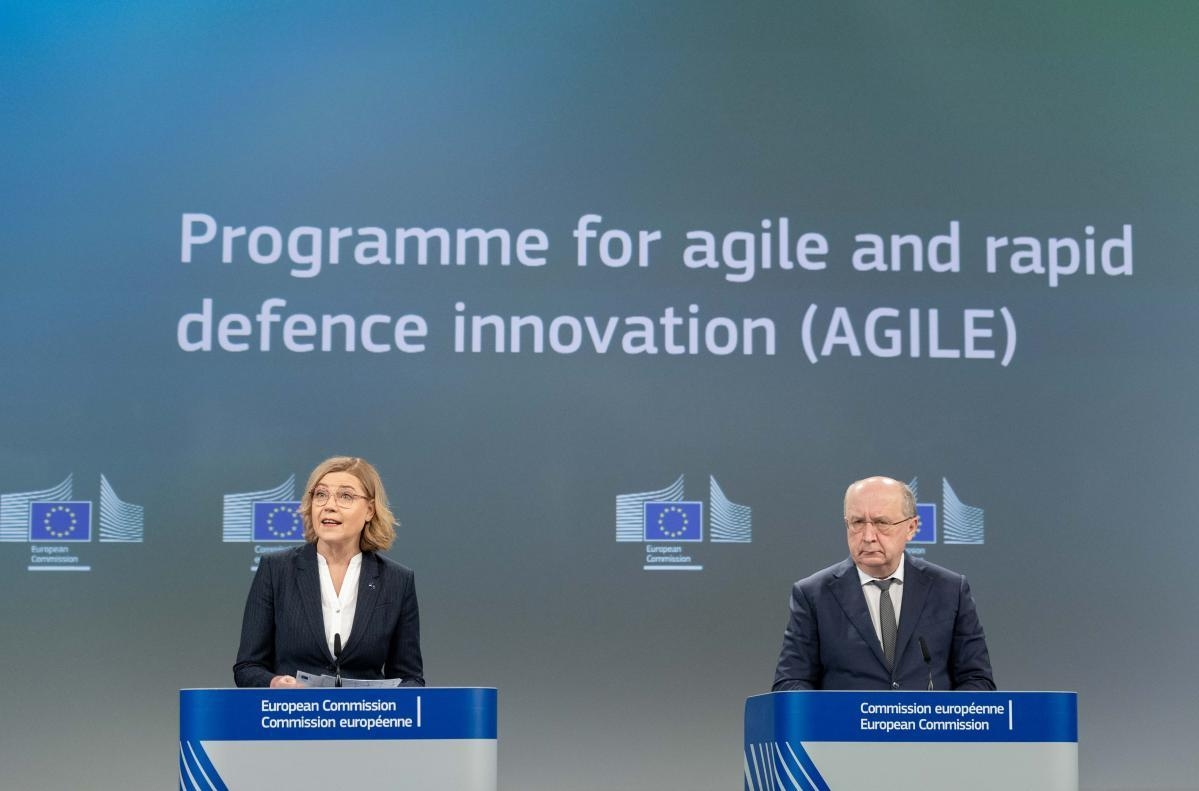
Brussels – From the laboratory to the battlefield “in record time,” within one to three years at most. The European Commission is seeking to reshape the logic of defence through a new instrument designed to accelerate the development and commercialisation of cutting-edge innovative technologies. A total of 115 million euros to fully fund projects of European interest of start-ups and small and medium-sized enterprises: this is AGILE, the special programme designed for a small number of targeted projects – between 20 and 30 – capable of producing technological solutions in the fields of artificial intelligence, quantum technology, and drones.
In line with the provisions of the special €150 billion SAFE programme, AGILE will also provide funding to European companies based in the EU, and will be extended to the countries of the European Economic Area (Norway, Iceland, and Liechtenstein) as well as Ukraine. According to the European Commission’s plans, the special financial instrument is designed for 2027, with a validity period running from 1 January to 31 December of next year. This is because the 115 million euros are funds that come entirely from reallocations within the current European budget, which expires next year (MFF 2021–2027). This nevertheless raises questions about the timeline for approving the Commission’s draft regulation, which the Council and Parliament are now called upon to adopt.
The von der Leyen team made it clear that it intends to follow the standard procedure, without, therefore, speeding up or rushing the process. However, the regulation’s text provides for national parliaments to be sidelined. Point 30 of the text states that “given the urgent need to support crucial investments in defence capabilities and
particularly in defence innovation in the context of pressing geopolitical challenges it
is appropriate to provide for an exception to the eight-week period…on the role of national Parliaments in the European Union” (the period that elapses between a draft legislative act being made available to national Parliaments in the official languages of the Union and the date when it is placed on a provisional agenda for the Council for its adoption or for adoption of a position under a legislative procedure). Therefore, on that basis, “this Regulation should enter into force on the day following that of its publication in
the Official Journal of the European Union.”
It is probably a gamble at a time when Europe is dominated by nationalist and sovereigntist forces, but in Brussels, it is believed this is the only way to achieve effective responses. “We want to create a culture of rapid doing, making sure that Europe´s SME´s and start-ups can foster European deterrence and safety by delivering innovative solutions,” said Henna Virkkunen, Executive Vice-President for Technological Sovereignty, Security and Democracy, who emphasises: “AGILE is the missing piece of our agenda” on security and defence.
Fast‑track procedures and company‑friendly retroactivity
To ensure that this culture of rapid action takes root, the proposed regulation for the AGILE instrument proposes to operate with funding disbursement times of just four months, so as to enable the research and development, production, and commercialisation process to begin immediately, thereby ensuring that new defence technology solutions reach the armed forces within 1–3 years. Regarding eligible costs and the possibility for the EU to cover them in full, a retroactive clause is envisaged that will allow companies to request reimbursement for expenses incurred up to three months prior to the call’s closing date, to facilitate rapid innovation.
“It is key that we rapidly test, validate, and integrate these technologies into our defence capabilities, ensuring that Europe’s defence industry can keep pace with the rapidly changing nature of modern warfare,” said Defence Commissioner, Andrius Kubilius. The programme, he explains, “will create fast-track procedures for project evaluation,” through self-certification, online applications, and preliminary reviews by the EU.
In financing AGILE, “it would be greatly appreciated if Ukrainian companies took part, because companies in Ukraine have extensive experience and their expertise would be very welcome,” Kubilius added, a hope that amounts to an explicit invitation for Ukraine to join the EU’s efforts.
English version by the Translation Service of Withub






![La video riunione dell'Eurogruppo [27 marzo 2026. Foto: European Council]](https://www.eunews.it/wp-content/uploads/2026/03/eurogruppo-260327-120x86.jpg)
