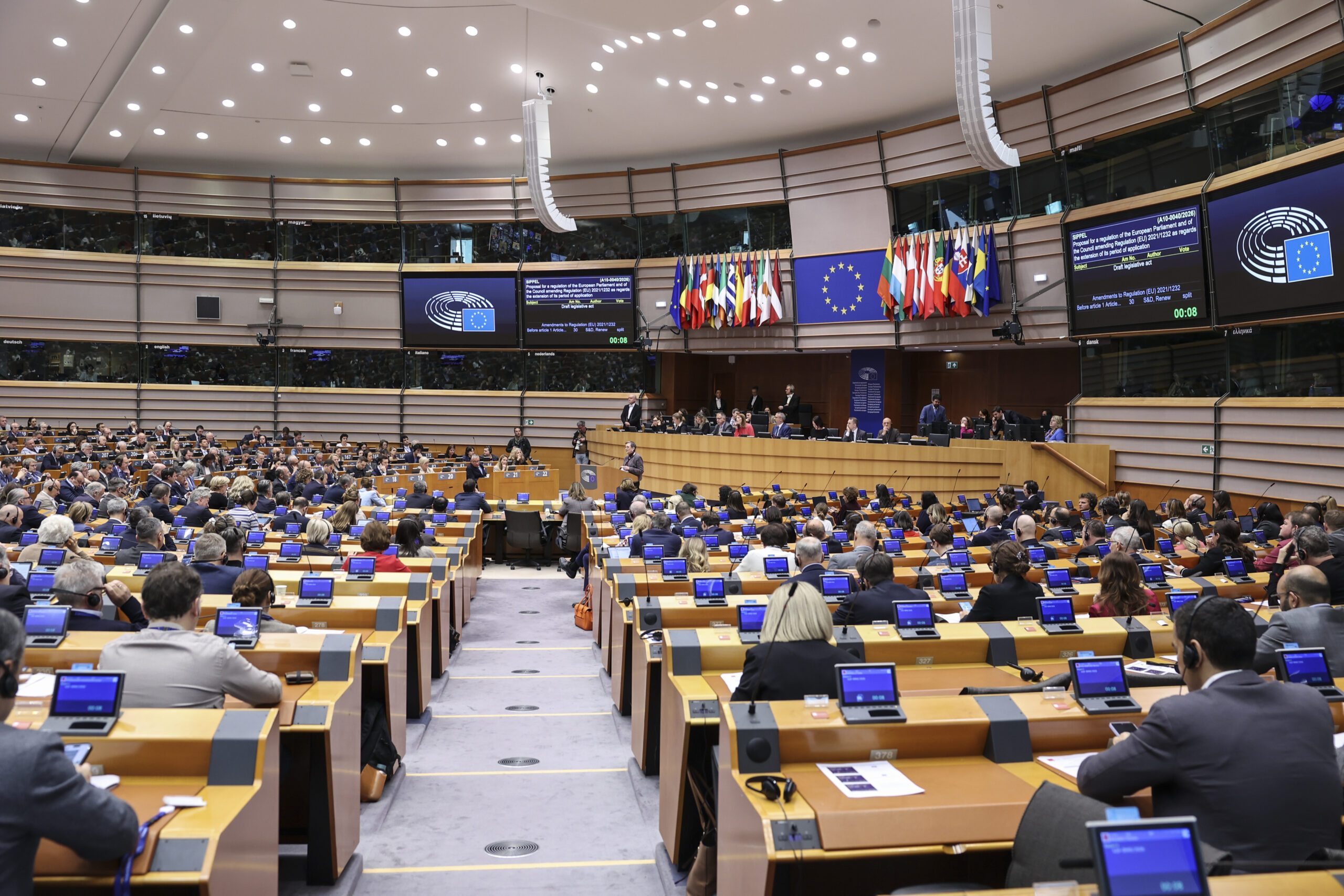
Brussels – The European Parliament has adopted today (26 March) the EU’s first anti-corruption directive, which will establish a harmonised criminal law framework to prevent and combat corruption. It did so by an overwhelming majority: 581 votes in favour, 21 against and 42 abstentions. In Italy, despite all party delegations (with the exception of Roberto Vannacci) having supported the text, there is already controversy over the meaning of one of the most sensitive passages in the directive: that relating to the offence of abuse of office.
The final text does not contain the term “abuse of office” at all. It refers to the “unlawful exercise of public functions”. It introduces an obligation for Member States to “ensure that at least certain serious breaches of the law in the performance or omission of an act by a public official in the exercise of their functions are punishable as a criminal offence, when committed intentionally.” This is a deliberately vague formulation, which leaves Member States with a wide margin of discretion in identifying criminally relevant conduct, the result of fierce negotiations both between Member States and within the European Parliament.
The European Commission’s original proposal, as well as the position adopted by the European Parliament’s Committee on Civil Liberties (LIBE) in February 2024, were more explicit. “Member States shall take the necessary measures to ensure that a culpable breach by a public official of his or her official duties, by failing to perform those duties or by performing them improperly, thereby causing substantial damage or harming the rights or legitimate interests of a natural or legal person, is punishable as a criminal offence,” stated the mandate with which the European Parliament entered into negotiations with the Member States to finalise the legislation. The Council of the EU, in June 2024, had already removed abuse of office from the scope of the directive, with the Italian Minister of Justice, Carlo Nordio, stating that he was “pleased with the compromise reached, which allows the objectives of the proposal to be reconciled with national measures.” During the trilogues, the issue of abuse of office dominated discussions for months, until, on 2 December, the European Parliament and the Council of the EU reached a provisional agreement on the final text of the directive.
On both sides, Italian political parties were claiming victory this morning. And the mudslinging began. Fratelli d’Italia said it was “extremely satisfied” with the anti-corruption directive, emphasising that the text “reiterates that Member States have full freedom to choose the most effective tools to combat corruption” and that “it is clear that Italy already has these tools within its legal system.” In short, Nicola Procaccini stated, “there is no need, under the directive, to reintroduce the offence of abuse of office.”
Yet, the Five Star Movement and the Democratic Party see things quite differently. According to Giuseppe Antoci, a Five Star Movement MEP, “the green light for the anti-corruption directive is also a vote of no confidence in the Italian government and Minister Nordio, who, in 2024, unwisely abolished the offence of abuse of office in Italy and removed a safeguard for citizens’ dignity.” Antoci condemned the obstructionism “especially on the part of the Italian government,” with the directive “stalled for months,” and the attempt to transform the article on abuse of office, “currently mandatory, into an optional one”. For Sandro Ruotolo, MEP for the Democratic Party, “the directive is clear”: abuse of office “is effectively coming back through the front door, contradicting the entire stance of the Meloni government, which in 2024 had chosen to abolish that offence.”
Two irreconcilable interpretations. The truth is that, for both sides, the victory is only partial: the opposition can point out that Brussels has made it clear that abuse of office is a criminal offence and, as such, must be prosecuted. But the government can rest easy: the directive leaves member states with considerable discretion over which acts committed by public officials should be prosecuted.
The Parliament’s rapporteur for the directive, the Dutch Liberal Raquel Garcia Hermida-Van der Walle, also spoke in the debate, arguing that “Italy, even within the scope allowed by the directive, will have to take action” on abuse of office. In other words, it will have to “make at least the two most serious offences falling within the scope of abuse of office subject to mandatory punishment,” she explained. The MEP then took a swipe at Rome and the majority parties: “If they hadn’t considered it such an important issue (the inclusion of abuse of office in the legislation, ed. ), they wouldn’t have fought so hard against it,” she said.
The President of the Italian Constitutional Court, Giovanni Amoroso, made his position clear this afternoon: “If this European Parliament directive alters the regulatory framework, it is possible that the Court will once again be called upon to carry out the review provided for in Article 111, paragraph 1, of the Constitution. Before that, of course, it will be up to the political sphere to take note of this new European legislation.” And even before that, one might add, the directive will also have to be formally adopted by the Council of the EU. At that point, Member States will have 24 months to transpose it. A headache (or a chance for revenge) for the next government.