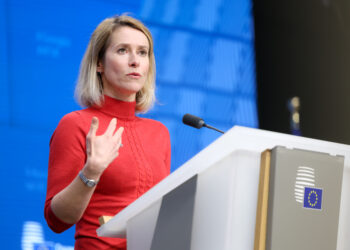
Brussels – “We understand that Russia is assisting Iranian intelligence in targeting US military bases in the Middle East.” In a press briefing prior to today’s meeting (27 March) among the G7 foreign ministers in Paris, the EU’s High Representative for Foreign Affairs and Security Policy, Kaja Kallas, confirmed a theory that has been circulating in European and US intelligence circles since the start of the new Middle Eastern conflict. “Russian support for Tehran is also military in nature: Moscow is supplying the ayatollahs with drones to attack both neighbouring countries and American targets in the region,” added the former Estonian prime minister on the steps of the Abbey of Vaux de Cernay, the picturesque setting for today’s meeting.
Kallas’s comments follow a reportage dated 7 March (10 days after the first Israeli-US attacks on Iran), in which CNN reported on information held by Washington’s intelligence services, according to which Russia had begun supplying Tehran with intelligence “to identify the positions and movements of American troops, as well as military ships and aircraft.” In particular, the satellites that the Kremlin has managed to place in orbit over the years are said to be giving the Iranians a major helping hand. While US intelligence has not yet confirmed or denied that the Iranian attacks against American targets in recent weeks were made possible precisely thanks to Russian “longa manus” (a theory supported by the Washington Post), what is emerging is that—to put it in the sarcastic words of one of the officials quoted by CNN—”Russia still really likes Iran.”
Alongside intelligence support, according to Kallas, there is also more strictly military support. In this case, too, whether true or not, the EU’s foreign policy chief merely repeated what had been reported by some major US newspapers in recent days. Yesterday’s edition (25 March) of the Financial Times also reported statements by certain secret agents in Washington claiming that Moscow and Tehran are reportedly in talks about sending Russian drones to the Middle East, a few days after the start of the war unleashed by the Trump-Netanyahu duo. The first deliveries are said to have reached their destination in early March, and the entire operation is expected to be completed by the end of the month. While the Kremlin had refrained from commenting on the allegations made by CNN, Vladimir Putin’s spokesperson, Dmitry Peskov, decided to respond to those of the British daily, stating that “at the moment, there is a lot of fake news circulating, but one thing is certain: we are continuing to engage in dialogue with the Iranian leadership.”
According to Kallas, what emerges from all these rumours is that “the two wars, the one in Ukraine and the one in the Middle East, are extremely interconnected.” Not only that: for the Estonian politician, the issue of Russian support for the regime in Tehran could be used by the EU “to urge the United States to be more assertive towards Putin regarding the negotiations with Ukraine.” “If America wants to stop the war in the Middle East, if it wants to stop Iranian attacks on its bases and its troops,” she added, “it should put more pressure on Russia so that they are unable to help them.”
Judging by the latest reports, Kallas’s appeals seem destined, once again, to fall on deaf ears. In an interview with Reuters, the Ukrainian president, Volodymyr Zelensky, confirmed that he had once again received an offer from the US of security guarantees in exchange for ceding the entire Donbas region to Moscow. Whether by chance or not, these words came the day after Zelensky himself had claimed to have “irrefutable evidence that Russia is blackmailing the US by proposing to stop providing intelligence support to Iran if Washington does the same with Ukraine.”
Before the start of the “Third Gulf War”, Russia and Iran had launched their military cooperation right in Ukraine. Since the start of the conflict, Tehran has supplied Moscow with a significant number of short-range ballistic missiles and, above all, Shahed drones.
English version by the Translation Service of Withub!['Alta rappresentante per la politica estera e di sicurezza dell'UE, Kaja Kallas [Bruxelles, 16 marzo 2026]](https://www.eunews.it/wp-content/uploads/2026/03/kallas-260316-350x250.png)