



![La video riunione dell'Eurogruppo [27 marzo 2026. Foto: European Council]](https://www.eunews.it/wp-content/uploads/2026/03/eurogruppo-260327.jpg)
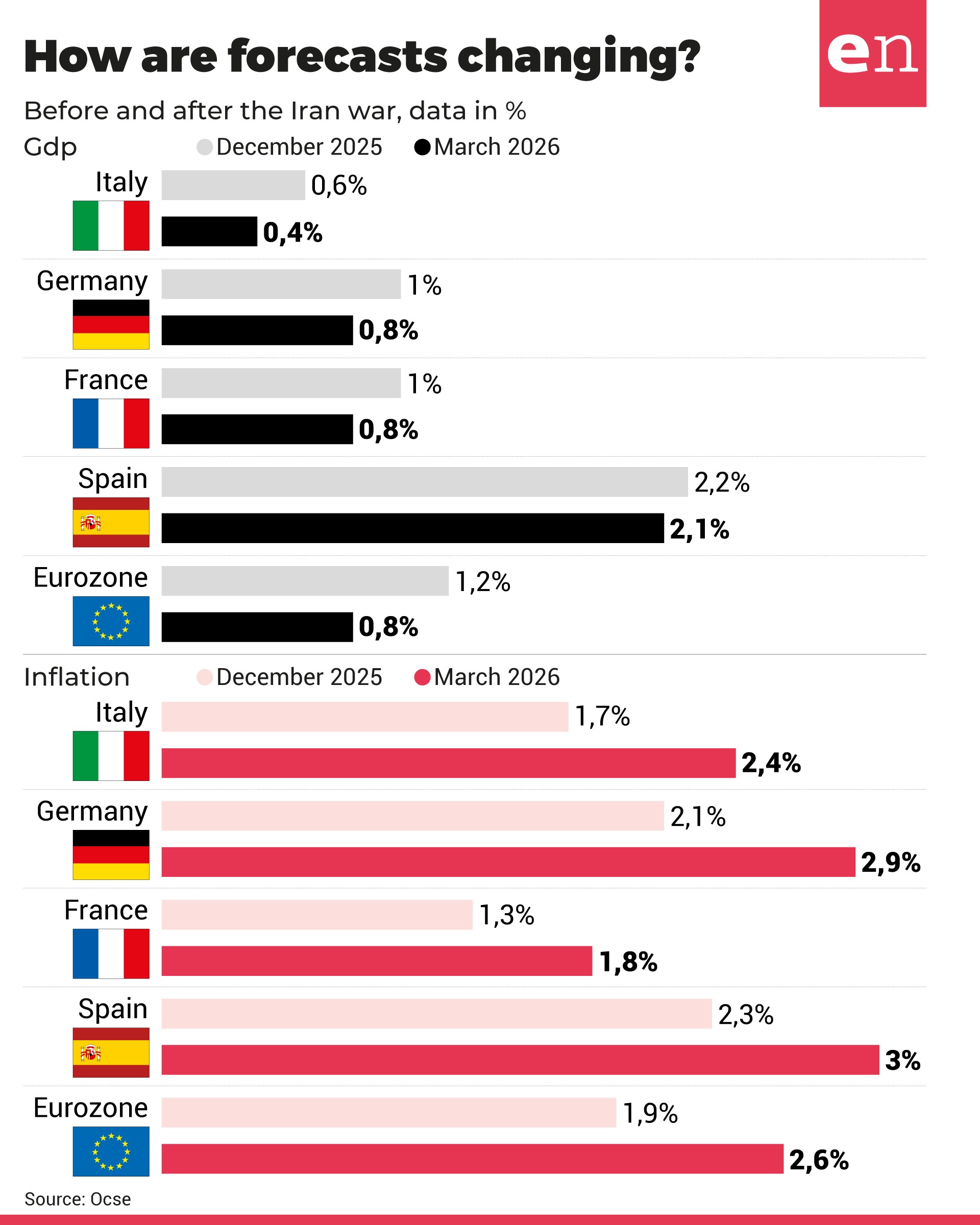
Brussels – Whatever happens, the war in Iran and its repercussions on freight transport and energy supplies will come at a cost – and a significant one at that. “We risk stagflation, even in the event of short-term disruptions,” said the Commissioner for the Economy, Valdis Dombrovskis, who, unlike last time when he began to warn of the risks of high inflation and low growth, provides figures: In the event of short-term disruptions in 2026, “EU growth in 2026 could be around 0.4 percentage points lower than projected in our Autumn Economic Forecast. And inflation could be up to 1 percentage point higher.”
Donald Trump’s US military operations in the Persian Gulf, therefore, risk resulting in “zero-point-something” growth for the Eurozone. Last November, the European Commission estimated that GDP would grow by 1.2 per cent this year, but the cut of almost half a percentage point undermines that estimate. “This is not a forecast, this is a scenario analysis,” Dombrovskis clarified at the end of the Eurogroup meeting held via videoconference. It is therefore not the most likely outcome, but a possible scenario nonetheless, being taken into account. And it is the best-case scenario. Because the Commissioner for Economic Affairs continues, if the disruptions were to continue for longer, “growth could be up to 0.6 percentage points lower in both 2026 and 2027.”
Dombrovskis finds it hard to be optimistic: “The Strait of Hormuz has been weaponised, and energy infrastructure continues to be targeted.” The result of all this is that “the outlook is clouded by profound uncertainty.” In short, the conditions are not in place to expect the economy to perform any differently from current trends.
The President of the Eurogroup, Kyriakos Pierrakakis, attempts to reassure: “Europe today is better prepared than it was in 2022 during the previous energy crisis…this means we can now respond more quickly.” However, there is widespread concern. “One month after the outbreak of the conflict, its effects are already beginning to pass through to the real economy, through rising energy prices,” and this is plain for all to see. Pierrakakis urges everyone to keep their nerve: “no short-term crisis should divert us from our reform commitments and our transition agenda”. As for support measures for households and businesses to counter high energy costs, these “must be targeted and temporary.”
English version by the Translation Service of Withub





![La video riunione dell'Eurogruppo [27 marzo 2026. Foto: European Council]](https://www.eunews.it/wp-content/uploads/2026/03/eurogruppo-260327-120x86.jpg)
