



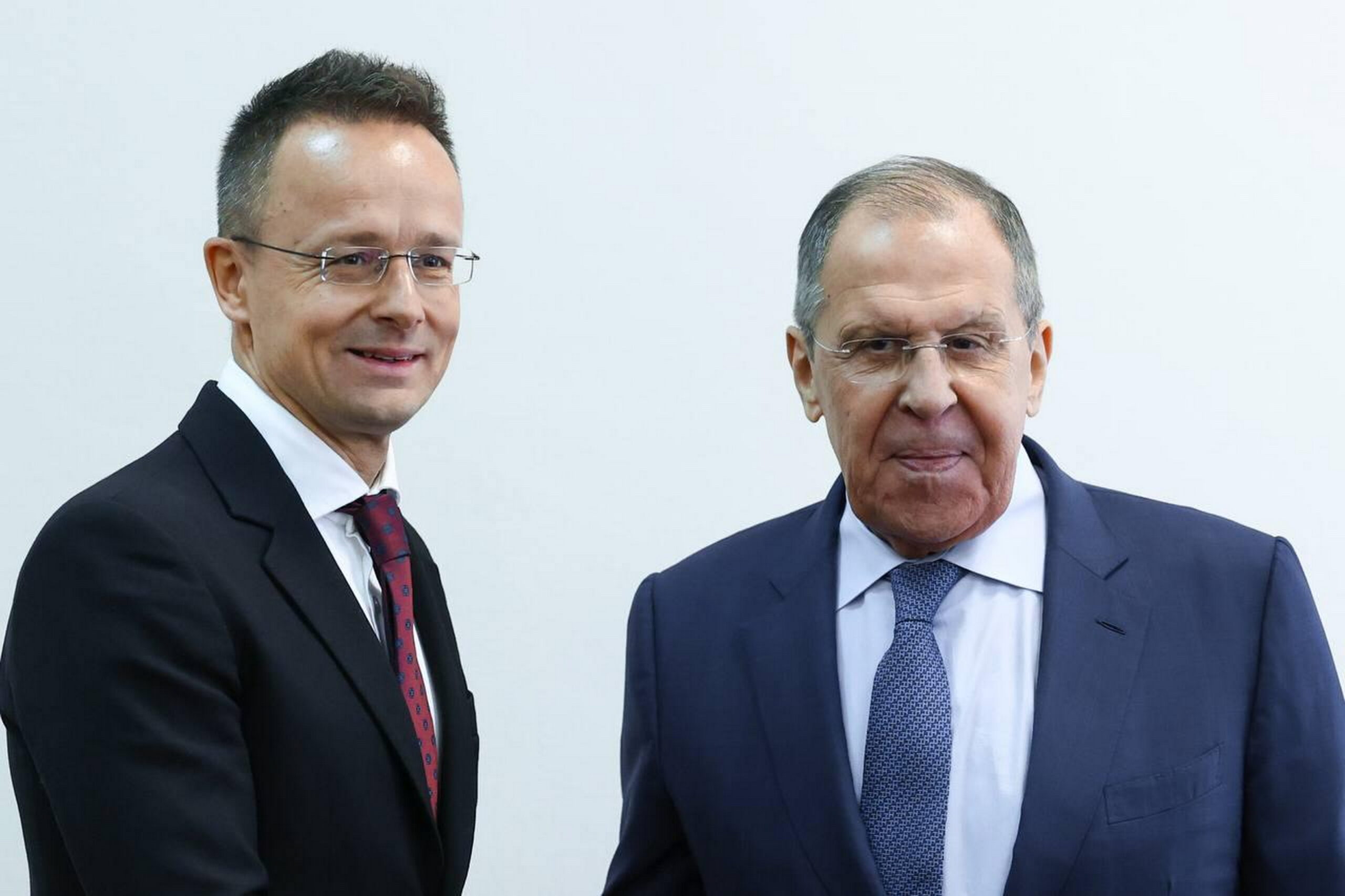
The Hungarian Foreign Minister, Peter Szijjarto, has admitted to maintaining regular contact with his Russian counterpart, Sergey Lavrov, even during EU Council meetings, thereby confirming recent revelations by the Washington Post.
Speaking at an election rally on Monday evening, Szijjarto defended his stance, stating that he had done so because “EU decisions on energy, industry, and security have a direct impact on relations with external partners, including Russia.”
In practical terms, it is as if there were a twenty-eighth member state at the negotiating table, given that Hungary’s position has, for years, appeared to mirror that of Russia.
And so, what had up until now been mere assumptions – though sufficient, in some cases, to justify the precaution of organising closed-door meetings without Hungarian representatives present, as Polish Prime Minister Donald Tusk recently pointed out – has now been confirmed: there is an “official” fifth column operating within the European Union.
Not that Viktor Orbán’s uncompromising stance against aid to Ukraine and sanctions against Russia – not to mention his dismissive attitude towards the European Union and most of its policies – left much room for doubt on the matter. And so, the circle is complete.
And it is quite striking to think that it was Hungary that became the first Eastern European country to rebel, in 1956, against the iron grip of Soviet control under the Warsaw Pact, and that it was Hungary again, in 1989, the first country to tear down the Iron Curtain which, in both a physical and figurative sense, had divided Europe in two since the end of the Second World War.
This is also because the “fatal attraction” to Putin’s Russia is not merely a matter of geographical proximity or objective energy dependence, but relates more generally to the model of government and vision of society that the two leaders pursue – a vision which, in the Russian case, is rooted, among other things, in the ideological legacy of the Great Patriotic War, which also resulted in Hungary’s subjugation to the Soviet Union.
The Hungarian minister’s whispers at the Kremlin have so far drawn few official comments, apart from a statement by the Commission’s Executive Vice-President, Henna Virkkunen, who said that any leaks regarding closed-door ministerial discussions are “very worrying.” The Commission is awaiting “clarification.”
In reality, everyone is probably just waiting for the matter to resolve itself, hoping that Orbán and his allies will be defeated in the upcoming general election on 12 April and that his challenger, Peter Magyar, will win. It is no coincidence that US Vice-President JD Vance is expected in Budapest in the coming days to lend the Prime Minister his support – talk about a coincidence.
But the issue remains. In most Member States, incidents of this kind lead to thorough investigations and specific allegations of criminal offences. The decisions of the EU Council are not exactly the sort of thing you’d discuss over a chat with four friends in a pub. And if action needs to be taken, it is right that it should be taken.
English version by the Translation Service of Withub


![Riunione del consiglio Affari esteri [Bruxelles, 16 marzo 2026. Foto: European Council]](https://www.eunews.it/wp-content/uploads/2026/03/consiglio-esteri-350x250.jpg)
![[credits: Dietmar Rabich / Wikimedia Commons / “Münster, Stadtweinhaus, Beflaggung Ukraine und EU -- 2022 -- 0219” / CC BY-SA 4.0]](https://www.eunews.it/wp-content/uploads/2026/03/ue-ucraina-350x250.jpg)




![La video riunione dell'Eurogruppo [27 marzo 2026. Foto: European Council]](https://www.eunews.it/wp-content/uploads/2026/03/eurogruppo-260327-120x86.jpg)
