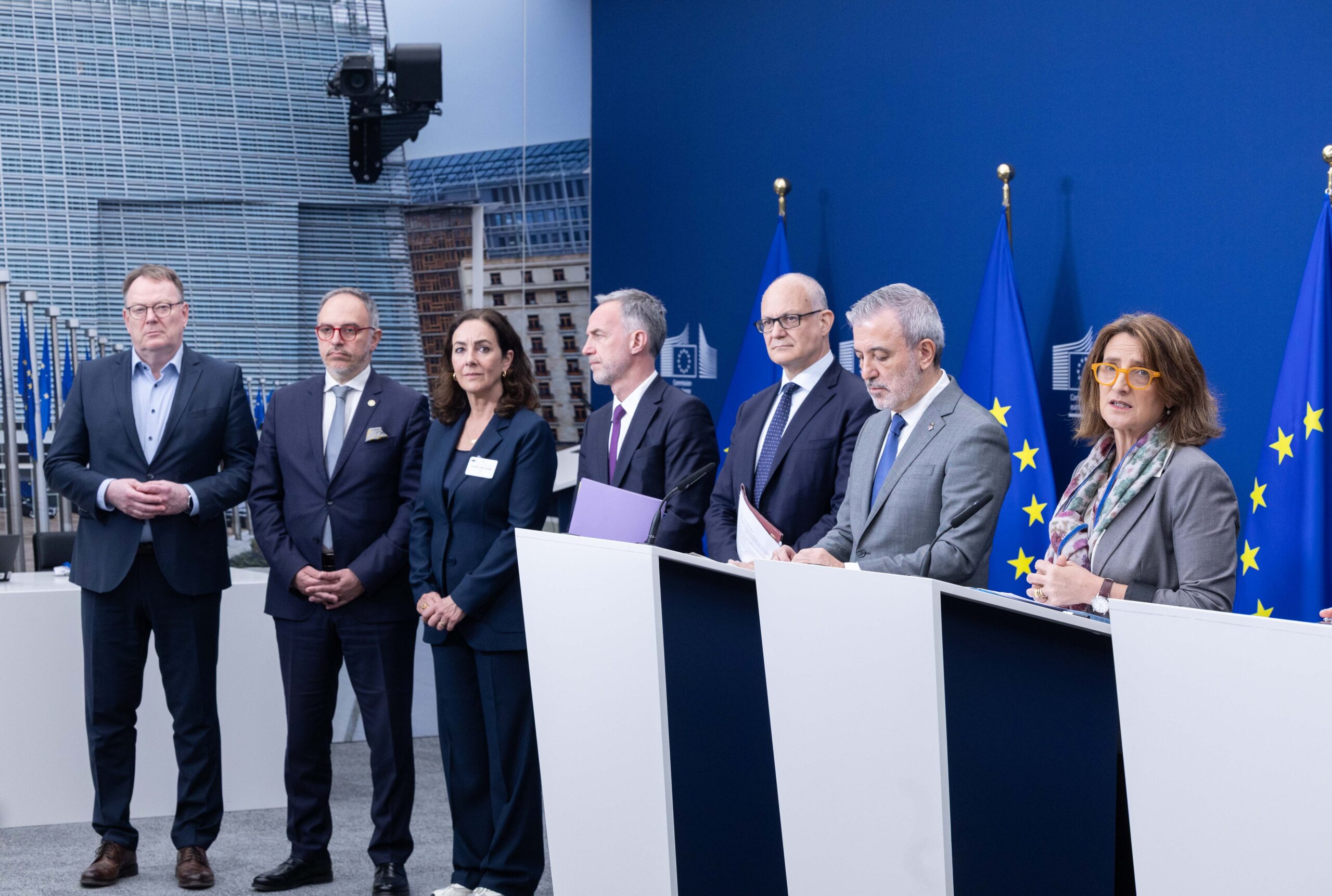
Brussels – “The figures for house prices are truly staggering”, with rents having risen “by more than 60 per cent between 2013 and 2024.” The concerns of the European Commission’s Vice-President responsible for Competition and the Green Deal, Teresa Ribera, were raised during a press conference at the European Commission alongside European mayors from the Housing Alliance. “Rents have risen by 20 per cent and building permits have fallen by over 22 per cent since 2021,” continued Ribera. “Housing has become a major concern for many Europeans, and it is our shared responsibility to address this issue and find solutions.”
To move in that direction, the European Commission’s next step is to “draft legislation on affordable housing – the Affordable Housing Plan – and work together with mayors to provide clear answers and make solutions available.” Today (30 April), the mayors of Paris, Rome, Amsterdam, Nicosia, Barcelona, and other European cities, some of the mayors of the 20 members of the Housing Alliance, met in Brussels to share their concerns with the European Commission. Jaume Collboni Cuadrado, Mayor of Barcelona, explained at a press conference that “over the last month, the twenty cities that make up the Alliance have been working to draft our contributions to the Multiannual Financial Framework (MFF) and the Housing Act.” The mayor concluded by stating that “today I am presenting these proposals in Brussels. They focus on six distinct areas: areas at risk of housing insecurity, funding, governance, homelessness and vulnerable groups, speculation, and short-term rentals.”
The Mayor of Rome, Roberto Gualtieri, also shared his concerns and strategic vision, stating that “housing is one of the key issues. We believe this is the moment when Europe can step in and demonstrate that it can deliver concrete results, supporting cities and governments in bringing about change to improve our governance and policies. Because housing is a fundamental pillar of the European social model.” Gualtieri also suggested allocating “additional resources for the Multiannual Financial Framework that could be used to support and finance a broader housing plan.” For the Mayor of Rome, there is an urgent need for “mandatory urban allocations in national regional partnership plans, because it is essential that the urban dimension is present in governance and in the definition of these plans, in the form of annexes to EU budgets, and that a mandatory urban chapter in national regional plans guarantees cities a direct role in the design and delivery of investments.”
Teresa Ribera responded to the mayors’ requests by confirming that the Commission intends to draw up a policy “on affordable housing” to provide clear answers and “concrete tools.” The Vice-President added that collaboration “is essential to providing effective solutions” and that the principle of subsidiarity will be respected, acknowledging that a “universal” solution is not feasible. However, she warned that the scale of the investment required “is immense” and for this reason, EU tools are being mobilised, convinced that investment in housing deserves serious consideration in the upcoming debate on the EU budget. The stated overall objective is to “ensure that the right to affordable housing is fully respected throughout the European Union through a multi-level platform that provides concrete answers to citizens.”
The European Commission’s plan to address the housing crisis was presented by Dan Jørgensen, Commissioner for Energy and Housing, in December 2025. According to Commission data, around 1.6 million new homes are currently being built in the EU each year, but the forecast for the future is stark: “Over the next 10 years, around 650,000 additional homes will be needed each year,” at a cost in terms of public and private investment of “150 billion euros a year.”
English version by the Translation Service of Withub