On Wednesday, 6 May, on the forecourt of Defence24 Days in Warsaw, a Polish NCO in a red beret was sitting on the front frame of a Rosomak (Made in Poland), parked in a row with six other sand-coloured armoured vehicles. Coffee in one hand, cigarette in the other, with the look of a man who had worked out that, for that week, Europe’s defence centre of gravity had moved a few hundred kilometres further east. In the evening, at the long counter mirrored against an anthology of bottles in the bar of the Hotel Bristol on Krakowskie Przedmieście, a Polish staff officer was telling a European counterpart, quietly, with his Goldwasser half drunk, that in Brussels “they still don’t understand the difference between urgency and haste“. Pilność against pośpiech: two distinct Polish words for “soon”, which many, too many, flatten into a single idea.
There is a recurring quality to the testimonies and confidences that surface in the lounge bars of large hotels, but so be it. What is certain is that Friday or Saturday dinners in Brussels are relaxed, small in number and equally rich in commentary. The encounters are of high quality, and the source of the Polish whisper, even if de relato, is solid. The distinction between urgency and haste is exactly what separates Warsaw from Kyiv today. And Kyiv from the rest of the Union.
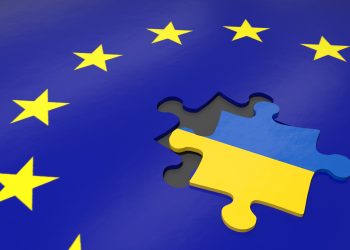
That distinction, in the previous ten days, had taken the shape of a public clash between Volodymyr Zelensky and Friedrich Merz. The German chancellor, speaking to a room of secondary-school pupils at the Carolus-Magnus-Gymnasium in Marsberg, between Dortmund and Kassel, had said, with the Rhenish bluntness that irritates even his friends, that the idea of Ukraine joining the EU on 1 January 2027 “won’t work“. Even 2028 is unrealistic, he added, and the path runs through a peace treaty in any case and, probably, through the legal recognition of borders different from those of 1991.
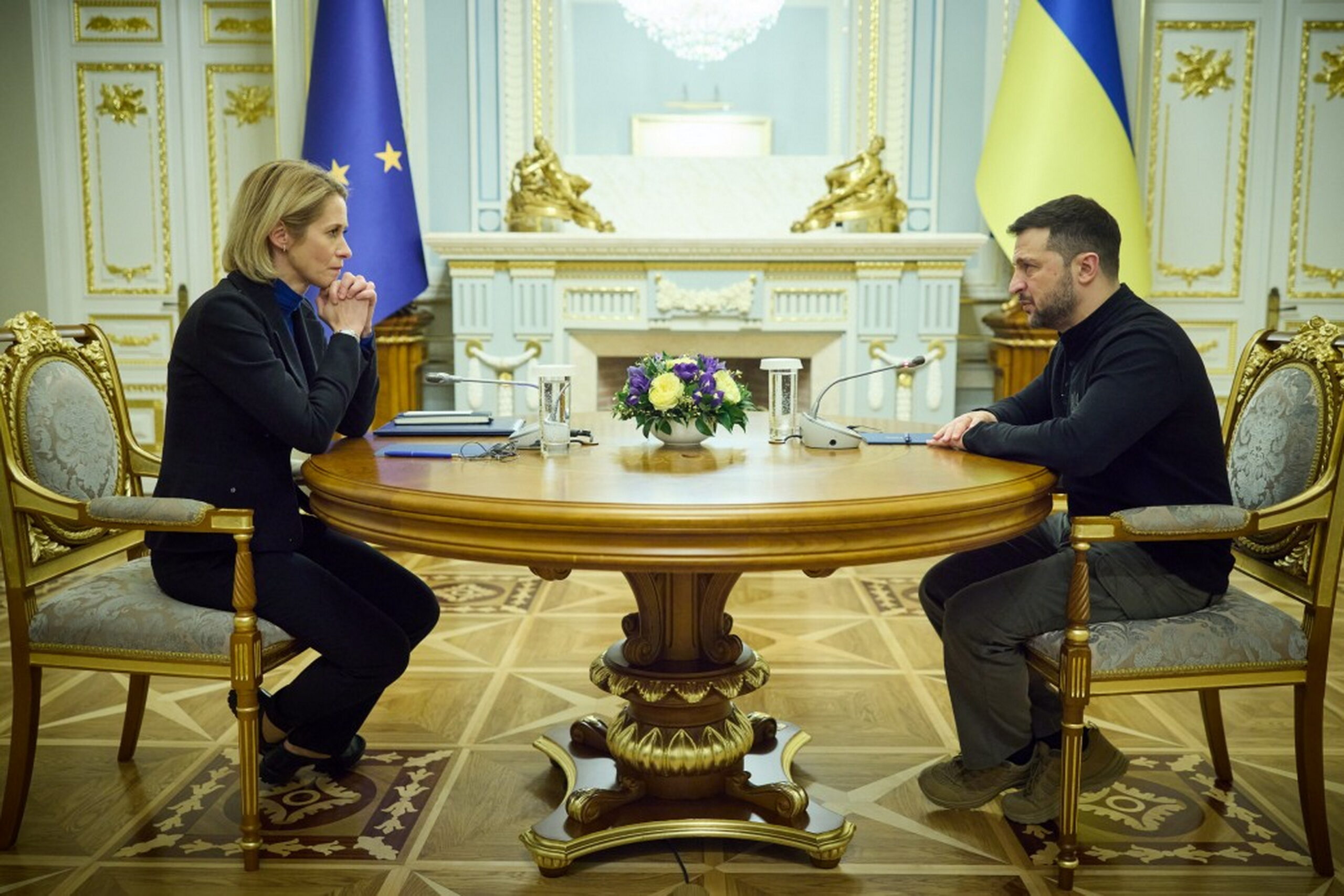
Politico, in a brilliant and unsparing piece in its Forecast newsletter, adds the detail: at the informal Cyprus summit on 24 April, the other heads of state and government rebuked Zelensky for having rejected the symbolic-membership formula put forward by Berlin and Paris (presence at meetings of the Council, Parliament and Commission, but with no voting rights). A former adviser at Bankova, the street in central Kyiv that is closed to ordinary traffic and houses both the office and the residence of the President (the House of Chimaeras, designed by a Polish architect in 1902 in Art Nouveau style and famous for the sculptures by the Italian Elia Sala), has a precise opinion. Quoted anonymously, he says without mincing words: “With the Americans, Zelensky is almost ready to walk away; with the Europeans, he is annoyed because he feels they are not yet ready.” True. But it is only part of the truth.
The other part is statistical, and Luis Garicano tells it better than anyone on his Substack Silicon Continent. Today’s Europe is not a slow-growing economy: it is two economies moving in opposite directions. In 2000, Poland stood at 34% of US GDP per capita; by 2030, on IMF projections, it will reach 67%. Romania, from 27 to 60. Lithuania, from 29 to 69. Bulgaria, from 23 to 53. These are the numbers of a convergence machine that worked because the countries that joined in 2004 and 2007 let themselves be reshaped by the reforms: single market, the acquis communautaire digested chapter by chapter, independent agencies, and rule of law. On the other side, France slips from 86% to 71%, Italy from 93% to 68%, and Spain from 72% to 61%. The 2022 security shock, as Garicano notes, found political room for reform precisely in the countries where the competitiveness problem was less acute, namely Poland, the Baltics, Finland, Sweden. No comparable room where it would have served most, namely in Italy, Spain and France. This is the missing piece of the European debate: nobody has yet produced a political mechanism capable of persuading the rear of the Union to invest, modernise, grow.
Onto this landscape came the most ambitious vonderleyenian move: the ReArm Europe / Readiness 2030 package. Eight hundred billion mobilisable, 150 billion in direct loans through SAFE (Security Action for Europe), adopted by the Council in May 2025 on the legal basis of Article 122 TFEU (the same as the pandemic-era SURE). Add the national escape clause of the Stability Pact which, once activated, frees up another 650 billion in four years. Add the Defence Readiness Roadmap 2030 presented in Krakow on 16 October by the Lithuanian commissioner Andrius Kubilius, the European Drone Defence Initiative, the Eastern Flank Watch, the European Air Shield and the European Space Shield expected in the second quarter of 2026, and on paper you have the most serious European rearmament architecture since the days of the Western European Union.
On paper, because the SIPRI numbers (Stockholm International Peace Research Institute) published on 28 April describe a Europe that spends asymmetrically. Belgium +59%, Spain +50%, Norway +49%, Denmark +46%, Germany +24%, Poland +23%. Poland sits at 4.7% of GDP, first in NATO, ahead of the United States. Germany stays under 3, and Merz’s Sondervermögen (special fund) is today more an accounting promise than a programme. Italy hovers below 2, and Giorgia Meloni, in the Senate on 17 December and again at her New Year press conference of 9 January, called for a European envoy to talk to Moscow, declaring herself opposed to European-only solutions in the name of a “pragmatism” that, in Berlin and Warsaw, reads simply as delay.
The Berlaymont knows this. That is also why Kaja Kallas, the Estonian who runs the EEAS from the Capital building at rond-point Schuman, gave two press conferences in a few days, on 21 April in Luxembourg and on 24 April in Nicosia, in which she repeated, with her dry precision, two things. The first is that the price of supporting Ukraine is high, but the price of its fall would be higher still. The second, more subtle, is that the 90-billion loan unlocked after Viktor Orbán’s electoral defeat is good news only if it is followed by the twenty-first sanctions package and by the Reparations Loan on immobilised Russian assets. On this last file Meloni applies the brake, prudently, for reasons of Italian financial-system exposure, even though the more realistic argument is that Russian assets are frozen in Brussels, not in Rome, and that the reputational risk falls mainly on Euroclear, the European securities settlement and custody centre.
Kallas’s rebranding matters: the EEAS is no longer, as in the Borrell years, the apparatus that runs after crises. It has become the diplomatic pivot that stitches together the Coalition of the Willing, the fourth-pillar security guarantees, EUMAM (European Union Military Assistance Mission in support of Ukraine), with its 90,000 trained Ukrainian soldiers, and the constant dialogue with Mark Rutte at NATO headquarters on Boulevard Léopold III. There the Dutchman, after the 5%-of-GDP request ratified last summer at the Hague summit, is trying to build the NATO-EU interoperability that Brussels has been chasing for fifteen years without ever managing to institutionalise it properly. At least on the Kallas-Kubilius-Costa-Rutte axis, Europe has stopped asking whether to rearm and is asking how.
What remains is the dissonance between this institutional work, slow and laborious, and the frantic pace of the Ukrainian president. At Davos in February, Zelensky took Europe to task with a phrase that has been doing the rounds in the European quarter ever since: “Europe loves to discuss the future but avoids taking action today“. In Cyprus, two months later, he refused the observer status offered by Berlin, calling “symbolic” an integration that would, in fact, open the three legislative branches of the Union to Ukrainian delegations. Zelensky’s logic is understandable: his soldiers die in earnest, not symbolically, as the Times noted last week in a piece written jointly with the NCO Dmytro Putiata, a veteran of the Kharkiv and Kursk offensives. But the logic of the accession process is another matter: the one Poland learned between 1994, the year of its application, and 2004, the year of effective entry. Ten years of Copenhagen criteria, of regulated courts, of a strengthened Court of Audit, of difficult privatisations, of conflict-of-interest laws. Ten years in which Warsaw was already in NATO but outside the EU, and in which the Prodi and Barroso Commissions never accepted political shortcuts to the technical exam.
The comparison with Poland is the real benchmark. In 1990 Polish GDP per capita was 13,100 dollars in real terms; today it is 47,100, a factor of 3.6, as the Finance Minister Andrzej Domański recalled in the pages of the IMF’s Finance & Development. An apparent paradox: Poland is today the NATO country that spends the most on defence relative to GDP, and is also the one growing the fastest. The explanation is institutional convergence, human capital trained by a university system expanded since the 1990s, and full access to the cohesion funds and the single market. None of these three is available to Kyiv on an accelerated scale. All three are possible on a decade-long scale, on three conditions: that the war end with a defensible border; that the anticorruption reform actually pass, not in words, the test of a strengthened NABU (National Anti-Corruption Bureau of Ukraine); and that the industrial cooperation between Kyiv and the European frontier countries (Poland, Romania, the Baltics, Finland) turn into a shared industry rather than open-ended aid dependency.
Ukraine already produces almost half of its own military needs, exports drones to Riyadh, Doha and Abu Dhabi, and has shown, between Kharkiv, Kursk and now Sumy, that it can combine tactical innovation with industrial resilience. This is the foundation of a defence base that can be Europeanised. But a base, for it to become a sector, needs multi-year orders, patient capital, a genuine European Defence Industrial Strategy: the EDIS that Kubilius is trying to turn into something more than an acronym.
This is the knot that Zelensky, for reasons of internal political survival, struggles to untie. The more he complains about Europe, the more he feeds a narrative very useful to Putin and his minor allies in Italy, Slovakia and Hungary, according to which “Brussels betrays”. The Economist this week, in its By Invitation column, hosts anonymously a former senior official of the Russian government who speaks of a “dead end”. Putin, he argues, has led Russia into a blind alley, and Russians are starting to imagine a future without him. “It arrived not as an event but as a sensation, felt everywhere at once“. If that is true, and there are serious reasons to suspect that it is at least in part, then time is Ukraine’s real strategic ally, not haste. Haste serves Zelensky as a domestic lever; patience serves Kyiv as a systemic one. They are two different timescales, and European diplomacy, the real kind, knows perfectly well how to tell them apart.
Back to the bar at the Bristol. The staff officer, having finished his bigos (the typical mixed stew of meats and sausages) and his second glass of Goldwasser, said something that works as a summary: “In Brussels you always talk about strategic autonomy. We in Warsaw talk about strategic patience. The difference is that the first is a slogan. The second is a practice.” Without arrogance, with the awareness of someone who has already lived through a systemic transition and knows that haste is a poor counsellor. The lesson holds for Kyiv, which should stop confusing its internal calendar with the Union’s. It holds for the Berlaymont, which has to stitch SAFE, EDIS and Readiness 2030 into an industrial strategy capable of obliging Italy, Spain and France to keep up with the rear, no longer hiding behind a “pragmatism” that is only a delay.
Above all, it holds for those in Rome, between the Quirinale and Palazzo Chigi, who have understood that the Europe to come passes by way of Warsaw, Helsinki and Vilnius, not the shortcuts of Mar-a-Lago. Strategic patience is not the elegant name for resignation. It is the discipline of those who accept that a country becomes, in ten or fifteen years, what Poland has become in twenty-five. It is the only realistic way for Zelensky, or whoever comes after him, not to remain the tired hero of an exhausted nation on his return from yet another Cyprus. And it is probably the only Europe that can still win.
English version by the Translation Service of Withub