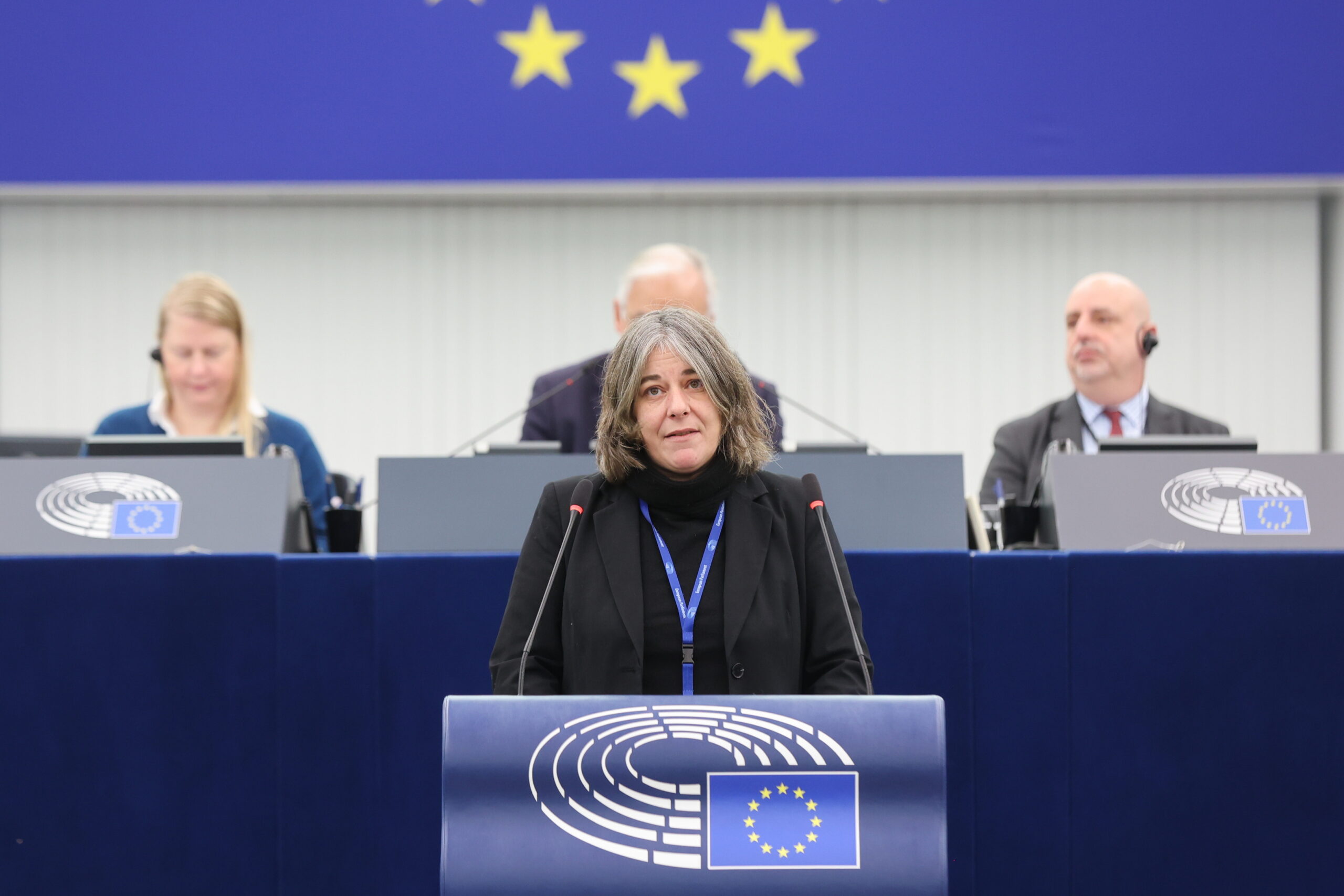
Strasbourg, by our correspondent – The Return Regulation is now in force. With 418 votes in favour, 218 against, and 30 abstentions, the European Parliament’s plenary session has given its approval. Now the regulation—which incorporates the measures forming part of the Pact on Migration and Asylum, which came into force on 12 June—will have to be formally adopted by the Council and published in the Official Journal before it can be implemented. But while the right is celebrating, the opposition is beginning to consider how to respond. Amongst them is Cecilia Strada, MEP for the Democratic Party, a “member of civil society who has turned to politics”, who has long criticised the Pact. And who, on the sidelines of the plenary vote in Strasbourg, in an interview with Eunews, expressed her deep unease at a European Union that “has legalised the systematic violation of human rights, violent pushbacks, arbitrary detentions and deportations”.
Eunews: The Return Regulation has been approved by the European Parliament. What changes will people see from today?
Cecilia Strada: “In fact, we’re moving to Minneapolis. We are preparing to do some of the very things we criticised most harshly when we were shocked by the images of ICE arresting children. The EU is ready to do the same: arrest families with children, detain them for over two years, force minors to stay in prison, and then deport them to countries they have never seen. This is the big news: I wonder if it is right to call it a ‘return regulation’, given that people may not be returned to their home countries but to so-called hubs in third countries. The protection of fundamental rights will no longer be the same. Not only are rights being undermined, but this will create a range of problems for our communities. Faced with the prospect of detention, many people will likely try to go into hiding to avoid it. I would do the same in such a situation. Therefore, I do not think we will achieve the security that is so often talked about. There is also another problem: no Member State is ready. For the time being, countries will only bring part of the regulation into force. The remaining provisions are due to be implemented in 12 months’ time. What will happen in the meantime? Chaos. With different laws and different ways of implementing them, the courts will be inundated with appeals. Meanwhile, the right is celebrating boisterously.”
E: How can we continue to practise solidarity, including at a political level?
C.S.: “Everyone will have to step up their efforts. I say this as a member of civil society involved in politics: I believe that progressive forces will need to increase their support for organisations that seek to hold our communities together, even as laws seek to tear them apart. The role of civil society will be crucial. Not only to provide essential services—legal assistance, advice, dissemination of information—but also to keep people united. There will undoubtedly be legal action. Monitoring work will also be important. MEPs, who, thanks to their passes, can enter return centres and other facilities serving the regulation, must use this power to keep a watchful eye. Here, too, doubts arise: if a CPR is built in a third country, our access will depend on the agreements in place. So not only will the EU operate in the style of the US ICE, but it will do so far from the public eye. A less visible form of violence, but one that is nonetheless structural.”
E: How is compliance with international law ensured in third countries?
C.S.: “This is a major cause for concern, because should any problem arise, it will be the jurisdiction of the third country that assesses it. Furthermore, there is a rather wide gap between reality and the Commission’s statements. One need only look at the list of countries deemed safe. One example suffices: Egypt, the country where Giulio Regeni died. There is an objective inconsistency in our actions. It is not difficult to imagine where these hubs will be; we have concrete evidence in the form of the centres in Albania. In theory, Italian jurisdiction applies, but by virtue of extraterritoriality, rights are not equally guaranteed. From the so-called ‘Albania model’, we can learn how not to do things.”
E: How can we challenge the positive narrative surrounding the hubs in Albania, at a time when they are, in fact, being held up as a model?
C.S.: “You have to be able to explain the complexities and have someone on the other side who is willing to listen. While the propaganda machine is in full swing, at the very moment I am explaining how things stand at the centre in Gjadër, thousands of lies have been spread. The centres in Albania are portrayed as a measure that works; no mention is made of the fact that most of the people taken to Gjadër were subsequently returned to Italy. Not only have we exacerbated their suffering, but we have also significantly increased the state’s costs. The government is going to great lengths to avoid releasing the figures that would make its failure evident. When it comes to propaganda, we are the losers, but I have one hope: I believe that the people of Europe and the Italians are far better than the politicians they elect. I want to believe that the hatred that oozes from the words we hear from our colleagues in Parliament does not reflect the hatred of their voters. Obviously, people have their own concerns and frustrations, but these are not linked to migrants who have just arrived in Lampedusa. They stem from the fact that in Italy, you cannot receive medical treatment without long waiting times, jobs are precarious, there is no minimum wage, and pensions are insufficient. We need to make it clear to citizens that if they cannot make ends meet, they should not turn their anger on those crossing the Mediterranean, but on Palazzo Chigi.”
E: The approval process was extremely swift by European Union standards. Just over 15 months elapsed between the Commission’s proposal and the final vote. Why the rush?
C.S.: “Because the right wants to show that it’s doing something, that it’s taking action, that it’s protecting citizens. We’ve seen the same rush when it comes to ‘safe countries’. It is, once again, a rush completely out of touch with reality because the conditions for implementing the regulation are not in place. Local authorities in Italy, as things stand, do not know what is going on; they have not received any guidance whatsoever from the government.”
E: Both the Commission and the European Parliament have emphasised that, at the European level, only 20 per cent of returns are actually carried out, suggesting that the regulation will have an impact in terms of effectiveness.
C.S. “If we stop protecting people’s rights, things will certainly become much simpler. The regulation simplifies procedures, but this cannot be the solution. We will then see how effective it actually is. According to the available data, long periods of detention tend to make return less likely due to appeals. We will also see whether the regulation stands up in court and whether the different ways Member States apply it are appropriate. What frightens me most, however, is the increasingly violent narrative surrounding migration.”
English version by the Translation Service of Withub


![[Foto: Unsplash]](https://www.eunews.it/wp-content/uploads/2026/06/daniel-schludi-e1RI3wRelqM-unsplash-350x250.jpg)

![Da sinistra: il presidente del Consiglio europeo, Antonio Costa; il presidente dell'Ucraina, Volodymir Zelensky: la presidente della Commissione europea, Ursula von der Leyen [Bruxelles, 18 giugno 2024. Foto: European Council]](https://www.eunews.it/wp-content/uploads/2026/06/euco_ua260618-120x86.jpg)
![[foto: Saverio De Giglio/imagoeconomica]](https://www.eunews.it/wp-content/uploads/2026/10/cpt-120x86.png)